The Best Buttondown Alternativefor Growing Teams
Buttondown is an indie-built, minimalist newsletter tool favored by developers and writers for its Markdown-first simplicity and clean API, but its lack of visual editing, automation depth, design systems, ecommerce integrations, and team features make it a poor fit for marketing teams or growing businesses.


Compare features.
Buttondown and Audienceful, side by side.
Buttondown vs Audienceful: summary
Buttondown is an indie-built, Markdown-first newsletter tool designed for writers and developers who want a simple, no-frills way to send emails. It has paid newsletter support via Stripe, a decent API, and a free plan for up to 100 subscribers. But it's intentionally minimal: there's no drag-and-drop editor, no visual design tools, no design systems, no automation beyond basic sequences, no Shopify integration, no real-time collaboration, and no AI features. It's a one-person operation, which keeps it opinionated and lean but limits feature development and support bandwidth.
AI and Collaboration
Audienceful's editor is built for speed and teamwork. Multiple people can edit the same email in real time with presence indicators and live cursors.
Buttondown has no AI features and no real-time collaboration. You write emails in Markdown, alone, with no AI assistance for drafting copy, generating subject lines, or creating images. There are no live cursors, no presence indicators, and no way for multiple team members to work on the same newsletter simultaneously. If you're a solo writer who prefers Markdown, this is fine. If you're part of a team shipping emails regularly, it's a bottleneck.
Audienceful's editor is built for speed and teamwork. Multiple people can edit the same email in real time with presence indicators and live cursors. Every plan also includes a built-in AI agent. It writes and edits emails in your voice using your best-performing sends as style references, reads URLs you paste for context, generates images inline, and can build audience segments or entire automations from a plain-language brief, executing with your approval before anything sends. For teams that ship regularly, this eliminates the single-writer bottleneck entirely.
Email Editor and Design
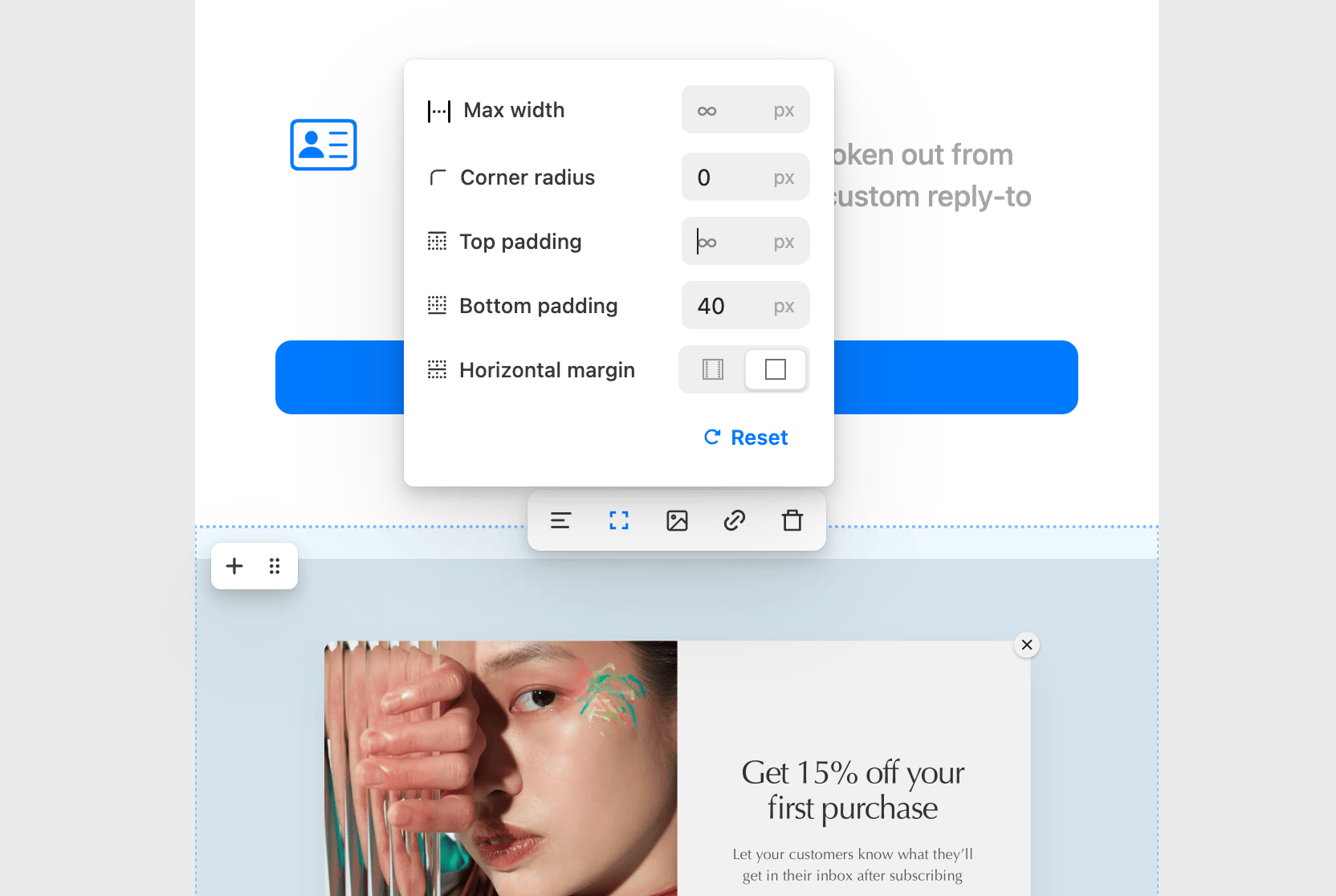
Audienceful takes a completely different approach with a unified block editor that combines writing speed with real design depth. You get a full design system with reusable styles and components, so e...
Buttondown is a Markdown editor. That's the pitch and the constraint. You write Markdown, it renders as a plain email. There's no drag-and-drop, no visual design tools, no reusable style components, and no design systems. You get whatever Markdown gives you, which is clean, readable text with no layout flexibility. If your brand has specific design standards or you want columns, images, or styled sections, you're either writing raw HTML or accepting that every email looks the same.
Audienceful takes a completely different approach with a unified block editor that combines writing speed with real design depth. You get a full design system with reusable styles and components, so every email stays on-brand regardless of who builds it. Deep layout control (columns, spacing, typography, color systems) is available without writing code. You can create highly polished, branded campaigns that go far beyond what plain Markdown can produce, while still being fast to compose.
Automation and Ecommerce
Audienceful's automation builder is built for complexity. Full branching logic, conditional splits, event-based triggers, and multi-step flows give you the sophistication that growing teams need.
Buttondown offers basic email sequences but nothing resembling a real automation builder. There's no branching logic, no conditional splits, no event-based triggers beyond simple subscriber actions. On the ecommerce side, there's nothing: no Shopify integration, no product catalog sync, no cart abandonment flows, no post-purchase sequences. Buttondown isn't trying to be an ecommerce tool; it's a personal newsletter tool.
Audienceful's automation builder is built for complexity. Full branching logic, conditional splits, event-based triggers, and multi-step flows give you the sophistication that growing teams need. Native Stripe and Shopify integrations mean you can build automations around actual purchase data, subscription lifecycle events, cart behavior, and product activity, all without middleware. Whether you're running a SaaS product or an ecommerce store, you get plug-and-play automation that doesn't require custom engineering.
Ready to see the difference?
Free up to 1,000 subscribers.
Integrations and Data
Audienceful ships with native Stripe and Shopify integrations that work out of the box. Subscriber data, purchase history, subscription events, and product catalogs sync directly into your email platf...
Buttondown has a decent API for a small tool. You can manage subscribers, send emails, and pull basic data programmatically. There's Stripe integration for paid newsletters. But the integration ecosystem is thin: no native Shopify connection, no deep third-party integrations, and the data model is built around simple subscriber lists rather than behavioral or purchase data. If you need to connect your email tool to your business stack, you're writing code or using Zapier.
Audienceful ships with native Stripe and Shopify integrations that work out of the box. Subscriber data, purchase history, subscription events, and product catalogs sync directly into your email platform without pipeline configuration. This means you can segment on real purchase behavior, trigger automations from revenue events, and build campaigns informed by what customers are actually doing, without maintaining custom integrations.
Deliverability
Audienceful treats deliverability as an engineering problem worth solving deeply. A manual approval process keeps bad senders off the platform entirely.
Buttondown's deliverability is reasonable for its scale. As a smaller platform sending primarily text-based newsletters, the sender reputation tends to be clean. But there's no sophisticated sending infrastructure: no dynamic batching, no per-provider throttling, no smart retry logic. For low-volume personal newsletters this is fine. At higher volumes or for business-critical sends, the lack of sending sophistication can become a liability.
Audienceful treats deliverability as an engineering problem worth solving deeply. A manual approval process keeps bad senders off the platform entirely. Dynamic batching staggers sends by each inbox provider's limits, so you don't trip rate limits or trigger bulk-sender flags. Smart retry logic automatically re-attempts delivery with optimized timing and backoff when emails soft-bounce or get deferred, and every address is checked on import for typos, dead inboxes and disposable domains. Audienceful also builds in the kind of deliverability monitoring larger senders usually buy separately: a Deliverability dashboard grades your setup and continuously checks SPF, DKIM, DMARC and DNS records with plain-English fixes, and the Growth plan adds 24/7 tracking of sender reputation, blocklist alerts, list warmth and inbox-provider breakdowns.
Who Each Tool Is Best For
Audienceful is built for ecommerce brands and SaaS teams that treat email as a revenue channel. You get a modern editor with AI and real-time collaboration, deep design control with reusable design sy...
Buttondown is a good fit for individual writers and developers who want a dead-simple, Markdown-first newsletter tool with no bloat. If you're sending a personal newsletter to a modest list, you like working in Markdown, and you don't need design tools, automation, or team features, Buttondown does the job with minimal friction. The free plan for up to 100 subscribers makes it easy to start.
Audienceful is built for ecommerce brands and SaaS teams that treat email as a revenue channel. You get a modern editor with AI and real-time collaboration, deep design control with reusable design systems, a powerful automation builder with native Stripe and Shopify integrations, revenue attribution, and advanced behavioral segmentation. If you've outgrown personal newsletter tools and need a platform that scales with your business, Audienceful gives you the depth and sophistication that Buttondown intentionally doesn't offer.
Migrate from Buttondown in less than 5 minutes
Bring your contacts over with a CSV import, then start from ready-made email templates and automations.
Start free migrationButtondown guides.
Pricing, alternatives and switching guides for Buttondown.
- 19 Best Buttondown Alternatives for Growing Newsletters (2026)Compare nineteen Buttondown alternatives by price at 10,000 subscribers, paid-subscription and store integrations, automation depth and one honest drawback each, with prices checked 25 November 2026.
- How to Migrate From Buttondown Without Losing SubscribersMigrate from Buttondown step by step: export subscribers by type, protect your unsubscribe list from automatic cleanup, move your archive and paid subscribers, rebuild automations, warm up and cancel last.
- Buttondown Emails Going to Spam? Causes and FixesButtondown emails going to spam? Set up a custom sending domain, fix SPF conflicts, add DMARC, keep within Buttondown's complaint and bounce standards and warm up imported lists.
More comparisons.
How Audienceful stacks up elsewhere.
Audienceful vs ActiveCampaign
ActiveCampaign is a marketing automation and CRM platform known for its powerful automation builder, but its sprawling feature set, dated email editor, and confusing pricing tiers make it a complex choice for teams that just want great email marketing.
See comparison →Audienceful vs Amazon SES
Amazon SES is raw email sending infrastructure from AWS. It charges $0.10 per 1,000 emails, but it provides zero marketing features, no editor, no automation, and no segmentation, requiring you to build everything yourself on top of a sending pipe.
See comparison →Audienceful vs AWeber
AWeber is one of the oldest email marketing platforms, launched in 1998. It's simple and beginner-friendly but has barely evolved, offering only basic autoresponders, a dated editor, limited AI, no real-time collaboration, and no meaningful ecommerce integrations.
See comparison →Join 10,000+ making the switch.
See why teams move all email to Audienceful.

“Holy sh*t this is fantastic… I'm really impressed so far. You all have built something special here.”


“I love products like Audienceful. It hints at a better future, connecting creatives with richer workflows.”


“So much easier to use… has already saved us hundreds of hours.”

Frequently asked questions
How much does Buttondown cost?
Buttondown is free for up to 100 subscribers. Paid tiers cost $9 a month for up to 1,000 subscribers, $29 for up to 5,000, $79 for up to 10,000 and $139 for up to 20,000. Above 20,000 subscribers Buttondown has no published pricing and you contact them for an enterprise quote.
What is the main difference between Buttondown and Audienceful?
Buttondown is a minimalist, Markdown-first newsletter tool for solo writers and developers, with a decent API and paid newsletters through Stripe. Audienceful is an email marketing platform with a visual block editor and design systems, real-time collaboration, automations with branching and conditional splits, native Shopify and Stripe integrations and a built-in AI agent. Buttondown's automation is limited to basic sequences, and it has no Shopify integration.
Who is Buttondown best for?
Buttondown is a good fit for individual writers and developers sending a personal newsletter to a modest list who like working in Markdown. It has no bloat, a clean interface and a usable API. Teams that need visual design, collaboration, automation logic or store data will find it too limited by design.
Can Buttondown send branded, designed emails?
Buttondown renders Markdown as a plain email, with no drag-and-drop editor, visual design tools or design systems, so columns and styled sections mean writing raw HTML. Audienceful's block editor gives layout, spacing and typography control without code, and its design system keeps reusable styles and components consistent across emails.
How do I move from Buttondown to Audienceful?
Export your subscribers from Buttondown as a CSV, then in Audienceful go to People > Add > Import CSV and map the columns to fields. Tags carry over as tags, custom data becomes custom fields, and segments are rebuilt as audiences, with every address checked on import for typos, dead inboxes and disposable domains. Then verify your sending domain, warm up lists of roughly 10,000 or more contacts gradually, and rebuild your forms and key automations. The team at support@audienceful.com can help with the move.
