Best Salesforce Marketing Cloud Alternative
TL;DR: Salesforce Marketing Cloud is the enterprise behemoth of email and cross-channel marketing, with absurdly powerful Journey Builder, Einstein AI predictions, and deep CRM integration, but with a price tag starting at $1,500/month for its Growth edition (often $10k+ at scale), months-long implementation timelines, and complexity that demands a dedicated admin just to keep the lights on.
Compare features
A side-by-side look at how Salesforce Marketing Cloud and Audienceful compare across the features that matter most.
Salesforce Marketing Cloud vs Audienceful: Summary
Salesforce Marketing Cloud is the enterprise-grade marketing automation platform used by Fortune 500 companies for cross-channel orchestration at massive scale. Journey Builder is genuinely powerful for complex multi-touch campaigns across email, SMS, push, and advertising. Einstein AI provides send-time optimization, engagement predictions, and content recommendations. Email Studio handles email creation with a functional but dated editor. The problem is everything else: pricing starts at $1,500/month for the Growth edition and commonly runs $10k+ for real usage at scale, implementation takes months with professional services, and you effectively need a dedicated admin or developer to operate the platform. Larger editions are quoted through Salesforce's sales process. If you're a large enterprise already deep in the Salesforce ecosystem with a dedicated marketing ops team, it's an incredibly capable platform. If you're anyone else, you're buying a fighter jet when you need a car.
Pricing: who's cheaper?
Salesforce Marketing Cloud's published pricing starts at $1,500/month for its Growth edition (billed annually), with the Advanced edition at $3,250/month and larger Engagement editions ($5,500/month and up) quoted through sales. Real-world usage commonly runs $10,000+/month once you add Journey Builder, additional channels, and contact volume. Implementation costs, professional services, and dedicated admin headcount push the total cost of ownership even higher. Audienceful uses straightforward per-subscriber pricing with a generous free tier, no implementation fees, and no hidden costs.
Audienceful vs Salesforce Marketing Cloud pricing
Salesforce Marketing Cloud does not publish per-tier pricing, so a direct comparison table is not possible. Where Salesforce runs five figures a month once fully configured, Audienceful's Essentials plan starts free and scales transparently by subscriber count.
Salesforce Marketing Cloud doesn’t publish per-tier pricing; plans are custom quotes through their sales team. Audienceful’s pricing is public and transparent at every tier.
AI and Collaboration
Summary: Audienceful built agentic AI and collaboration directly into the platform. Multiple team members can work on the same email simultaneously with live cursors and presence indicators.
Salesforce Marketing Cloud has Einstein AI, which provides send-time optimization, engagement predictions, content recommendations, and audience scoring. These are enterprise-grade ML features that work well at scale, particularly for large send volumes where statistical models have enough data to be meaningful. However, Einstein operates at the platform level. It optimizes when and to whom you send, not the content creation process itself. The email editor has no inline AI content generation or AI image creation. Collaboration in Email Studio is single-player: one person edits at a time, and teams coordinate through external workflows, approval chains, and Salesforce's broader collaboration tools.
Audienceful built agentic AI and collaboration directly into the platform. Multiple team members can work on the same email simultaneously with live cursors and presence indicators. The built-in AI agent (included on every plan) writes and edits emails in your voice using your best-performing sends as style references, makes targeted edits to drafts, generates images natively, and can propose a multi-step plan and execute it with your approval before anything sends. While Salesforce's Einstein predicts and optimizes across massive datasets, Audienceful's agent actually does the work (drafting, restyling, building segments and automations). That's a fundamentally different kind of AI that benefits teams who ship emails frequently.
Email Editor and Design
Summary: Audienceful's unified block editor combines writing speed with deep layout and design control. You get a proper design system with reusable styles and components, so brand consistency is structural ra...
Email Studio's editor gets the job done but feels like what it is: enterprise software from a different era. It's a drag-and-drop builder with template-based layouts, adequate for basic campaigns but lacking the design depth that brand-conscious teams need. There are no design systems in the modern sense: no reusable style tokens, no shared components that propagate changes globally. Maintaining brand consistency across campaigns requires manual effort and template discipline. For many Salesforce Marketing Cloud customers, the email editor is the weakest part of the platform, and some teams resort to building emails in external tools and importing the HTML.
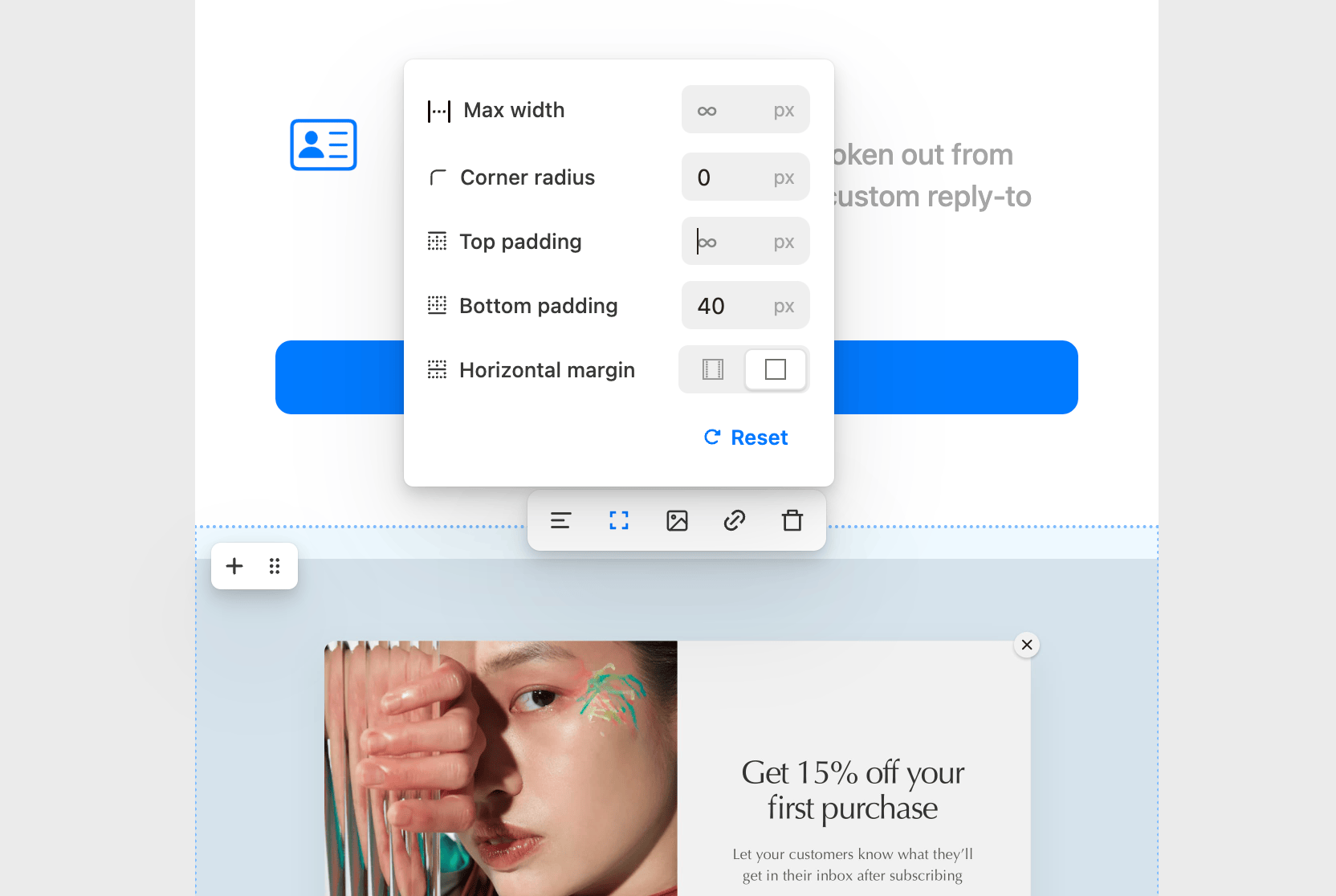
Audienceful's unified block editor combines writing speed with deep layout and design control. You get a proper design system with reusable styles and components, so brand consistency is structural rather than something enforced by process. The editor gives you fine-grained control over typography, spacing, and layout without sacrificing the speed of a block-based workflow. For teams that care about how their emails look, not just whether they land in the inbox, Audienceful offers a level of design control that Email Studio simply doesn't match.
Automation and Ecommerce
Summary: Audienceful's automation builder ships with branching logic, conditional splits, and event-based triggers that cover the scenarios most email marketing teams actually need: welcome sequences, behavior...
Journey Builder is where Salesforce Marketing Cloud earns its reputation. Cross-channel orchestration across email, SMS, push, advertising, and custom channels with sophisticated branching, wait steps, decision splits, and Einstein-powered optimization. It's genuinely powerful for enterprise-scale campaign orchestration. The catch is twofold: it takes significant expertise to configure and maintain, and the ecommerce story is weaker than you'd expect. Shopify integration exists only through AppExchange marketplace apps, not as a native first-party connection. For ecommerce brands, the purchase data and product catalog integrations that power effective post-purchase flows require custom implementation work.
Audienceful's automation builder ships with branching logic, conditional splits, and event-based triggers that cover the scenarios most email marketing teams actually need: welcome sequences, behavioral triggers, purchase-based flows, and subscription lifecycle automations. Native Shopify and Stripe integrations mean product data, order events, and subscription changes flow directly into your automations without middleware or consulting engagements. And instead of hiring a Journey Builder specialist, you can describe an automation in plain language and the built-in AI agent assembles the trigger, steps, and email bodies for you to review. It doesn't attempt cross-channel orchestration across eight different channels, but for email marketing automation with deep ecommerce and SaaS data, it delivers comparable depth without the enterprise cost and complexity.
Ready to see the difference?
Free up to 1,000 subscribers.
Integrations and Data
Summary: Audienceful takes the opposite approach: fewer integrations, but the ones that matter for email marketing are native and deep. Shopify integration syncs product data, order history, and customer profi...
Salesforce Marketing Cloud's greatest strength is its integration with the broader Salesforce ecosystem. If your organization runs Sales Cloud, Service Cloud, Commerce Cloud, and Data Cloud, Marketing Cloud can tap into a unified customer data model that few platforms can match. Beyond the Salesforce ecosystem, AppExchange offers thousands of connectors. However, integrations outside the Salesforce world often require custom development, MuleSoft middleware, or third-party iPaaS tools. The Shopify story is marketplace connectors only. Stripe integration requires custom API work or third-party bridges. The platform is optimized for enterprises that have the resources to build and maintain complex integration architectures.
Audienceful takes the opposite approach: fewer integrations, but the ones that matter for email marketing are native and deep. Shopify integration syncs product data, order history, and customer profiles directly into segmentation and automation. Stripe integration means subscription events, MRR data, and payment lifecycle triggers are available out of the box, with no middleware, no consulting, and no custom development. Revenue attribution connects email campaigns to actual purchases. The integration surface prioritizes ecommerce and SaaS use cases rather than trying to connect to everything, and the result is deeper data flow where it counts.
Deliverability
Summary: Audienceful approaches deliverability with more granular send optimization. A manual approval process for new accounts keeps sender reputation clean from the start.
Salesforce Marketing Cloud has strong deliverability infrastructure built for enterprise-scale sending. Dedicated IP options, sophisticated sender reputation management, authentication handling, and relationships with major inbox providers. At the volumes Salesforce Marketing Cloud handles, their deliverability team and infrastructure are well-established. The platform also offers deliverability reporting and inbox placement tools to monitor performance.
Audienceful approaches deliverability with more granular send optimization. A manual approval process for new accounts keeps sender reputation clean from the start. Dynamic batching staggers sends based on inbox provider limits and engagement signals, avoiding the bulk-blast pattern that can trigger throttling at any volume. Smart retry with optimized backoff handles soft bounces and temporary deferrals automatically, re-attempting delivery at intervals designed to maximize inbox placement. Both platforms deliver well; the difference is that Audienceful bakes send optimization into the platform by default rather than relying on dedicated deliverability teams to configure it.
Who Each Tool Is Best For
Summary: Audienceful is built for teams who want feature-complete, AI-native email marketing without the enterprise complexity and cost. If you care about the email creation experience (a modern editor with re...
Salesforce Marketing Cloud is the right choice if you're a large enterprise already invested in the Salesforce ecosystem, you have a dedicated marketing operations team (or budget for one), and you need cross-channel orchestration at massive scale. If you're running campaigns across email, SMS, push, and advertising to millions of contacts with Journey Builder complexity, and you have the $10k+/month budget and 3-6 month implementation timeline to make it work, Marketing Cloud is genuinely best-in-class for that use case.
Audienceful is built for teams who want feature-complete, AI-native email marketing without the enterprise complexity and cost. If you care about the email creation experience (a modern editor with real-time collaboration, a built-in AI agent, and proper design systems) and you need strong automation with native ecommerce and SaaS integrations, Audienceful delivers that at a fraction of the cost. It's especially strong for ecommerce brands and SaaS teams who need Shopify and Stripe integrations that work out of the box, and for anyone who's looked at Salesforce Marketing Cloud's pricing and implementation timeline and realized they need results this quarter, not six months from now.
Frequently asked questions
Is Audienceful better than Salesforce Marketing Cloud?
For ecommerce brands and SaaS teams, yes. Audienceful offers a modern block editor, native Shopify and Stripe integrations, and deliverability infrastructure designed for scale. Salesforce Marketing Cloud has strengths in other areas; read the full comparison above to see the detailed breakdown.
Can I migrate from Salesforce Marketing Cloud easily?
Yes. Export your subscriber list as a CSV from Salesforce Marketing Cloud and import it directly into Audienceful. We handle deduplication, tagging, and validation automatically. Most teams complete their migration in under 15 minutes.
Which is cheaper, Audienceful or Salesforce Marketing Cloud?
Audienceful is typically significantly cheaper. The free plan includes 1,000 subscribers with all features. At scale, Audienceful is typically 30–50% cheaper because we don't charge for unsubscribed or inactive contacts.
Does Salesforce Marketing Cloud have better automation?
Salesforce Marketing Cloud's automation is solid. Audienceful matches it on branching logic and adds native ecommerce triggers from Shopify and Stripe, so you can automate based on real purchase data without third-party middleware.
Which platform is better for ecommerce?
Audienceful. Native Shopify and Stripe integrations mean purchase data flows directly into segmentation and automation, with no middleware required.
How do deliverability rates compare?
Audienceful uses dynamic batching with per-provider throttling and smart retry logic, which typically results in higher inbox placement, especially for larger sends.
Migrate from Salesforce Marketing Cloud in less than 5 minutes
Import your contacts, templates, and automations. We handle the hard parts.
Start Free MigrationRelated comparisons
Audienceful vs ActiveCampaign
ActiveCampaign is a marketing automation and CRM platform known for its powerful automation builder, but its sprawling feature set, dated email editor, and confusing pricing tiers make it a complex choice for teams that just want great email marketing.
See comparison →Audienceful vs Amazon SES
Amazon SES is raw email sending infrastructure from AWS. It's incredibly cheap at $0.10 per 1,000 emails, but it provides zero marketing features, no editor, no automation, and no segmentation, requiring you to build everything yourself on top of a sending pipe.
See comparison →Audienceful vs AWeber
AWeber is one of the oldest email marketing platforms, launched in 1998. It's simple and beginner-friendly but has barely evolved, offering only basic autoresponders, a dated editor, no AI, no real-time collaboration, and no meaningful ecommerce integrations.
See comparison →Stop searching.
Start emailing.
Your first 1,000 subscribers are totally free.
Start Free