A better Shopify Email alternative
TL;DR: Shopify Email is a free built-in email tool for Shopify stores. It's dead simple and zero setup, but extremely basic in editor flexibility, automation, segmentation, and design control. You'll outgrow it fast if email is a real channel.
Compare features
A side-by-side look at how Shopify Email and Audienceful compare across the features that matter most.
Shopify Email vs Audienceful: Summary
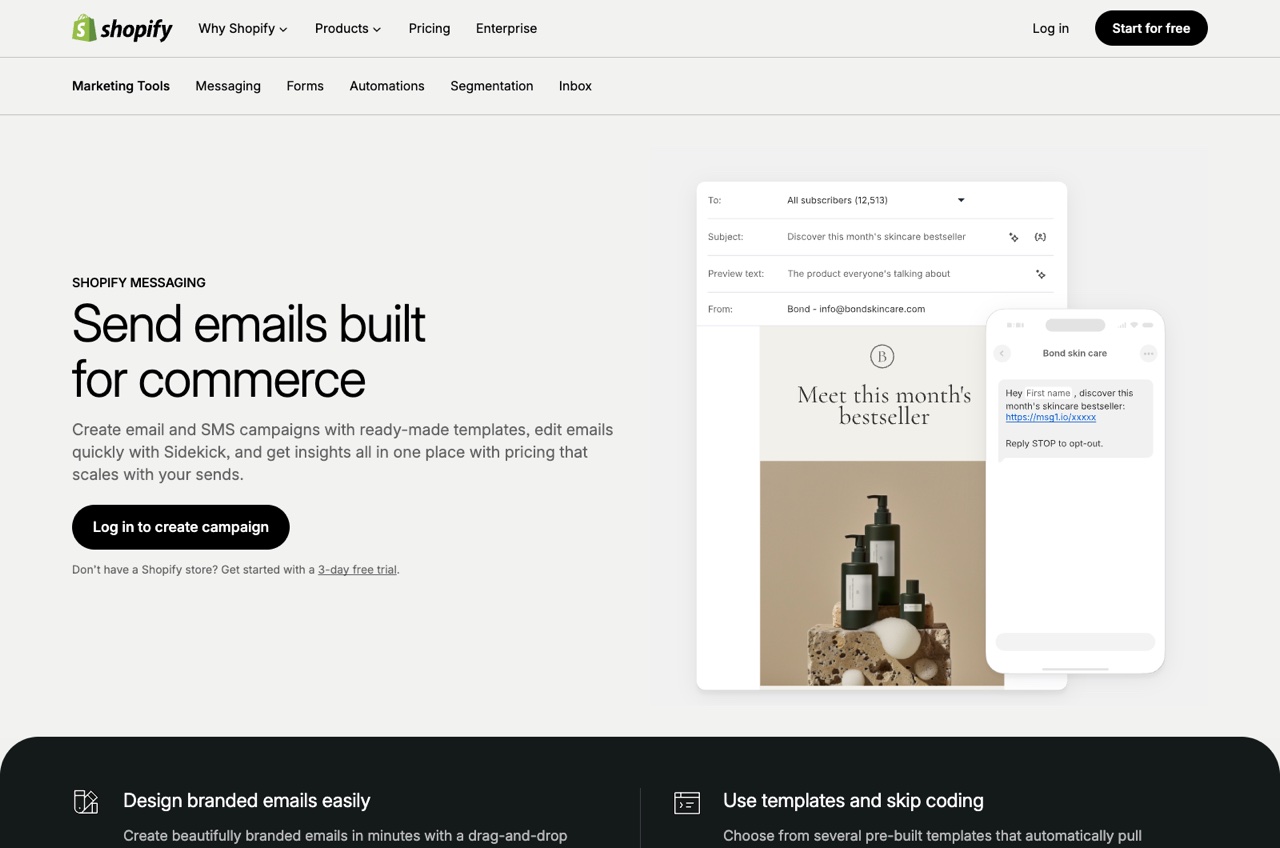
Shopify Email is the native email marketing tool built directly into Shopify. Its biggest advantage is zero setup. It pulls your product catalog, branding, and customer data automatically, and the first 10,000 emails per month are free. For small Shopify stores sending basic promotional campaigns, it's the path of least resistance. But the limitations add up quickly. The editor is rigid and locked to Shopify's template constraints, with no design systems, no deep layout control, and no way to break out of the pre-set structures. Automation is minimal within Shopify Email itself (Shopify Flow exists separately but is a different product). Segmentation is limited to basic Shopify customer groups with no behavioral or event-based targeting. There's no real-time collaboration, no meaningful AI beyond basic subject line suggestions, no Stripe integration, and no email-specific API. Deliverability runs on shared infrastructure that's adequate at low volume but offers no send optimization. It's a perfectly fine free add-on for stores sending occasional campaigns, but it's not a serious email marketing platform.
Pricing: who's cheaper?
Shopify Email is one of the cheapest email tools available, if you're already paying for Shopify. The first 10,000 emails per month are included free with any Shopify plan, and after that it's just $1 per 1,000 additional emails. There are no contact-based tiers or feature gates on the email side. The catch is that you need an active Shopify plan (starting at $39/month) to use it at all, so the true cost is never really $0. Audienceful charges per contact on a flat monthly plan with unlimited sends.
Shopify Email vs Audienceful pricing
Shopify Email costs compared to Audienceful Essentials at standard contact tiers, assuming ~4 emails per contact per month. Shopify Email is cheap for light senders but costs add up, and it lacks the automation depth, segmentation, and design control that Audienceful provides.
Monthly price by contact volume
Pricing data sourced from public pricing pages · Last verified October 2026
AI and Collaboration
Summary: Audienceful builds agentic AI and collaboration directly into the workflow. Multiple team members can work on the same email simultaneously with real-time cursors and presence indicators.
Shopify Email's AI capabilities are minimal. You get basic subject line suggestions and that's about it: no inline content generation, no AI-powered rewriting, and no image generation. The editor is strictly a solo experience with no collaboration features. If your team needs to review or co-edit an email, you're sharing screenshots, working sequentially, or managing the review process entirely outside the tool.
Audienceful builds agentic AI and collaboration directly into the workflow. Multiple team members can work on the same email simultaneously with real-time cursors and presence indicators. The built-in AI agent (included on every plan) writes and edits emails in your voice using your best-performing sends as style references, reads URLs you paste for context, generates images in context, and can restyle an entire theme's colors, fonts, and layout on request. For any team producing email regularly, the difference in speed and quality of the creation process is substantial.
Email Editor and Design
Summary: Audienceful's unified block editor gives you both speed and depth. A proper design system with reusable styles and components means brand consistency is built into the tool, not managed manually.
Shopify Email's editor is designed for simplicity, and it achieves that, at the cost of everything else. You pick a template, swap in your products, adjust some text, and send. The product blocks that pull directly from your Shopify catalog are genuinely convenient. But the editor is rigid. You can't break out of Shopify's template constraints, there's no meaningful control over layout structure, spacing, or typography beyond what the templates allow. There are no design systems, no reusable components, no way to enforce brand consistency at a structural level. Every email feels like a slight variation of the same Shopify template, because it is.
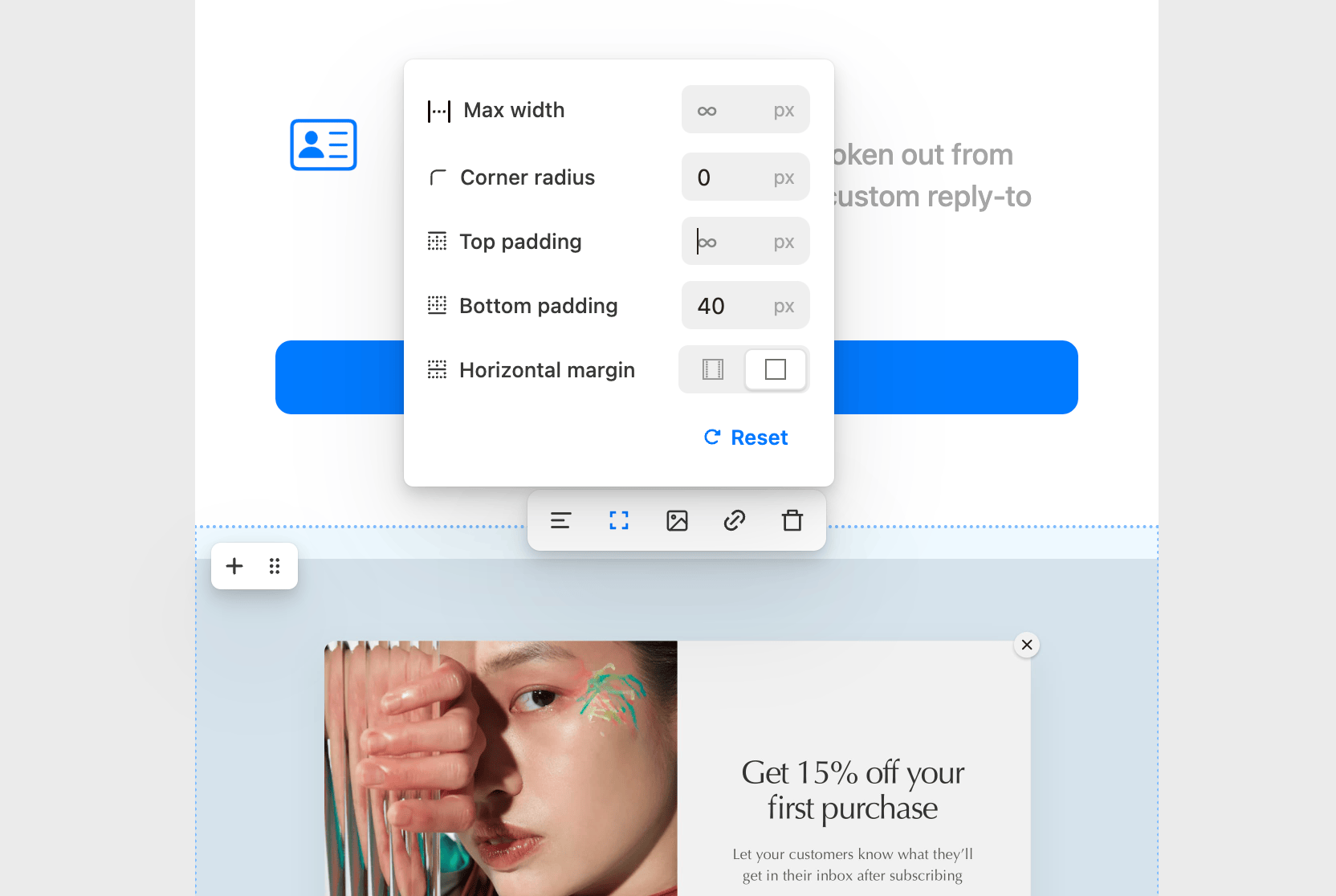
Audienceful's unified block editor gives you both speed and depth. A proper design system with reusable styles and components means brand consistency is built into the tool, not managed manually. You get fine-grained control over layout, spacing, and typography while maintaining the efficiency of a block-based workflow. For teams that want emails that look intentional and distinct (not like default Shopify templates), it's a fundamentally different class of editor.
Automation and Workflows
Summary: Audienceful's automation builder is purpose-built for email workflows with real depth. Branching logic, conditional splits, event-based triggers, and multi-step flows are all native.
This is where the gap is widest. Shopify Email's native automation is extremely basic. You can set up simple automated campaigns, but anything resembling a real workflow requires Shopify Flow, which is a separate product with a different interface and a different mental model. There's no branching logic, no conditional splits, no event-based triggers within Shopify Email itself. If you want a welcome series that behaves differently based on what someone bought, or an abandoned cart flow with time-delayed conditional branches, you're either cobbling together Shopify Flow with Shopify Email or you need a different platform entirely.
Audienceful's automation builder is purpose-built for email workflows with real depth. Branching logic, conditional splits, event-based triggers, and multi-step flows are all native. You can build automations that respond to purchase behavior, engagement patterns, and custom events without needing a separate workflow tool. The native Shopify integration feeds order and product data directly into automation triggers, and the native Stripe integration extends automation to subscription events, payment milestones, and revenue-based logic, covering use cases that Shopify Email can't touch even with Flow involved.
Ready to see the difference?
Free up to 1,000 subscribers.
Integrations and Data
Summary: Audienceful ships with native Shopify and Stripe integrations, covering both traditional ecommerce and subscription-based businesses. Purchase data, subscription events, and customer profiles sync dir...
Shopify Email's integration story is simple: it integrates with Shopify. That's it. Product data, customer profiles, and order history flow in automatically because it's a native Shopify feature. This is genuinely useful: no setup, no syncing, no middleware. But it's also the entire integration surface. There's no Stripe integration (Shopify payments only), no email-specific API, and no way to pull in data from external sources. If your business runs on anything beyond Shopify (subscriptions through Stripe, custom events from your app, data from a CRM), Shopify Email has no way to use that data.
Audienceful ships with native Shopify and Stripe integrations, covering both traditional ecommerce and subscription-based businesses. Purchase data, subscription events, and customer profiles sync directly into segmentation and automation. For Shopify stores, you get the same product and order data access. For SaaS teams or businesses with Stripe billing, you can segment on MRR, trigger automations from payment events, and attribute revenue to specific email campaigns. Advanced behavioral segmentation works across both data sources, giving you a unified view that Shopify Email's Shopify-only data model can't provide.
Deliverability
Summary: Audienceful takes deliverability seriously as a technical problem. A manual approval process screens new senders before they access shared infrastructure, protecting sender reputation at the pool leve...
Shopify Email's deliverability is adequate for small-volume senders. It runs on shared infrastructure, which means your sender reputation is pooled with every other Shopify store using the same sending IPs. At low volumes (a few thousand emails a month), this is generally fine. Shopify handles the basics of authentication and compliance. But there's no send optimization to speak of: no dynamic batching, no per-provider throttling, no smart retry logic for soft bounces. As your sending volume grows or you compete for inbox placement in crowded categories, shared infrastructure without optimization becomes a real liability.
Audienceful takes deliverability seriously as a technical problem. A manual approval process screens new senders before they access shared infrastructure, protecting sender reputation at the pool level. Dynamic batching staggers sends based on inbox provider limits and engagement signals, avoiding the bulk-blast pattern that triggers throttling. Smart retry with optimized backoff handles soft bounces and temporary deferrals automatically. For any email program beyond occasional promotional sends, the difference in inbox placement adds up over time.
Who Each Tool Is Best For
Summary: Audienceful is built for ecommerce brands and SaaS teams that treat email as a real channel, not an afterthought. If you've outgrown Shopify Email's rigid templates and want a modern editor with real-...
Shopify Email is the right choice for small Shopify stores that want to send occasional promotional campaigns without paying for or learning a separate email platform. If your email needs are simple (announce a sale, promote new products, send a basic newsletter) and you're happy staying within Shopify's template constraints, the free tier and zero-setup convenience are hard to argue with. It's a perfectly adequate free add-on for stores where email isn't a primary growth channel.
Audienceful is built for ecommerce brands and SaaS teams that treat email as a real channel, not an afterthought. If you've outgrown Shopify Email's rigid templates and want a modern editor with real-time collaboration, an AI agent that can build entire automations from a plain-language brief, and proper design systems, or if you need automation with actual branching and conditional logic instead of basic sends, Audienceful is the more capable platform. It's especially relevant for teams that need native Stripe support alongside Shopify, advanced behavioral segmentation, or deliverability infrastructure that scales beyond small-volume shared sending.
Frequently asked questions
Is Audienceful better than Shopify Email?
For ecommerce brands and SaaS teams, yes. Audienceful offers a modern block editor, native Shopify and Stripe integrations, and deliverability infrastructure designed for scale. Shopify Email has strengths in other areas; read the full comparison above to see the detailed breakdown.
Can I migrate from Shopify Email easily?
Yes. Export your subscriber list as a CSV from Shopify Email and import it directly into Audienceful. We handle deduplication, tagging, and validation automatically. Most teams complete their migration in under 15 minutes.
Which is cheaper, Audienceful or Shopify Email?
Audienceful is typically significantly cheaper. The free plan includes 1,000 subscribers with all features. At scale, Audienceful is typically 30–50% cheaper because we don't charge for unsubscribed or inactive contacts.
Does Shopify Email have better automation?
Shopify Email's automation is solid. Audienceful matches it on branching logic and adds native ecommerce triggers from Shopify and Stripe, so you can automate based on real purchase data without third-party middleware.
Which platform is better for ecommerce?
Audienceful. Native Shopify and Stripe integrations mean purchase data flows directly into segmentation and automation, with no middleware required.
How do deliverability rates compare?
Audienceful uses dynamic batching with per-provider throttling and smart retry logic, which typically results in higher inbox placement, especially for larger sends.
Migrate from Shopify Email in less than 5 minutes
Import your contacts, templates, and automations. We handle the hard parts.
Start Free MigrationRelated comparisons
Audienceful vs ActiveCampaign
ActiveCampaign is a marketing automation and CRM platform known for its powerful automation builder, but its sprawling feature set, dated email editor, and confusing pricing tiers make it a complex choice for teams that just want great email marketing.
See comparison →Audienceful vs Amazon SES
Amazon SES is raw email sending infrastructure from AWS. It's incredibly cheap at $0.10 per 1,000 emails, but it provides zero marketing features, no editor, no automation, and no segmentation, requiring you to build everything yourself on top of a sending pipe.
See comparison →Audienceful vs AWeber
AWeber is one of the oldest email marketing platforms, launched in 1998. It's simple and beginner-friendly but has barely evolved, offering only basic autoresponders, a dated editor, no AI, no real-time collaboration, and no meaningful ecommerce integrations.
See comparison →Stop searching.
Start emailing.
Your first 1,000 subscribers are totally free.
Start Free