The Best Marketo Alternativefor Modern Teams
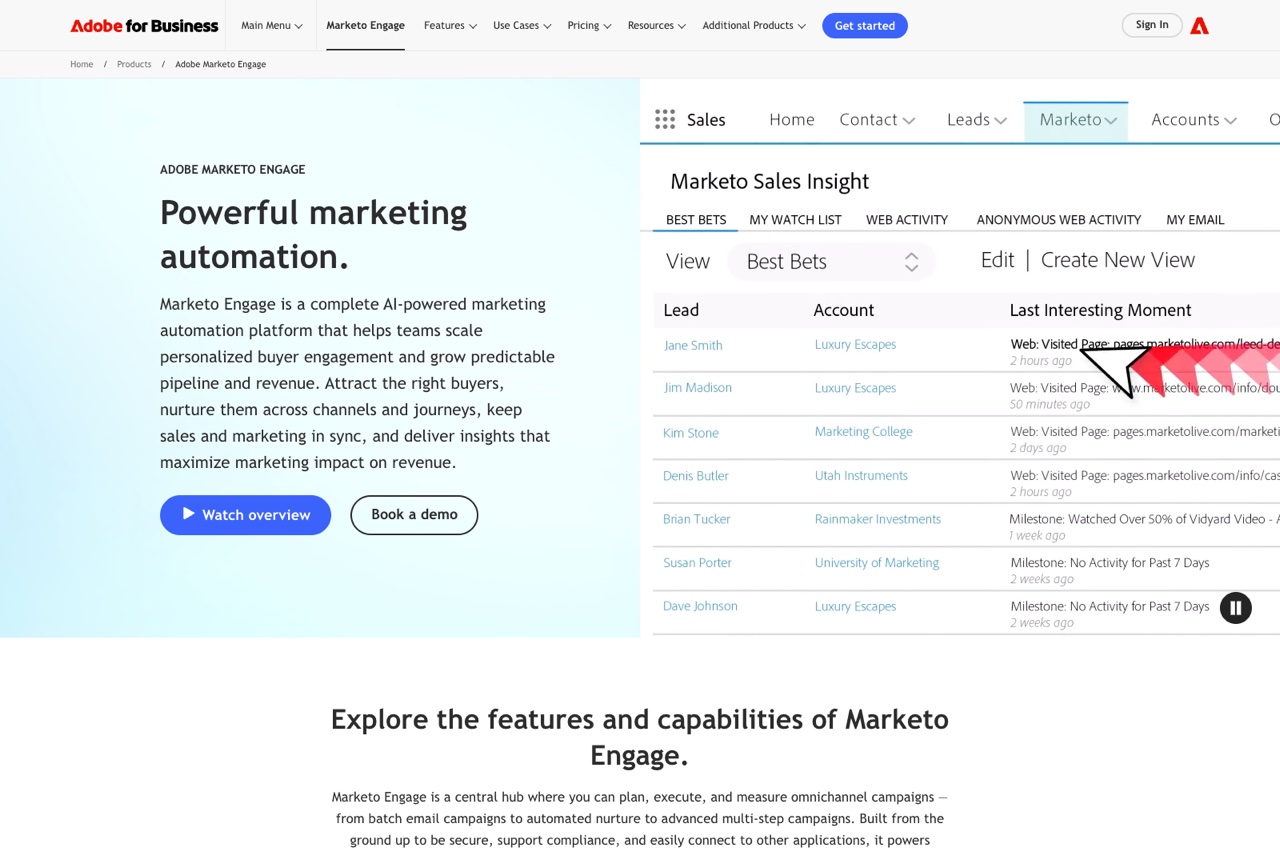
Adobe Marketo Engage is the heavyweight of enterprise B2B marketing automation: incredible lead scoring, nurture campaigns, and sales alignment, but a terrible email editor, no ecommerce DNA, brutal pricing starting at $1,250+/month, and an implementation process that requires a dedicated admin just to keep the lights on.



Compare features.
Marketo (Adobe) and Audienceful, side by side.
Marketo (Adobe) vs Audienceful: summary
Adobe Marketo Engage is the enterprise standard for B2B marketing automation, now part of Adobe Experience Cloud. It excels at lead scoring, multi-touch nurture campaigns, account-based marketing, and deep sales-marketing alignment through CRM integrations. It's built for demand generation teams at large B2B companies with complex buying cycles. The email editor, however, is notoriously outdated: clunky, limited in design capability, and completely lacking real-time collaboration or in-editor AI. Pricing starts at $1,250/month for the most basic tier and commonly reaches $2,000+ for meaningful functionality. Implementation is measured in months, not days, and most organizations need a dedicated Marketo admin to manage the platform. There's no native Shopify integration because ecommerce was never the target market. If you're running enterprise B2B demand gen with a dedicated ops team and budget, Marketo is purpose-built for that. If you're doing anything else (ecommerce, DTC, SaaS email marketing), it's the wrong tool entirely.
Pricing: who's cheaper?
Adobe Marketo Engage uses custom enterprise pricing with no publicly listed plans, so you have to contact sales for a quote. Our [Marketo pricing guide](/blog/marketo-pricing) covers what drives that quote. Industry estimates put the entry point around $1,250/month for the Growth tier, but most organizations end up paying $1,500–$3,000+/month once they need meaningful functionality like advanced automation, custom reporting, or API access. Multi-year contracts are standard, and implementation costs (consulting, onboarding, training) can add tens of thousands on top. Audienceful publishes its plans (Free, Essentials and Growth), priced on subscribed contacts, and you can sign up and start sending without a sales call. Because Marketo doesn't publish pricing, a direct tier-by-tier comparison isn't possible. The two pricing models are different in kind: Marketo is a custom enterprise contract, usually multi-year and quoted by sales, while Audienceful has published, self-serve tiers that start with a free plan.
Marketo (Adobe) doesn’t publish per-tier pricing; plans are custom quotes through their sales team. Audienceful’s pricing is public and transparent at every tier.
AI and Collaboration
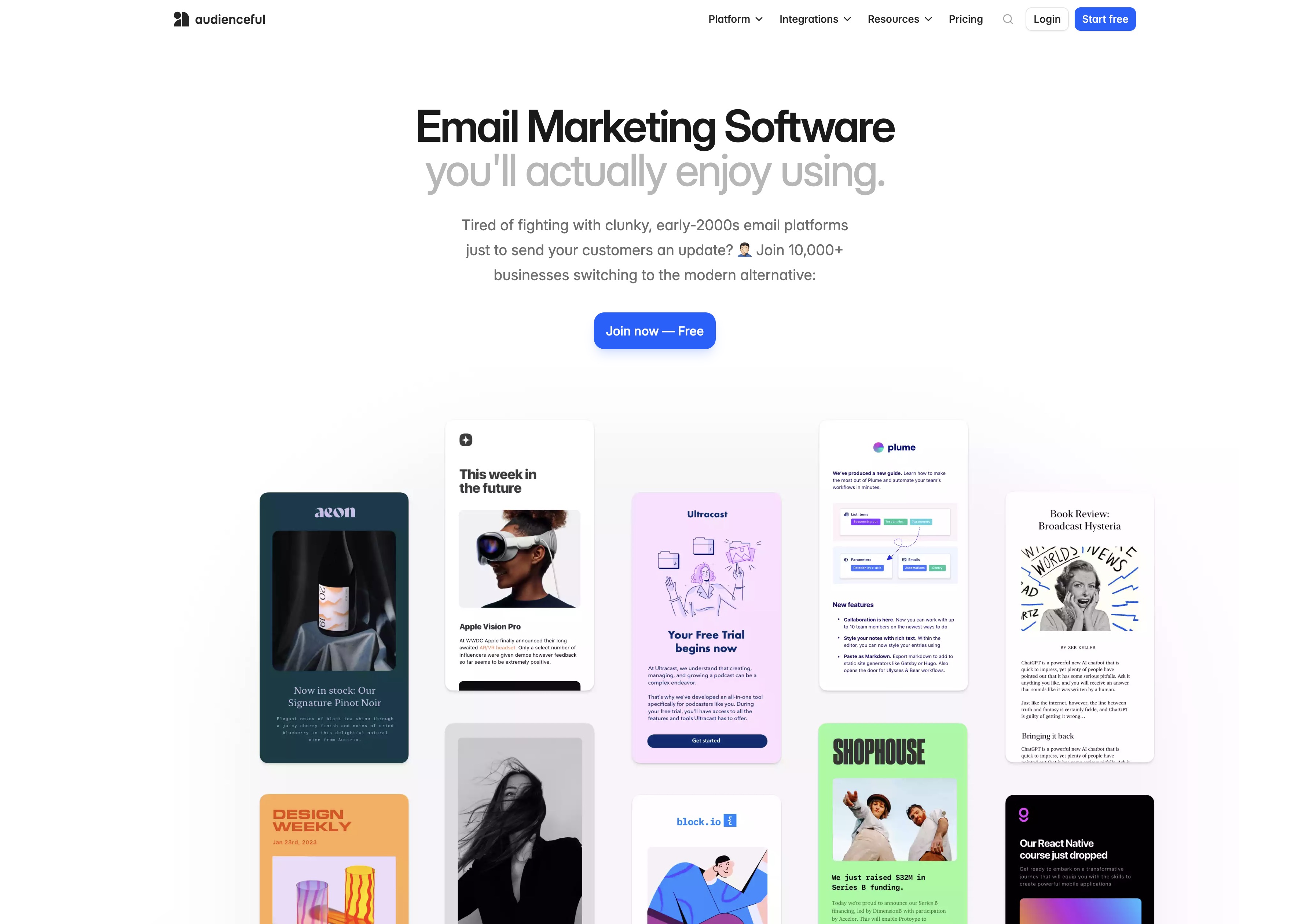
Audienceful embeds AI directly in the email workflow, as an agent rather than a sidebar. Multiple team members can work on the same email simultaneously with live cursors and presence indicators, and ...
Adobe has invested heavily in AI across Experience Cloud under the Sensei and Firefly brands, and some of that has reached Marketo: predictive audiences, content recommendations, and account scoring. But these are platform-level features that sit alongside the email workflow rather than inside it. The email editor itself has no inline AI content generation, no AI image creation, and no contextual writing assistance while you're building an email. Collaboration is similarly absent from the editing experience. Marketo's workflow is built around individual operators (typically a dedicated admin) creating campaigns and routing them through approval chains. There's no real-time co-editing.
Audienceful embeds AI directly in the email workflow, as an agent rather than a sidebar. Multiple team members can work on the same email simultaneously with live cursors and presence indicators, and every plan includes a built-in AI agent that writes and edits emails in your voice using your best-performing sends as style references, reads URLs you paste for context, generates images, restyles entire themes, and can build audience segments or complete automations from a plain-language brief, proposing a plan and executing it only with your approval. For teams that ship emails frequently, the difference between platform-level AI and an agent that does the work is the difference between a feature that exists and a feature you actually use.
Email Editor and Design
Audienceful's unified block editor combines writing speed with deep layout and design control. A proper design system with reusable styles and components makes brand consistency structural rather than...
Marketo's email editor is widely considered one of the weakest aspects of the platform. It's functional in the sense that it produces HTML emails, but the design experience is dated, rigid, and frustrating. Templates are the primary workflow, and customizing beyond template boundaries is painful. There are no design systems: no shared style tokens, no reusable components that propagate changes globally. Every email requires manual attention to maintain brand consistency, and the editor provides minimal visual control compared to modern tools. For a platform that costs $2,000+/month, the email creation experience feels a decade behind.
Audienceful's unified block editor combines writing speed with deep layout and design control. A proper design system with reusable styles and components makes brand consistency structural rather than manual. Fine-grained control over typography, spacing, and layout is available without sacrificing the speed of a block-based workflow. For teams where email design quality matters (not just getting a message out, but how it looks and feels), the gap between Marketo's editor and a purpose-built email editing experience is enormous.
Automation and Workflows
Audienceful's automation builder includes branching logic, conditional splits, and event-based triggers that cover the core automation needs of ecommerce and SaaS email marketing. Triggers based on pu...
This is where Marketo earns its reputation. The automation engine is genuinely world-class for B2B use cases: multi-branch nurture programs, sophisticated lead scoring models, sales alert triggers, CRM-synced lifecycle stages, account-based triggers, and engagement programs that adapt based on buying signals. If you're running enterprise B2B demand gen with a long sales cycle and complex buying committee, Marketo's automation depth is hard to match. The trade-off is complexity. Building and maintaining these programs requires specialized knowledge, and most organizations employ a full-time Marketo admin or agency.
Audienceful's automation builder includes branching logic, conditional splits, and event-based triggers that cover the core automation needs of ecommerce and SaaS email marketing. Triggers based on purchases, subscription events, behavioral signals, and custom events are available without needing a dedicated platform operator. Marketo's automation is deeper for enterprise B2B specifically, but for ecommerce flows (abandoned carts, post-purchase sequences, win-back campaigns, subscription lifecycle) and SaaS flows (onboarding, upgrade nudges, churn prevention), Audienceful covers the territory without the complexity.
Ready to see the difference?
Free up to 1,000 subscribers.
Integrations and Data
Audienceful ships with native Shopify and Stripe integrations built in. Purchase data, subscription events, and customer profiles sync directly into segmentation and automation without middleware or t...
Marketo's integration story is built around B2B infrastructure. Deep native integrations with Salesforce and Microsoft Dynamics are the centerpiece, along with connections to webinar platforms, ABM tools, and enterprise data systems. What Marketo doesn't have is ecommerce integration. There's no native Shopify integration, since it was never built for that market. Stripe integration for SaaS subscription data isn't part of the core platform either. If your data lives in a CRM and your business model is B2B sales, Marketo's integrations are excellent. If your data lives in a shopping cart or payment processor, you're looking at custom API work or middleware.
Audienceful ships with native Shopify and Stripe integrations built in. Purchase data, subscription events, and customer profiles sync directly into segmentation and automation without middleware or third-party connectors. For ecommerce teams, product and order data flows into automations natively. For SaaS teams, Stripe integration means segmenting on MRR, triggering flows from payment failures or upgrades, and building revenue attribution into email strategy from day one. The integration surface is narrower than Marketo's enterprise ecosystem, but the integrations that matter for ecommerce and SaaS email are deeper and require zero custom development.
Deliverability
Audienceful builds enterprise-level deliverability tooling in, without needing a deliverability specialist to run it. A manual approval process for new senders keeps bad actors off shared infrastructu...
Marketo has strong deliverability infrastructure, backed by Adobe's resources and established relationships with inbox providers. Dedicated IP options, authentication management, and deliverability reporting are all part of the platform. For enterprise senders with large volumes, Marketo's deliverability is reliable and well-managed. This is one area where the platform's maturity and scale work in its favor.
Audienceful builds enterprise-level deliverability tooling in, without needing a deliverability specialist to run it. A manual approval process for new senders keeps bad actors off shared infrastructure. Dynamic batching staggers sends by inbox-provider limits, and smart retries handle soft bounces and temporary deferrals automatically. Every address is checked on import for typos, dead inboxes and disposable domains. A built-in Deliverability dashboard grades your setup and continuously checks SPF, DKIM, DMARC and DNS records, with plain-English fixes, and on the Growth plan a 24/7 monitoring suite tracks sender reputation over time, alerts you to blocklist listings, and breaks results down by inbox provider. Both platforms include deliverability reporting; Audienceful's is designed for teams that don't have the dedicated deliverability expertise that enterprise Marketo users typically employ.
Who Each Tool Is Best For
Audienceful is built for teams who need powerful email marketing with a modern creation experience and don't operate in the enterprise B2B demand gen world. If you're an ecommerce brand that needs nat...
Marketo is the right choice if you're running enterprise B2B demand generation with a complex sales cycle, a CRM-centric tech stack, and the budget and staffing to support it. If you have a dedicated marketing ops person or team, need deep Salesforce integration, run sophisticated lead scoring and nurture programs, and can justify $2,000+/month for marketing automation, Marketo is purpose-built for that specific scenario. It's the industry standard for enterprise B2B for good reason.
Audienceful is built for teams who need powerful email marketing with a modern creation experience and don't operate in the enterprise B2B demand gen world. If you're an ecommerce brand that needs native Shopify integration, a SaaS company that needs Stripe-powered automation, or any team that cares about the email editing experience (real-time collaboration, a built-in AI agent, design systems), Audienceful delivers capabilities that Marketo simply doesn't offer, with published pricing you can sign up for without a sales process. For anyone who's looked at Marketo and realized it's a B2B tool being forced into an ecommerce or SaaS context, Audienceful is the purpose-built alternative. For a wider shortlist, see our roundup of Marketo alternatives.
Migrate from Marketo (Adobe) in less than 5 minutes
Bring your contacts over with a CSV import, then start from ready-made email templates and automations.
Start free migrationMarketo (Adobe) guides.
Pricing, alternatives and switching guides for Marketo (Adobe).
- Is Marketo Too Expensive? When to Cut the Contract or SwitchDecide whether Marketo is too expensive for the program you run. See how Adobe prices Marketo Engage, six cost levers before renewal, a worked audit and the math on switching.
- Marketo Pricing: What Adobe Marketo Engage Costs and WhyMarketo pricing explained: Adobe Marketo Engage packages, what Adobe publishes and what it doesn't, how database size, tier and add-ons drive the quote, and the contract terms to check before you sign or renew.
- 7 Best Marketo Alternatives and Competitors in 2026Compare seven Marketo alternatives and competitors by use case, price at 10,000 contacts, integrations, automation depth and one honest drawback each, with vendor pricing checked November 2026.
- How to Migrate From Marketo Without Losing Your Nurture ProgramsA step-by-step guide to migrating from Marketo: export leads and smart lists, keep honoring unsubscribes and suppressions, move your sending domain and IPs, rebuild nurture programs, and cancel only once everything runs elsewhere.
- Marketo Emails Going to Spam? How to Diagnose and Fix ItMarketo emails going to spam? Add mktomail.com to SPF, set up custom DKIM, align DMARC on DKIM, brand your tracking links and stop mailing the whole database.
More comparisons.
How Audienceful stacks up elsewhere.
Audienceful vs ActiveCampaign
ActiveCampaign is a marketing automation and CRM platform known for its powerful automation builder, but its sprawling feature set, dated email editor, and confusing pricing tiers make it a complex choice for teams that just want great email marketing.
See comparison →Audienceful vs Amazon SES
Amazon SES is raw email sending infrastructure from AWS. It charges $0.10 per 1,000 emails, but it provides zero marketing features, no editor, no automation, and no segmentation, requiring you to build everything yourself on top of a sending pipe.
See comparison →Audienceful vs AWeber
AWeber is one of the oldest email marketing platforms, launched in 1998. It's simple and beginner-friendly but has barely evolved, offering only basic autoresponders, a dated editor, limited AI, no real-time collaboration, and no meaningful ecommerce integrations.
See comparison →Join 10,000+ making the switch.
See why teams move all email to Audienceful.

“Holy sh*t this is fantastic… I'm really impressed so far. You all have built something special here.”


“I love products like Audienceful. It hints at a better future, connecting creatives with richer workflows.”


“So much easier to use… has already saved us hundreds of hours.”

Frequently asked questions
How much does Marketo cost?
Adobe Marketo Engage doesn't publish pricing, so you need a quote from Adobe's sales team. Industry estimates put the entry point around $1,250 a month, with most organizations paying $1,500 to $3,000 or more once they need advanced automation, custom reporting or API access. Multi-year contracts are standard, and implementation costs can add tens of thousands on top. Audienceful publishes its pricing, based on subscribed contacts, with no sales call needed.
What's the main difference between Marketo and Audienceful?
Marketo is enterprise B2B marketing automation built around lead scoring, nurture programs, account-based marketing and deep Salesforce and Microsoft Dynamics integration. Audienceful is an email marketing platform for ecommerce and SaaS teams, with a block editor with design systems and real-time collaboration, automations on native Shopify and Stripe data, and a built-in AI agent. For complex B2B sales cycles, Marketo's automation goes deeper.
Who is Marketo best for?
Marketo is built for enterprise B2B demand generation teams with long sales cycles, a CRM-centric stack, and the budget and staff to run it, usually including a dedicated Marketo admin. Its lead scoring, nurture programs and multi-touch B2B attribution are among the best available. Ecommerce, DTC and SaaS email teams rarely need that machinery.
How long does it take to set up Marketo?
Marketo implementation is usually measured in months, and most organizations rely on a dedicated Marketo admin or an agency to build and maintain programs. Onboarding, consulting and training are often a project of their own. Audienceful is self-serve: new accounts start with a 14-day free trial of the Growth plan, no credit card needed.
Does Marketo work for ecommerce or Shopify stores?
Not well. Marketo has no native Shopify integration and no native Stripe integration, so store and subscription data needs custom API work or middleware. Audienceful's native Shopify and Stripe integrations feed purchase, subscription and product data into segments and automations with branching and conditional splits.
How do I move from Marketo to Audienceful?
Export your leads from Marketo as a CSV, then in Audienceful go to People > Add > Import CSV and map each column to a field. Custom data becomes custom fields, lists and segments are rebuilt as audiences, and every address is checked on import for typos, dead inboxes and disposable domains. Then verify your sending domain, warm up lists of roughly 10,000 or more gradually, and rebuild your forms and key automations. The team at support@audienceful.com can help with the move.
