The Best Resend Alternative for Email Marketing
TL;DR: Resend is a developer-first email API built by the creator of React Email. It now covers transactional email, Broadcasts, automations and an official MCP server, but it's still built around code, with no ecommerce integrations and marketing priced on a separate plan from transactional email.
Compare features
A side-by-side look at how Resend and Audienceful compare across the features that matter most.


Resend vs Audienceful: Summary
Resend was built by the creator of React Email to modernize the developer email experience. The API is clean, the documentation is excellent, and the SDKs are genuinely well-crafted, a sharp contrast to legacy email APIs like SendGrid and Mailgun. It has grown quickly: Broadcasts for marketing sends, segments and topics for organizing contacts, automations triggered by events (launched April 2026), a rebuilt template editor, inbound email, and an official open-source MCP server that lets assistants like Claude and Cursor send email and manage broadcasts. It's still a developer's tool first. Most teams build emails as templates or React Email components, there's no built-in AI writing agent, no real-time collaboration, and no native Shopify or Stripe integrations for marketing. Transactional and marketing email are priced on separate plans. For developers who want a modern email API, Resend is a compelling choice. For marketing teams who need to plan, write and measure campaigns together, it's a stretch.
Pricing: who's cheaper?
Resend sells transactional and marketing email on separate plans. Transactional email is billed by volume: the free tier covers 3,000 emails a month (100 a day), and Pro starts at $20/mo for 50,000 emails, with pay-as-you-go overages above your plan. Marketing email (Broadcasts) is billed by contacts: free up to 1,000 contacts, then $40/mo for 5,000, $80/mo for 10,000 and up to $650/mo for 150,000, with custom pricing beyond that. Broadcasts don't count against your transactional limit, but teams that send both pay for both. Audienceful charges per contact with unlimited sends on every plan, and transactional email through the API is included. The table below compares Resend's marketing plans with Audienceful at the same contact counts.
Audienceful is cheaper up to about 30,000 contacts
Below 30,000 contacts Audienceful costs less than Resend's marketing plans, before counting the separate transactional plan Resend needs for product email. Between 50,000 and 100,000 contacts Resend's marketing plans are slightly cheaper, and above 150,000 Resend moves to custom pricing.
Monthly price by contact volume
Pricing data sourced from public pricing pages · Last verified October 2026
AI and Collaboration
Summary: Audienceful's editor is built for teams that create email together. Multiple people can edit the same email simultaneously with live cursors and presence indicators.
Resend doesn't have an AI agent inside the product. Its AI story is agent tooling for developers: an official MCP server, agent skills and plugins for Claude Code, Codex, ChatGPT and Cursor, so your own assistant can call the Resend API. That's powerful for a developer, but the assistant acts on the API directly, and a send goes out when the tool is called. There's no real-time collaboration either: no shared drafts, live cursors or comments for a team working on a campaign.
Audienceful's editor is built for teams that create email together. Multiple people can edit the same email simultaneously with live cursors and presence indicators. A built-in AI agent, included on every plan, writes and edits emails in your voice, builds segments and entire automations from a brief, and generates images. If you prefer your own assistant, Audienceful's MCP server works with Claude, ChatGPT, Gemini, Cursor and Claude Code, and every send needs a preview of the recipients and a single-use approval first.
Email Editor and Design
Summary: Audienceful takes a different approach with a unified block editor that combines fluid writing with deep layout and design control. A built-in design system lets you define reusable styles and compone...
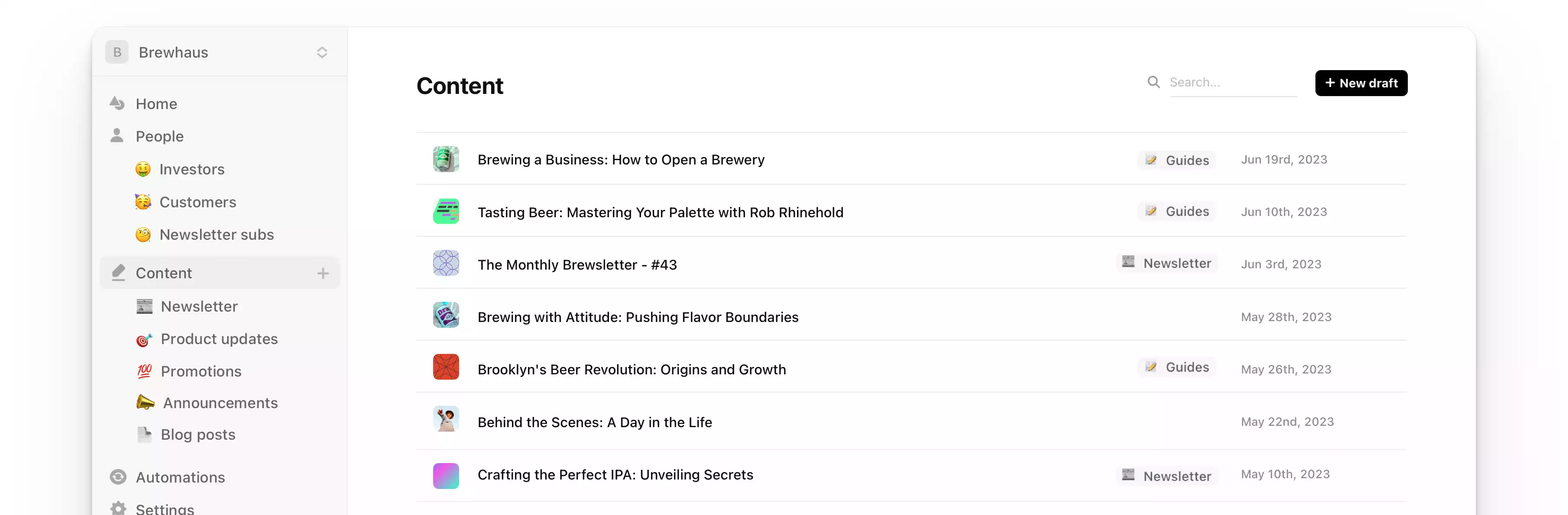
Resend rebuilt its template editor in 2026, and React Email now includes an open-source visual editor. But Resend is still oriented around templates that developers own: React Email components, HTML, or templates published from the dashboard. That works well for transactional email that rarely changes. For a weekly newsletter or a seasonal campaign, it usually means a developer is involved in every email.
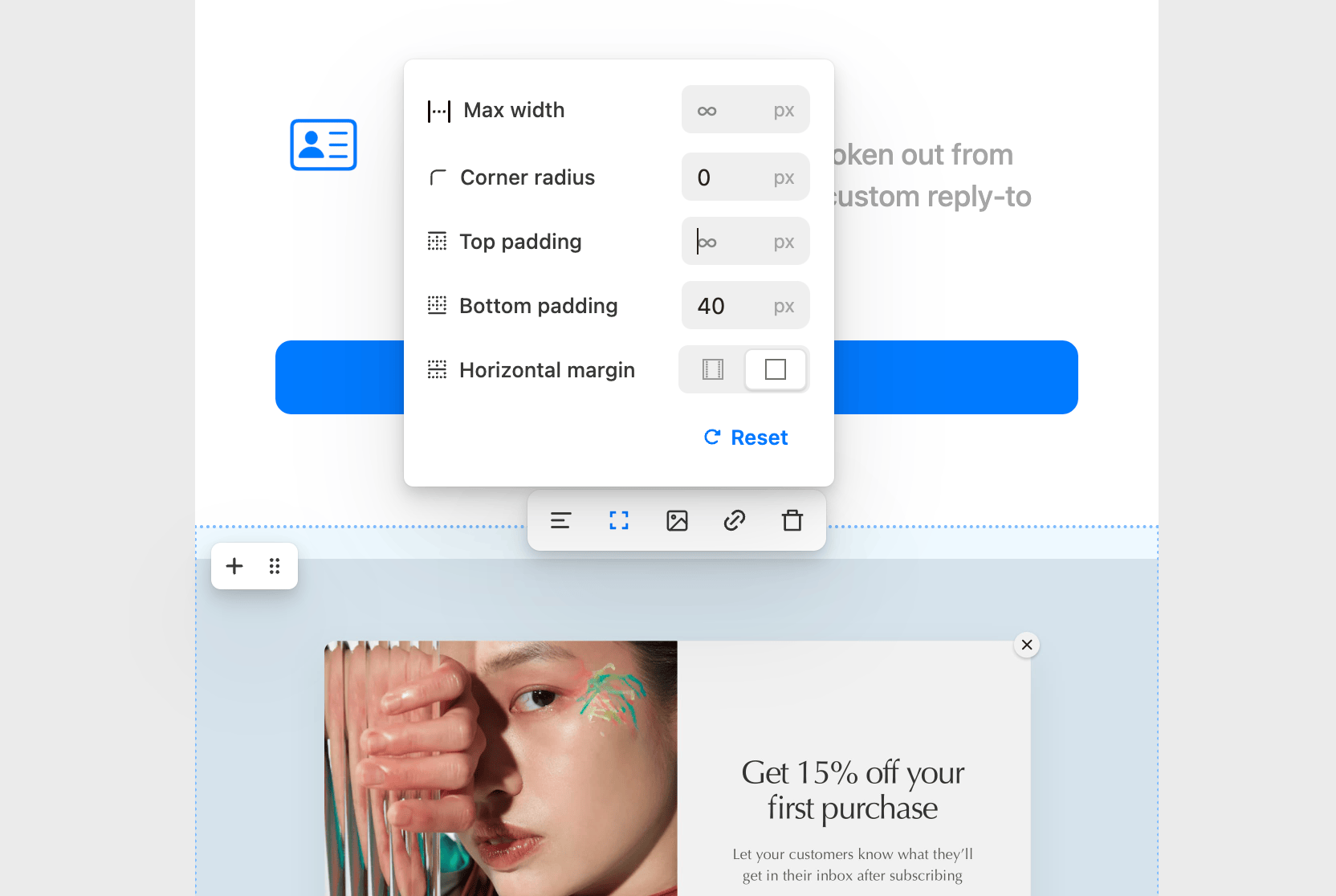
Audienceful takes a different approach with a unified block editor that combines fluid writing with deep layout and design control. A built-in design system lets you define reusable styles and components so every email stays on-brand without rebuilding from scratch. Anyone on the team can produce a polished email, not just developers, and the same emails can be sent as campaigns, automation steps or transactional messages.
Automation and Ecommerce
Summary: Audienceful's automation builder supports full branching logic, conditional splits and event-based triggers, connected to native Stripe and Shopify integrations. You can build automations around purch...
Resend launched automations in April 2026. They're triggered by events you send from your app and can be built through the API, SDKs, CLI or MCP server, which suits product-led flows like onboarding. What Resend doesn't have is ecommerce or billing data: there are no native integrations with Shopify or Stripe, so abandoned cart, post-purchase or failed-payment flows need you to send every event yourself.
Audienceful's automation builder supports full branching logic, conditional splits and event-based triggers, connected to native Stripe and Shopify integrations. You can build automations around purchase events, subscription changes, cart abandonment and engagement patterns without writing the plumbing. Custom events from your app work too, and the same events can trigger transactional sends and marketing sequences.
Ready to see the difference?
Free up to 1,000 subscribers.
Segmentation and Data
Summary: Audienceful's segmentation is built for revenue-focused teams. Native Stripe and Shopify integrations pull purchase history, subscription data and product information into the platform, so you can seg...
Resend organizes contacts into segments (formerly audiences) and topics, with custom contact properties. That covers list management and subscription preferences. It doesn't ingest purchase or subscription data, so targeting by what customers bought or how much they've spent means building and syncing that data yourself.
Audienceful's segmentation is built for revenue-focused teams. Native Stripe and Shopify integrations pull purchase history, subscription data and product information into the platform, so you can segment on purchase behavior, revenue thresholds, subscription status and engagement. Revenue attribution connects campaigns to real purchases, so you can measure the return on every send.
Deliverability
Summary: Audienceful approaches deliverability as a first-class engineering problem specifically for marketing email. A manual approval process maintains platform-wide sender quality, preventing the reputation...
Resend takes deliverability seriously and has built solid infrastructure for reliable email delivery. Domain verification is straightforward, dedicated IP addresses are available, and the platform provides clear sending analytics. For transactional email (password resets, order confirmations, verification codes), Resend delivers well. The platform is still relatively young compared to established infrastructure providers, but the team's focus on developer experience extends to deliverability tooling, with clear DKIM/SPF setup guides and delivery event tracking.
Audienceful approaches deliverability as a first-class engineering problem specifically for marketing email. A manual approval process maintains platform-wide sender quality, preventing the reputation pollution that plagues shared-infrastructure providers. Dynamic batching staggers sends based on inbox provider limits and engagement signals, avoiding the rate-limit trips and bulk-sender flags that can hit less sophisticated platforms. Smart retry logic re-attempts deferred deliveries with optimized timing and backoff. For marketing campaigns at scale, this purpose-built infrastructure produces consistently high inbox placement, a different challenge than transactional delivery, which Resend is primarily optimized for.
Who Each Tool Is Best For
Summary: Audienceful is built for ecommerce brands and SaaS teams where marketing email is a revenue channel and more than developers touch it. You get a real-time collaborative editor, an AI agent that builds...
Resend is the right choice for developer teams that want a modern, well-designed email API. If your email is mostly programmatic (password resets, notifications, receipts, product-triggered onboarding) and you value clean API design, React Email and an MCP server for your editor, Resend is purpose-built for that workflow, and its Broadcasts cover the occasional product update.
Audienceful is built for ecommerce brands and SaaS teams where marketing email is a revenue channel and more than developers touch it. You get a real-time collaborative editor, an AI agent that builds segments and automations from a plain-language brief, an MCP server with approval built in, native Stripe and Shopify integrations, revenue attribution, and transactional email through one API call, all on one plan priced by contacts.
Frequently asked questions
Is Audienceful better than Resend?
For ecommerce brands and SaaS teams, yes. Audienceful offers a modern block editor, native Shopify and Stripe integrations, and deliverability infrastructure designed for scale. Resend has strengths in other areas; read the full comparison above to see the detailed breakdown.
Can I migrate from Resend easily?
Yes. Export your subscriber list as a CSV from Resend and import it directly into Audienceful. We handle deduplication, tagging, and validation automatically. Most teams complete their migration in under 15 minutes.
Which is cheaper, Audienceful or Resend?
Audienceful is typically significantly cheaper. The free plan includes 1,000 subscribers with all features. At scale, Audienceful is typically 30–50% cheaper because we don't charge for unsubscribed or inactive contacts.
Does Resend have better automation?
Resend's automation is solid. Audienceful matches it on branching logic and adds native ecommerce triggers from Shopify and Stripe, so you can automate based on real purchase data without third-party middleware.
Which platform is better for ecommerce?
Audienceful. Native Shopify and Stripe integrations mean purchase data flows directly into segmentation and automation, with no middleware required.
How do deliverability rates compare?
Audienceful uses dynamic batching with per-provider throttling and smart retry logic, which typically results in higher inbox placement, especially for larger sends.
Migrate from Resend in less than 5 minutes
Import your contacts, templates, and automations. We handle the hard parts.
Start Free MigrationRelated comparisons
Audienceful vs ActiveCampaign
ActiveCampaign is a marketing automation and CRM platform known for its powerful automation builder, but its sprawling feature set, dated email editor, and confusing pricing tiers make it a complex choice for teams that just want great email marketing.
See comparison →Audienceful vs Amazon SES
Amazon SES is raw email sending infrastructure from AWS. It's incredibly cheap at $0.10 per 1,000 emails, but it provides zero marketing features, no editor, no automation, and no segmentation, requiring you to build everything yourself on top of a sending pipe.
See comparison →Audienceful vs AWeber
AWeber is one of the oldest email marketing platforms, launched in 1998. It's simple and beginner-friendly but has barely evolved, offering only basic autoresponders, a dated editor, no AI, no real-time collaboration, and no meaningful ecommerce integrations.
See comparison →Stop searching.
Start emailing.
Your first 1,000 subscribers are totally free.
Start Free