Best Mailchimp Alternative (2026)
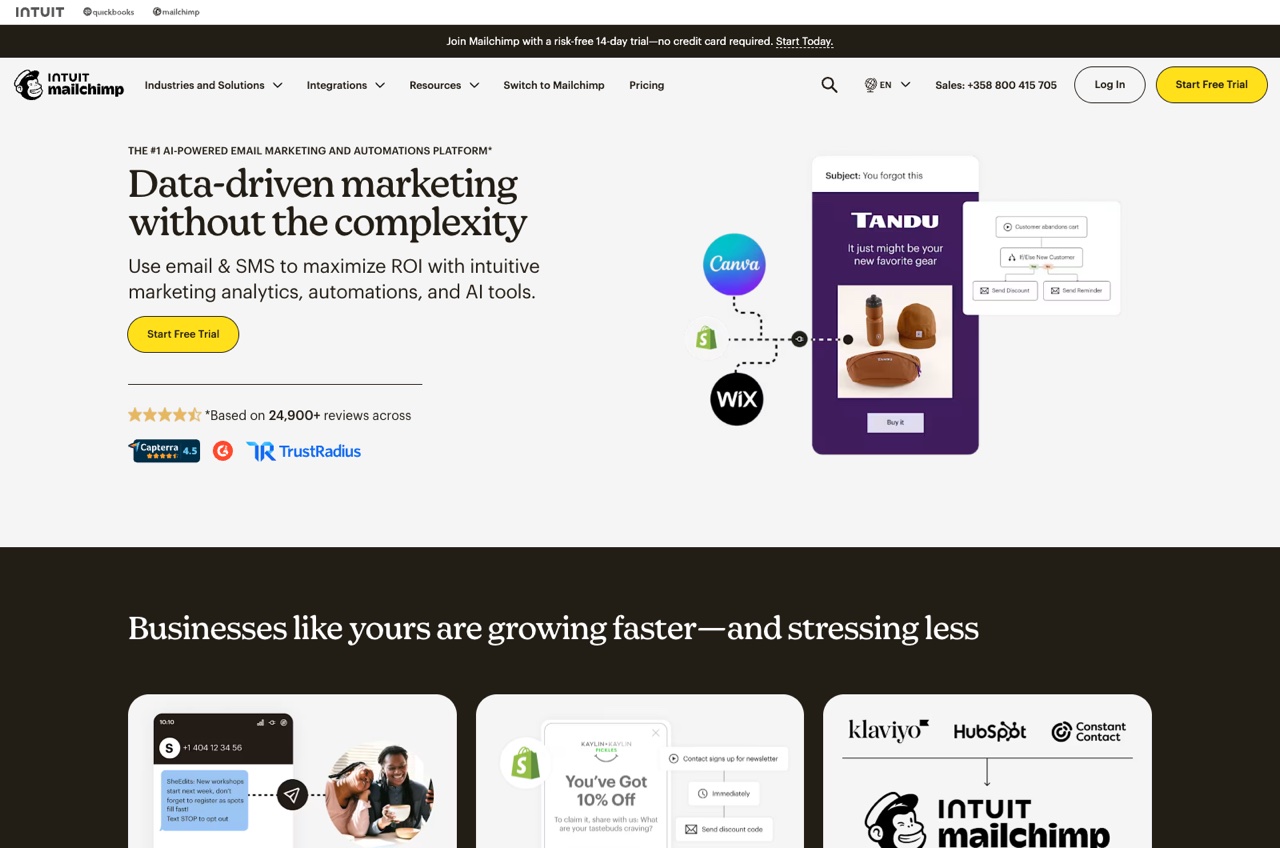
TL;DR: Mailchimp is the most recognized name in email marketing, but since its Intuit acquisition it's become a bloated, expensive marketing platform with a clunky editor, aggressive pricing that charges for unsubscribed contacts, and AI features that feel bolted on rather than native.
Compare features
A side-by-side look at how Mailchimp and Audienceful compare across the features that matter most.
Mailchimp vs Audienceful: Summary
Mailchimp is the most widely recognized email marketing platform, now owned by Intuit. Over the years it's expanded into a full 'marketing platform' with landing pages, social posting, CRM features, and more, but that expansion has come at the cost of focus. The email editor is notoriously clunky and template-rigid, pricing has become increasingly aggressive (you pay for unsubscribed and inactive contacts sitting in your audience), and the product feels like it's coasting on brand recognition rather than innovating. AI features exist but feel tacked on rather than woven into the editing experience. For ecommerce teams, the lack of a native Shopify integration (years after their public breakup) remains a real gap.
Pricing: who's cheaper?
Mailchimp's pricing has become increasingly aggressive since the Intuit acquisition, and they charge for unsubscribed and inactive contacts sitting in your audience, which inflates costs quickly. Audienceful uses straightforward per-subscriber pricing with a generous free tier and no charges for inactive contacts.
Audienceful is on average ~40% less expensive than Mailchimp
Based on publicly available pricing across all tiers (5K–200K contacts). The gap widens significantly at higher contact volumes, where Mailchimp's per-contact costs accelerate.
Monthly price by contact volume
Pricing data sourced from public pricing pages · Last verified October 2026
AI Agents and MCP Servers
Summary: Audienceful gives you both on every plan, including Free. The built-in AI agent builds audiences, automations and emails from a brief and waits for your approval, and the hosted email marketing MCP se...
Mailchimp's AI, Intuit Assist, helps write content, and Analytics AI answers questions about your results. Intuit has announced an agent that plans and builds campaigns, but it wasn't available at the time of writing. Mailchimp's MCP server connects Claude to your account to plan and draft campaigns, but it can't send them, and it's limited to Standard and Premium plans.
Audienceful gives you both on every plan, including Free. The built-in AI agent builds audiences, automations and emails from a brief and waits for your approval, and the hosted email marketing MCP server lets Claude, ChatGPT, Gemini or Cursor do the same work, through to scheduling the send once you've approved the exact recipients. New automations arrive paused, and the MCP server doesn't use AI credits. See our Mailchimp MCP guide for what each server can do.
AI and Collaboration
Summary: Audienceful treats AI and collaboration as foundational. Multiple team members can edit the same email simultaneously with live cursors and presence indicators, exactly like working in a Google Doc.
Mailchimp has added AI features over the past few years (subject line suggestions, a Creative Assistant for generating design variations, and some predictive analytics), but these feel like add-ons layered on top of an aging product rather than core to the experience. You still can't highlight a paragraph and ask AI to rewrite it inline, generate images natively, or use AI as part of your actual writing flow. Content creation in Mailchimp is still fundamentally manual, and there's no real-time collaboration. If two people need to work on a campaign, one waits while the other finishes.
Audienceful treats AI and collaboration as foundational. Multiple team members can edit the same email simultaneously with live cursors and presence indicators, exactly like working in a Google Doc. And rather than a grab-bag of assistants, every plan includes one built-in AI agent that does real work: it writes and edits emails in your voice using your best-performing sends as style references, reads URLs you paste for context, generates images, restyles entire themes, builds segments from a plain-language description, and can assemble complete automations from a brief, always with your approval before anything sends. For teams shipping campaigns regularly, this eliminates the constant context-switching between your email tool, a copywriting AI, and a separate image tool.
Email Editor and Design
Summary: Audienceful's unified block editor gives you the speed of writing in a modern document editor with deep layout and design control underneath. A built-in design system lets you define reusable styles a...
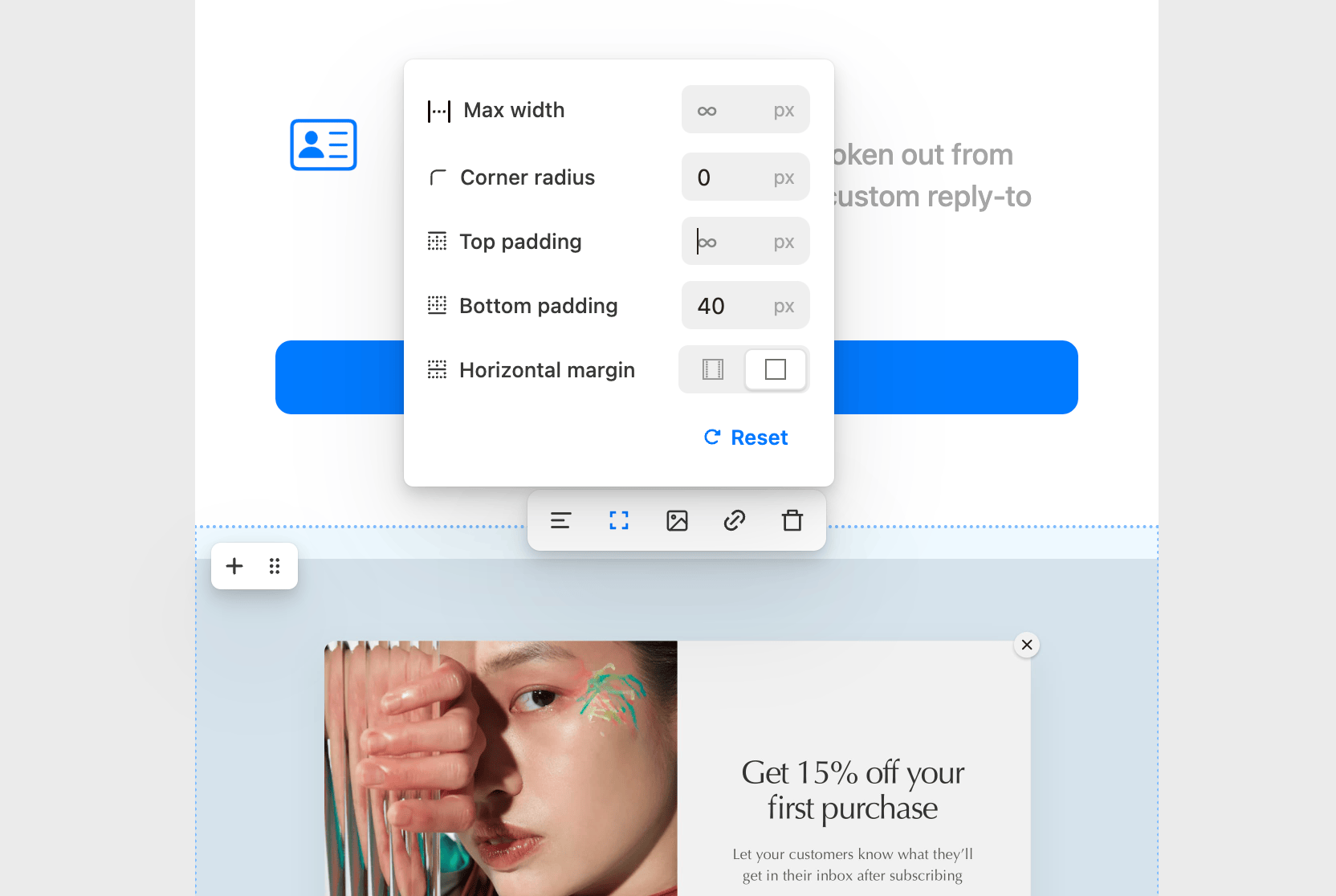
Mailchimp's email editor is one of the most common complaints from its users. The template system is rigid: you pick a layout up front and then fight the builder to customize it beyond its constraints. Drag-and-drop blocks are limited in how they can be arranged, spacing and alignment controls are frustrating, and achieving a truly custom design often requires dropping into raw HTML. The editor itself is slow to load and interact with, especially on larger campaigns. There's no concept of a design system. Every email is a standalone effort, which leads to brand inconsistency across campaigns as different team members build emails in slightly different ways.
Audienceful's unified block editor gives you the speed of writing in a modern document editor with deep layout and design control underneath. A built-in design system lets you define reusable styles and components, so every email your team sends stays on-brand without requiring a designer to police templates. You get fine-grained control over layout, spacing, and typography without ever needing to touch HTML. For teams that have outgrown the frustration of wrestling with Mailchimp's template constraints, it's a fundamentally different editing experience.
Ready to see the difference?
Free up to 1,000 subscribers.
Automation and Ecommerce
Summary: Audienceful's automation builder is purpose-built to compete at the Klaviyo and Customer.io level. It supports full branching logic, conditional splits, wait conditions, and event-based triggers that ...
Mailchimp's Customer Journey Builder is a capable automation tool. It supports branching paths, if/else conditions, and a decent set of triggers. It's a real step up from basic autoresponders. But for serious ecommerce teams, it has notable gaps. The biggest is the missing native Shopify integration: after Mailchimp and Shopify parted ways in 2019, there's still no direct connection, meaning ecommerce data flows through third-party middleware that adds latency, cost, and potential for breakage. Automation templates exist but tend to be generic rather than built around real ecommerce workflows like post-purchase upsells, winback sequences, or replenishment reminders driven by actual product data.
Audienceful's automation builder is purpose-built to compete at the Klaviyo and Customer.io level. It supports full branching logic, conditional splits, wait conditions, and event-based triggers that pull from native Stripe and Shopify integrations, so you can trigger flows based on actual purchase data, subscription changes, cart events, and product interactions without any middleware. Revenue attribution ties directly into your automations, so you can see exactly which flows are driving sales. For ecommerce brands and SaaS teams, this is the difference between automations that feel like fancy newsletters and automations that actually drive measurable revenue.
Integrations and Data
Summary: Audienceful takes a narrower but deeper approach to integrations. Native Stripe and Shopify integrations sync purchase history, subscription data, and product catalogs directly into the platform with ...
Mailchimp's integration ecosystem is genuinely extensive; it's one of the benefits of being the market incumbent for over a decade. Hundreds of apps connect through their marketplace, and their API is well-documented and mature. However, the quality of those integrations varies wildly, and many are maintained by third parties with inconsistent update cycles. The most glaring gap for ecommerce teams is Shopify: you need a third-party connector to sync store data, which introduces cost, data lag, and a dependency on a tool that could break or change pricing at any time. Segmentation is decent but leans heavily on engagement data and basic tags rather than deep behavioral or purchase-based criteria.
Audienceful takes a narrower but deeper approach to integrations. Native Stripe and Shopify integrations sync purchase history, subscription data, and product catalogs directly into the platform with no middleware, no lag, no extra cost. This means your segmentation can go far beyond opens and clicks into actual revenue behavior: purchase frequency, average order value, product affinity, subscription status, and more. For teams where email is a revenue channel, the depth of data available for targeting and personalization is a significant advantage over Mailchimp's broader but shallower integration layer.
Deliverability
Summary: Audienceful approaches deliverability as an engineering problem. On top of a manual sender approval process, Audienceful uses dynamic batching (intelligently staggering sends based on inbox provider r...
Mailchimp invests in deliverability infrastructure and has a large enough sending volume that inbox providers generally recognize their IPs. They offer domain authentication, abuse monitoring, and compliance enforcement. That said, the sheer scale of their platform means you're sharing IP reputation with millions of other senders, and while Mailchimp does segment IPs by sender quality, your deliverability is still partially at the mercy of your pool neighbors. There's no intelligent per-provider send-rate optimization or sophisticated retry logic on Mailchimp's standard plans. Dedicated IPs are available on premium tiers, but that comes with a significantly higher price tag.
Audienceful approaches deliverability as an engineering problem. On top of a manual sender approval process, Audienceful uses dynamic batching (intelligently staggering sends based on inbox provider rate limits and real-time engagement signals), so large campaigns don't trip bulk-sender flags at Gmail, Outlook, or Yahoo. When emails soft-bounce or get temporarily deferred, a smart retry system re-attempts delivery with optimized backoff timing instead of either giving up or hammering the provider with immediate retries. The result is consistently higher inbox placement, especially on larger sends where scale-related throttling is most likely to hurt you.
Who Each Tool Is Best For
Summary: Audienceful is built for ecommerce brands and SaaS teams who need email to be a real revenue driver, not just a broadcast channel. If you want a modern editor that your team can collaborate in, automa...
Mailchimp still makes sense for businesses that value ecosystem breadth and brand familiarity over product depth. If you need a well-known platform with hundreds of integrations, don't mind paying a premium for the brand, and your email strategy is primarily newsletters and basic campaigns, Mailchimp's existing feature set will cover you, though you'll likely feel the editor and pricing pain as you scale.
Audienceful is built for ecommerce brands and SaaS teams who need email to be a real revenue driver, not just a broadcast channel. If you want a modern editor that your team can collaborate in, automation that rivals dedicated ecommerce platforms like Klaviyo, native Stripe and Shopify data without middleware, and deliverability infrastructure designed for scale, Audienceful is the more advanced, more capable tool for teams that have outgrown what Mailchimp's aging platform can offer.
Frequently asked questions
Is Audienceful better than Mailchimp?
For ecommerce brands and SaaS teams, yes. Audienceful offers a modern block editor, native Shopify and Stripe integrations, and deliverability infrastructure designed for scale. Mailchimp has strengths in other areas; read the full comparison above to see the detailed breakdown.
Can I migrate from Mailchimp easily?
Yes. Export your subscriber list as a CSV from Mailchimp and import it directly into Audienceful. We handle deduplication, tagging, and validation automatically. Most teams complete their migration in under 15 minutes.
Which is cheaper, Audienceful or Mailchimp?
Audienceful is typically significantly cheaper. The free plan includes 1,000 subscribers with all features. At scale, Audienceful is typically 30–50% cheaper because we don't charge for unsubscribed or inactive contacts.
Does Mailchimp have better automation?
Mailchimp's automation is solid. Audienceful matches it on branching logic and adds native ecommerce triggers from Shopify and Stripe, so you can automate based on real purchase data without third-party middleware.
Which platform is better for ecommerce?
Audienceful. Native Shopify and Stripe integrations mean purchase data flows directly into segmentation and automation, with no middleware required.
How do deliverability rates compare?
Audienceful uses dynamic batching with per-provider throttling and smart retry logic, which typically results in higher inbox placement, especially for larger sends.
Migrate from Mailchimp in less than 5 minutes
Import your contacts, templates, and automations. We handle the hard parts.
Start Free MigrationRelated comparisons
Audienceful vs ActiveCampaign
ActiveCampaign is a marketing automation and CRM platform known for its powerful automation builder, but its sprawling feature set, dated email editor, and confusing pricing tiers make it a complex choice for teams that just want great email marketing.
See comparison →Audienceful vs Amazon SES
Amazon SES is raw email sending infrastructure from AWS. It's incredibly cheap at $0.10 per 1,000 emails, but it provides zero marketing features, no editor, no automation, and no segmentation, requiring you to build everything yourself on top of a sending pipe.
See comparison →Audienceful vs AWeber
AWeber is one of the oldest email marketing platforms, launched in 1998. It's simple and beginner-friendly but has barely evolved, offering only basic autoresponders, a dated editor, no AI, no real-time collaboration, and no meaningful ecommerce integrations.
See comparison →Stop searching.
Start emailing.
Your first 1,000 subscribers are totally free.
Start Free