The Best Mailjet Alternative for Email Marketing
TL;DR: Mailjet is a developer-friendly email platform owned by Sinch that offers solid transactional email infrastructure and real-time collaboration in its editor. But its marketing automation is basic, it lacks native ecommerce integrations, and its marketing features feel secondary to the API and infrastructure side.
Compare features
A side-by-side look at how Mailjet and Audienceful compare across the features that matter most.

Mailjet vs Audienceful: Summary
Mailjet, owned by Sinch (which also owns MessageBird), started as an email API and infrastructure provider before layering marketing features on top. Its Passport email editor is genuinely decent and (unusually for the category) supports real-time collaboration, letting multiple team members edit the same email simultaneously. The transactional email API is reliable with good documentation and SMTP relay support, making it a natural choice for developer-led teams. However, the marketing side has clear limitations: automation is restricted to simple linear workflows with no real branching or conditional logic, there are no native Shopify or Stripe integrations, segmentation is basic, and there are no AI features anywhere in the platform. Pricing is based on email volume rather than contacts. Mailjet works well for teams that need both transactional and marketing email from one vendor without requiring advanced automation or ecommerce depth.
Pricing: who's cheaper?
Mailjet prices by monthly email volume rather than contacts, which makes direct comparison tricky. Their Premium plan (the tier with advanced features like segmentation, A/B testing, and priority support) starts at $27/month for 15,000 emails. To compare fairly, we assume roughly 4 emails per contact per month, a typical cadence for active email marketing. At that rate, a 10K-contact list needs about 40K emails/month, which falls into Mailjet's 50K email tier at $55/month. At smaller list sizes, Mailjet's volume-based pricing looks cheaper on paper. But this comparison has caveats: Mailjet's Premium plan lacks advanced automation, native ecommerce integrations, AI features, and design systems that Audienceful includes at every tier. You're comparing a transactional-first platform with basic marketing bolted on against a purpose-built marketing platform. At higher volumes, Mailjet requires custom pricing.
Mailjet is cheaper at most tiers, but with significant feature gaps
Based on published Mailjet Premium plan pricing (converted from email volume assuming ~4 emails/contact/month) and Audienceful Essentials plan pricing as of March 2026.
Monthly price by contact volume
Pricing data sourced from public pricing pages · Last verified October 2026
AI and Collaboration
Summary: Audienceful also offers real-time collaborative editing but goes further. Every plan includes a built-in AI agent that drafts and edits emails in your voice using your best-performing sends as style r...
Mailjet deserves genuine credit here: its Passport editor supports real-time collaboration, letting multiple team members work on the same email simultaneously. This is rare in the email marketing space, and for teams that review and edit campaigns together, it is a meaningful advantage over most competitors. However, the collaboration story stops there: there is no AI content generation, no AI-powered rewriting, no subject line suggestions, and no AI image creation. Every word and every visual is manual.
Audienceful also offers real-time collaborative editing but goes further. Every plan includes a built-in AI agent that drafts and edits emails in your voice using your best-performing sends as style references, reads URLs you paste for context, generates images, restyles entire themes, and can build segments or complete automations from a plain-language brief, proposing a plan and executing it only with your approval. On top of collaboration, Audienceful adds a design system layer so teams can enforce brand consistency automatically. Where Mailjet gives you collaborative editing, Audienceful gives you collaborative editing plus an agentic AI teammate plus design governance: a more complete system for teams producing email at pace.
Email Editor and Design
Summary: Audienceful's unified block editor combines the speed of writing with deep layout and design control. A built-in design system lets you define reusable styles, colors, and components that enforce bran...
Mailjet's Passport editor is a solid drag-and-drop builder. It handles standard layouts well, supports responsive design, and the interface is clean and reasonably intuitive. For straightforward marketing campaigns (a newsletter, a product announcement, a promotional send), it gets the job done without friction. But it lacks deeper design infrastructure. There are no design systems for enforcing brand consistency across campaigns, no reusable style tokens, and limited fine-grained control over typography and spacing. Each email is essentially designed from scratch or cloned from a previous send.
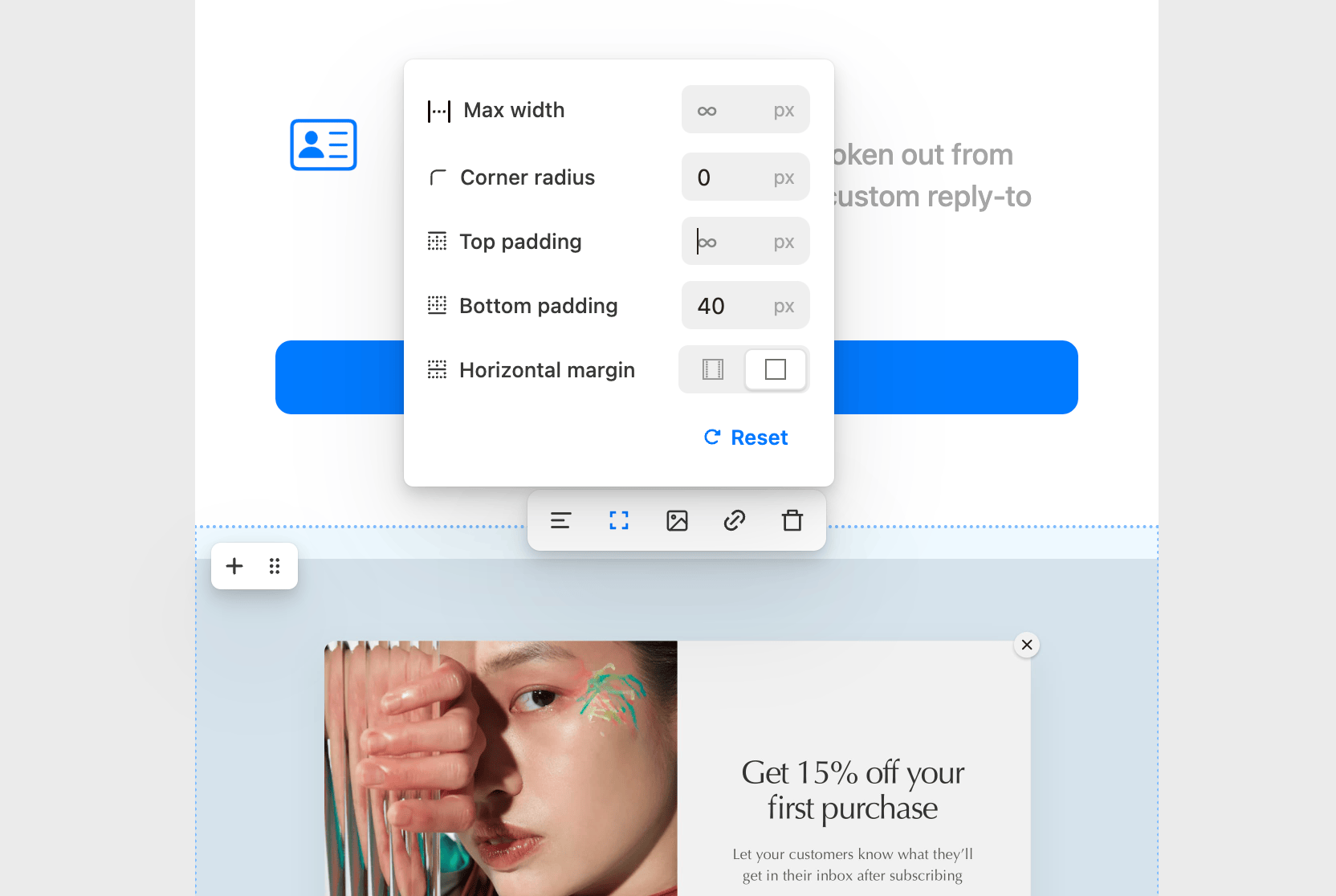
Audienceful's unified block editor combines the speed of writing with deep layout and design control. A built-in design system lets you define reusable styles, colors, and components that enforce brand consistency automatically, so every email stays on-brand without manual recreation. You get precise control over spacing, typography, and responsive behavior while the writing experience stays fluid and fast. For teams shipping emails regularly, the difference between a capable editor and an editor with design infrastructure compounds over time.
Automation and Ecommerce
Summary: Audienceful's automation builder is designed for ecommerce and SaaS teams where email drives revenue. It supports full branching logic, conditional splits, and event-based triggers connected to native...
Mailjet's automation is where the platform shows its limitations most clearly. You can build simple workflows, like a welcome sequence triggered by a list subscription or a basic drip series with time delays, but there is no real branching logic, no conditional splits based on user behavior, and no event-driven triggers beyond the basics. For teams that need abandoned cart flows, post-purchase sequences, or automations based on subscription lifecycle events, Mailjet does not have the infrastructure. There are no native Shopify or Stripe integrations, so any ecommerce data requires custom API development or third-party middleware like Zapier.
Audienceful's automation builder is designed for ecommerce and SaaS teams where email drives revenue. It supports full branching logic, conditional splits, and event-based triggers connected to native Stripe and Shopify integrations. You can build automations based on purchase events, subscription changes, cart behavior, revenue thresholds, and engagement patterns. Abandoned cart, post-purchase, win-back, trial conversion, and churn prevention flows all work out of the box with real commerce data, not manual list tagging or third-party workarounds.
Ready to see the difference?
Free up to 1,000 subscribers.
Segmentation and Data
Summary: Audienceful's segmentation is built around revenue and behavior. Native Stripe and Shopify integrations bring purchase history, subscription status, product catalogs, and revenue data directly into th...
Mailjet's segmentation covers the basics: you can segment by contact properties (custom fields, subscription date) and engagement metrics (opens, clicks, activity). For teams running straightforward campaigns to defined lists, this is adequate. But there is no deep behavioral segmentation based on purchase history, revenue data, or product interactions. The platform was built around email delivery infrastructure, and its marketing data model reflects that. It knows about email events, not customer behavior.
Audienceful's segmentation is built around revenue and behavior. Native Stripe and Shopify integrations bring purchase history, subscription status, product catalogs, and revenue data directly into the segmentation engine. You can build segments based on what customers actually buy, how much they spend, which products they interact with, and where they are in their subscription lifecycle. Revenue attribution ties email campaigns directly to purchases, giving you clear ROI measurement rather than proxy metrics like open rates.
Deliverability
Summary: Audienceful treats marketing email deliverability as a first-class engineering problem. A manual approval process maintains platform-wide sender quality, preventing the reputation dilution that affect...
Mailjet has decent deliverability infrastructure backed by Sinch's broader messaging platform. It supports dedicated IPs on higher plans, offers authentication setup guidance (SPF, DKIM, DMARC), and provides real-time monitoring dashboards. For transactional email especially, deliverability is reliable. Marketing email deliverability is solid but not differentiated: there is no dynamic batching, no per-provider send optimization, and no intelligent retry logic tuned for campaign-scale delivery.
Audienceful treats marketing email deliverability as a first-class engineering problem. A manual approval process maintains platform-wide sender quality, preventing the reputation dilution that affects shared-infrastructure providers. Dynamic batching staggers sends based on inbox provider limits and engagement signals, avoiding the rate-limit issues and bulk-sender flags that simpler platforms encounter. Smart retry logic re-attempts deferred deliveries with optimized timing and backoff. For marketing campaigns specifically, this produces consistently higher inbox placement.
Who Each Tool Is Best For
Summary: Audienceful is built for ecommerce brands and SaaS teams where marketing email is a revenue channel. If you need a collaborative editor enhanced with AI and design systems, an automation builder with ...
Mailjet is a good fit for developer-led teams that need both transactional and marketing email from a single vendor. If your primary need is a reliable email API with SMTP relay for transactional messages, and you also want to send occasional marketing campaigns with a capable editor and real-time collaboration (without needing advanced automation or deep ecommerce integrations), Mailjet delivers solid value at competitive pricing. Its volume-based pricing model also suits high-volume transactional senders.
Audienceful is built for ecommerce brands and SaaS teams where marketing email is a revenue channel. If you need a collaborative editor enhanced with AI and design systems, an automation builder with real branching and event-driven logic, native Stripe and Shopify integrations powering advanced segmentation and revenue attribution, and deliverability infrastructure engineered for marketing sends, Audienceful is the purpose-built platform. It treats campaign creation, automation, and revenue measurement as core capabilities rather than secondary features alongside an email API.
Frequently asked questions
Is Audienceful better than Mailjet?
For ecommerce brands and SaaS teams, yes. Audienceful offers a modern block editor, native Shopify and Stripe integrations, and deliverability infrastructure designed for scale. Mailjet has strengths in other areas; read the full comparison above to see the detailed breakdown.
Can I migrate from Mailjet easily?
Yes. Export your subscriber list as a CSV from Mailjet and import it directly into Audienceful. We handle deduplication, tagging, and validation automatically. Most teams complete their migration in under 15 minutes.
Which is cheaper, Audienceful or Mailjet?
Audienceful is typically significantly cheaper. The free plan includes 1,000 subscribers with all features. At scale, Audienceful is typically 30–50% cheaper because we don't charge for unsubscribed or inactive contacts.
Does Mailjet have better automation?
Mailjet's automation is solid. Audienceful matches it on branching logic and adds native ecommerce triggers from Shopify and Stripe, so you can automate based on real purchase data without third-party middleware.
Which platform is better for ecommerce?
Audienceful. Native Shopify and Stripe integrations mean purchase data flows directly into segmentation and automation, with no middleware required.
How do deliverability rates compare?
Audienceful uses dynamic batching with per-provider throttling and smart retry logic, which typically results in higher inbox placement, especially for larger sends.
Migrate from Mailjet in less than 5 minutes
Import your contacts, templates, and automations. We handle the hard parts.
Start Free MigrationRelated comparisons
Audienceful vs ActiveCampaign
ActiveCampaign is a marketing automation and CRM platform known for its powerful automation builder, but its sprawling feature set, dated email editor, and confusing pricing tiers make it a complex choice for teams that just want great email marketing.
See comparison →Audienceful vs Amazon SES
Amazon SES is raw email sending infrastructure from AWS. It's incredibly cheap at $0.10 per 1,000 emails, but it provides zero marketing features, no editor, no automation, and no segmentation, requiring you to build everything yourself on top of a sending pipe.
See comparison →Audienceful vs AWeber
AWeber is one of the oldest email marketing platforms, launched in 1998. It's simple and beginner-friendly but has barely evolved, offering only basic autoresponders, a dated editor, no AI, no real-time collaboration, and no meaningful ecommerce integrations.
See comparison →Stop searching.
Start emailing.
Your first 1,000 subscribers are totally free.
Start Free