Our Drip review in short: Drip is still a capable ecommerce email platform with a good visual workflow builder and solid store integrations, but it has no free plan, prices close to Klaviyo at 10,000 people, and new accounts can't currently add SMS. It's worth keeping if your workflows are built and working; it's harder to justify as a new purchase. If cost is the issue, Audienceful runs the same store flows for less, covered at the end.
Disclosure: we make Audienceful, a competitor. Prices and terms below come from Drip's own pricing page and help center, checked 14 November 2026. We did not run a paid Drip account or a support ticket for this review, and we say where a point comes from documentation or third-party reports.
Drip review: the verdict
| Our score | 3.5 out of 5 |
| Best for | Established ecommerce stores, especially on Shopify or WooCommerce, with workflows already built in Drip |
| Not for | New stores wanting a free start, or stores that need SMS from day one |
| Price at 10,000 people | $154 a month |
| Biggest strength | Visual workflow builder with store events and branching |
| Biggest catch | Pricing near Klaviyo's without Klaviyo's depth, and SMS unavailable to new users |
How we scored it: pricing and value 25% (2.5/5), ecommerce automations 25% (4/5), segmentation and data 15% (4/5), ease of use 15% (4/5), support 10% (2.5/5), reporting 10% (4/5). Weighted total 3.5.
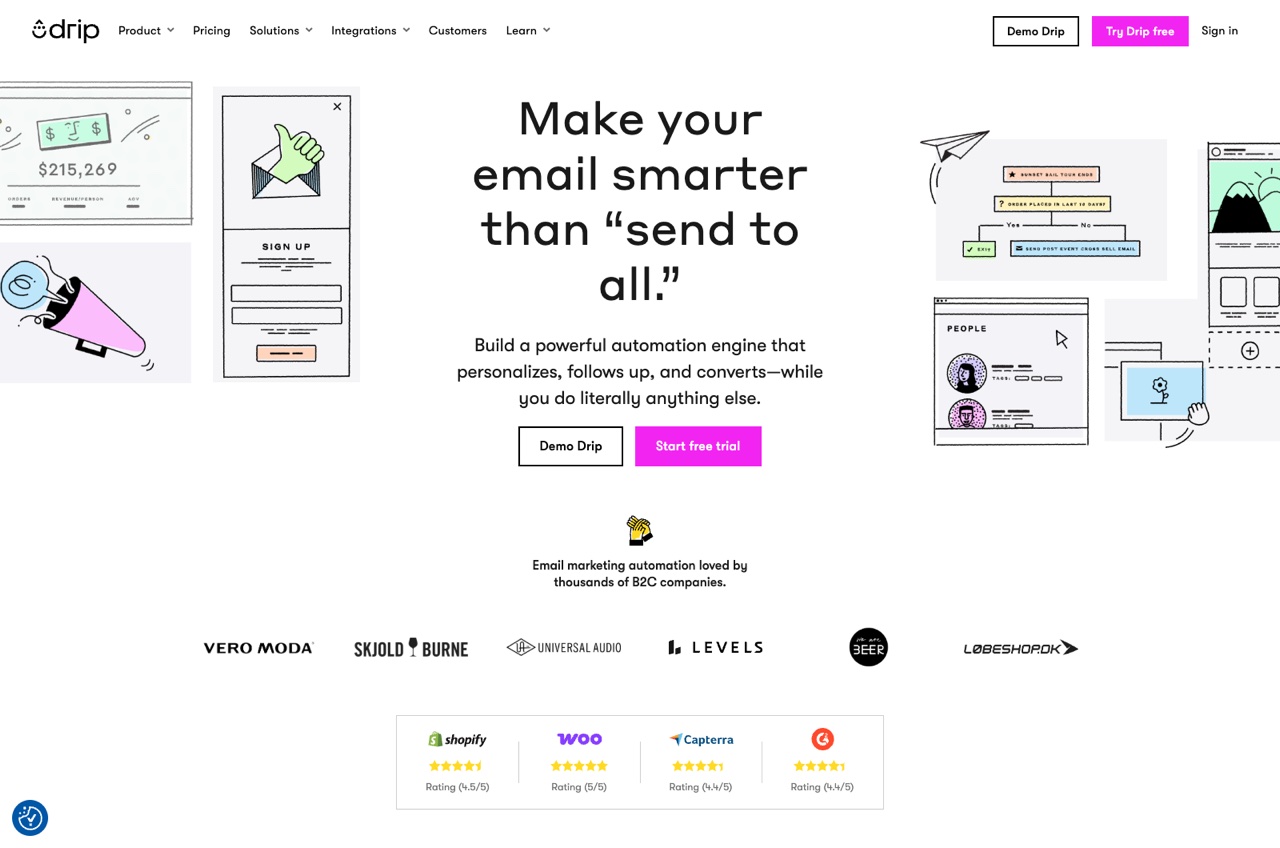
Drip's website, from our competitor screenshot library. Not an in-app screen.
What Drip is in 2026
Drip positions itself as email marketing for ecommerce. The pricing page sells one package priced by the number of active people, which includes store integrations, dynamic segments, onsite campaigns (popups and forms), an MCP connection and up to 50 workflows.
Drip has narrowed over the years. It used to pitch itself as an "ecommerce CRM" with heavier lead scoring and B2B use. Today the product is clearly aimed at online stores, which makes this review an ecommerce one.
Drip pricing review
Drip bills on active people, which isn't the same as subscribed people. Its Active People guide explains that active unsubscribed people can still count. Archiving or deleting people you don't need is how you lower the bill.
Monthly prices from the live selector, checked 14 November 2026:
| People | Monthly price | Email sends |
|---|---|---|
| Up to 2,500 | $39 | Unlimited |
| 5,000 | $89 | Unlimited |
| 10,000 | $154 | Unlimited |
| 20,000 | $289 | Unlimited |
| 25,000 | $369 | Unlimited |
| 50,000 | $699 | 600,000 a month |
| 100,000 | $1,199 | About 12 times the tier |
Above 30,000 people, the selector shows an allowance of about 12 times the tier rather than unlimited sends.
There's no free plan. Drip advertises a 14-day trial with no credit card, and its FAQ says unlimited sending isn't included during the trial. The full tier-by-tier ladder is in our Drip pricing guide, and the history of changes is in Drip's price increase.
How that compares, regular monthly prices on the same day:
| People or contacts | Drip | Klaviyo Email | Omnisend Standard |
|---|---|---|---|
| 10,000 | $154 | $150 | $132 |
| 50,000 | $699 | $720 | $413 |
| 100,000 | $1,199 | $1,380 | $900 |
Sources: Drip, Klaviyo, Omnisend.
Shopify and WooCommerce setup
Drip connects to Shopify, WooCommerce and other store platforms. Setup follows the usual pattern:
- Install the Drip app from the Shopify App Store, or the WooCommerce plugin, and connect your store.
- Customers, orders and products sync, and store events like checkout started and order placed become available as workflow triggers.
- Authenticate your sending domain.
- Add Drip's onsite forms or popups so new signups enter a welcome workflow.
- Start from a pre-built workflow and edit it.
On the Shopify App Store, Drip has a 4.0 rating from 57 reviews, checked 14 November 2026. That's a small number of reviews for a platform of its age, and well below Klaviyo (4.7 from 3,442) and Omnisend (4.7 from 3,213).
Workflows and pre-built playbooks
The workflow builder is Drip's best feature. It's visual, it handles store events well, and you can branch on purchase history, tags and engagement. Pre-built workflows cover the core ecommerce journeys, such as welcome, abandoned cart, post-purchase and win-back.
The package includes up to 50 workflows. Most stores use far fewer, but large catalogs with per-collection flows should count before they commit.
Segmentation, tags and lead scoring
Drip segments on tags, custom fields, events and purchase history, and segments update as data arrives. Tags and custom fields are flexible, which is good for stores that also collect quiz answers or preferences. Drip has supported lead scoring for years, though most stores now segment on purchase and engagement data instead.
Email builder
Drip's visual builder has product blocks that pull from your catalog and dynamic content. It does the job for product-led promotions. Try it with your own templates during the trial, since the editor is where your team will spend most of its time.
SMS
This is a real limitation for new customers. Drip's SMS billing guide describes usage-based SMS tiers starting at $39 a month for US accounts. But its user settings guide says SMS is currently unavailable to new users. If text messages are in your plan, confirm eligibility with Drip before buying.
Reporting and revenue attribution
Drip reports revenue by email and by workflow, using the store orders it syncs. That's what you need to judge whether a flow earns its place. As always, check the attribution window before comparing Drip's revenue figures with another tool's.
Support
Drip has a help center and a support team you contact from the app. The weakness shows up in third-party reviews: MailCon's June 2026 review notes reports of support waits of 8 to 9 days, and user reviews on aggregator sites repeat the theme of slow replies. We didn't run our own support test, so treat this as reported, not measured.
Ratings snapshot
| Source | Rating | Reviews | Checked |
|---|---|---|---|
| Shopify App Store | 4.0 out of 5 | 57 | 14 November 2026 |
| MailCon email marketing score | 4.4 out of 5 | Not applicable | Published June 2026 |
Who should stay on Drip
Stay if your workflows are built, they're earning, and your list is under about 25,000 people where the price gap to alternatives is smaller. Moving costs time, and a store with tuned workflows shouldn't switch for a small saving.
Leave if you need SMS on a new account, if your bill at 50,000 people and up has become a top-five expense, or if you've waited more than a week for support on something that blocked a send. If price is the main problem, see what to do when Drip is too expensive.
Drip vs Klaviyo in brief
At 10,000 people Drip is $154 and Klaviyo Email is $150, so price won't decide it. Klaviyo has deeper predictive data, more integrations, SMS for new customers and a much larger review base. Drip's workflow builder is easier for many teams, and its unlimited sending up to 30,000 people helps heavy senders. For most new stores comparing the two, Klaviyo is the safer pick; for existing Drip users, staying is reasonable. Our full Klaviyo vs Drip comparison goes through it feature by feature.
Alternatives to Drip
Audienceful is cheaper than Drip at every list size and has a free plan up to 1,000 contacts, where Drip has none.
| Contacts | Drip | Audienceful |
|---|---|---|
| 1,000 | $39 | Free |
| 10,000 | $154 | $79 billed yearly ($99 monthly) |
| 50,000 | $699 | $272 billed yearly ($320 monthly) |
| 100,000 | $1,199 | $499 billed yearly ($590 monthly) |
The 10K and 50K rows are Essentials (three flows); at 100K the row is Growth, which has unlimited flows. Growth is $118 and $309 billed yearly at 10K and 50K, still under Drip. Both pricing pages checked 14 November 2026.
What you get: a native Shopify app with customers, orders and products synced plus a historical import; nine ready-made flows in the Shopify flow library; branching automations with custom events; revenue attribution; an AI agent that builds segments and flows from a brief, with full MCP coverage; agency-designed templates and deliverability monitoring. New accounts start with a 14-day Growth trial and no card.
For WooCommerce stores, see the WooCommerce integration page for how the connection works.
Compare directly in Audienceful vs Drip, browse Drip alternatives, and when you're ready, follow migrating from Drip and the import help guide.
FAQs
How much does Drip cost?
Drip starts at $39 a month for up to 2,500 people, then $154 at 10,000, $699 at 50,000 and $1,199 at 100,000, checked on its live selector on 14 November 2026. SMS is separate.
Does Drip have a free plan?
No. Drip offers a 14-day trial with no credit card, and unlimited sending isn't included during the trial.
Is Drip good for Shopify?
It works well with Shopify: customers, orders and products sync, and store events trigger workflows. Its Shopify App Store rating is 4.0 from 57 reviews, lower and thinner than the main alternatives.
Is Drip better than Klaviyo?
Not for most new stores. The price is about the same at 10,000 people, and Klaviyo has more data depth, more integrations and SMS for new accounts. Drip's builder is easier for some teams, and existing Drip users with working flows have little reason to rush.
Does Drip offer SMS?
Drip documents SMS billing for US accounts, but its settings guide says SMS is currently unavailable to new users. Confirm eligibility before you buy if you need texts.
How good is Drip's support?
Drip has a help center and in-app support. Third-party reviews report slow replies, including waits of over a week. We didn't run our own test.
Cheaper than Drip at every size, with a free plan. Start your 14-day Growth trial, no card.
