Klaviyo vs Drip comes down to list size and how much of Klaviyo's wider product you will actually use. Klaviyo is cheaper at small lists and has a free plan, while Drip becomes the cheaper of the two past roughly 10,000 contacts and keeps a simpler, store-focused package. Both run the core Shopify flows well. If you want those flows without either bill, Audienceful is a third option covered at the end.
We make Audienceful. Prices below come from the live Klaviyo and Drip pricing selectors, checked 14 November 2026. Screenshots are from our competitor library and show each vendor's website, not their flow builders.
Klaviyo vs Drip: the short verdict
Pick Klaviyo if you are under about 8,000 active profiles, want a free plan to start, or plan to use predictive analytics, SMS, reviews and its helpdesk in one account. It has the deepest ecommerce data model of the two and a very large integration directory.
Pick Drip if your list is past 10,000 people, you mostly need email flows and campaigns, and you would rather pay one flat contact-based price with unlimited sending up to 30,000 people. Drip is a narrower product, and for many stores that is the point.
Neither is a bad choice. The common mistake is choosing on the starting price, which tells you nothing about the bill at 25,000 or 50,000 contacts.
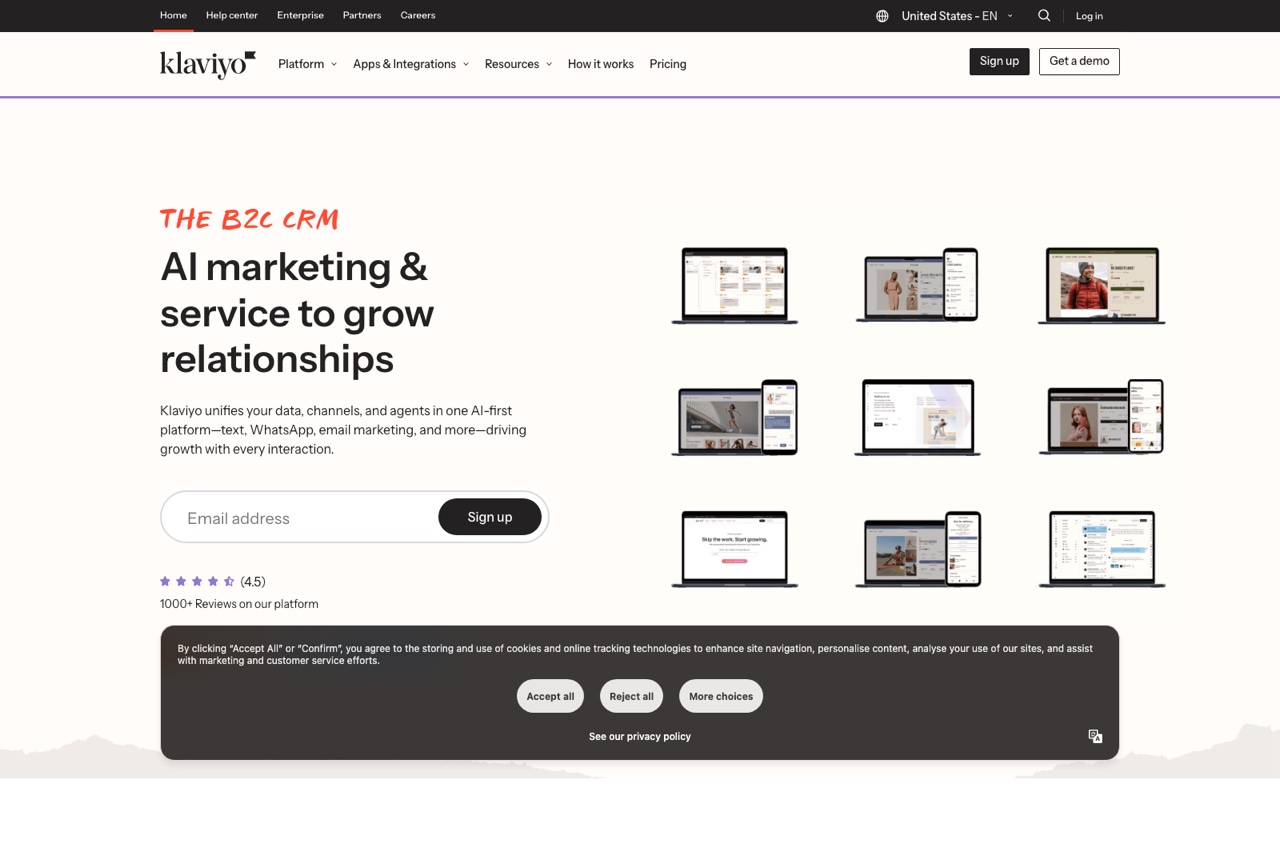
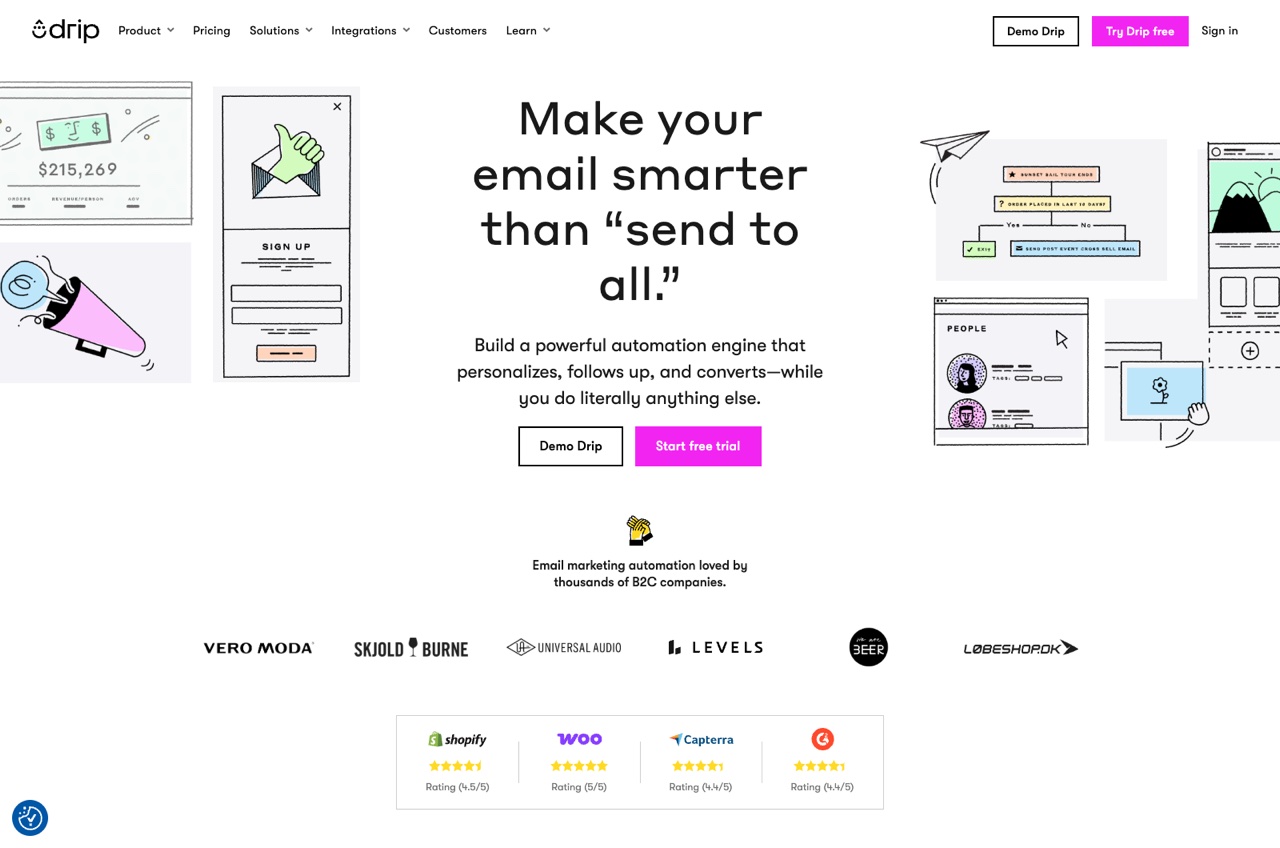
At a glance
| Klaviyo | Drip | |
|---|---|---|
| Billing unit | Active profiles | Active people |
| Free plan | Yes, 250 active profiles and 500 emails a month | No, 14-day trial |
| Entry paid price | $20/month at 500 profiles (Email plan) | $39/month up to 2,500 people |
| Price at 10K | $150/month | $154/month |
| Sending | Plan allowance by tier | Unlimited up to 30K people, capped above |
| SMS | Add-on to Email and Marketing plans | Separate usage-based SMS billing, from $39/month |
| Workflows | Flows across email, SMS, push and more | Up to 50 workflows on the current package |
| Best fit | Stores using several Klaviyo products together | Stores that want focused email at a flatter price |
Sources: Klaviyo pricing, Drip pricing and Drip SMS billing, checked 14 November 2026.
Klaviyo vs Drip pricing at real list sizes
Both vendors bill on contacts, but they count them differently. Klaviyo bills on active profiles, which are people you can email or text, and suppressing a profile is what removes it from the count. Drip bills on active people. In both cases, a cleaner list costs less.
| Contacts | Klaviyo Email | Drip |
|---|---|---|
| 1,000 | $30 | $39 |
| 10,000 | $150 | $154 |
| 50,000 | $720 | $699 |
| 100,000 | $1,380 | $1,199 |
Monthly list prices in USD before tax and SMS, from the live selectors, checked 14 November 2026. Drip's figure at 1,000 is its 2,500-person entry tier.
Where Drip becomes cheaper
At 1,000 contacts Klaviyo is $9 a month cheaper, and below 250 profiles it is free. At 10,000 the two are within $4 of each other. Past that point the gap opens in Drip's favor: $21 a month at 50,000, and $181 a month at 100,000, which is $2,172 a year.
So the crossover sits just above 10,000 contacts. If your list is growing quickly, model the bill at the size you expect in 12 months rather than today. Our Klaviyo pricing guide and the Klaviyo pricing calculator show every Klaviyo tier, and the Drip pricing guide lists every Drip tier with its sending cap.
The sending cap matters at 50K
Drip's displayed tiers include unlimited email up to 30,000 people. Above that, each tier has a monthly send allowance: 600,000 emails at 50,000 people and 1.2 million at 100,000. A store sending eight full-list campaigns a month at 50,000 contacts uses 400,000 sends before any flow emails go out. Check your real monthly volume before treating Drip's lower price as a straight saving.
Klaviyo's Email plan also includes a monthly email allowance tied to the profile tier. Look at the number shown in its selector for your tier.
Shopify and WooCommerce integrations
Klaviyo's Shopify integration syncs customers, orders, products, checkouts and on-site activity, and it supports the full set of ecommerce triggers. Klaviyo also has a WooCommerce integration and hundreds of other apps in its directory.
Drip's pricing page lists store integrations, dynamic segments, onsite campaigns and revenue reporting in its single package. It supports Shopify and WooCommerce. As with any integration, install it on a test store and confirm the specific events you need: checkout started, order placed, order fulfilled, product viewed.
For a Shopify store, both will work. The deciding question is usually whether you need the extra data Klaviyo collects, such as predicted next order date and churn risk, or whether purchase history and cart events are enough.
Ecommerce flows side by side
Both tools ship pre-built ecommerce flows. Here is how the standard set lines up.
| Flow | Klaviyo | Drip |
|---|---|---|
| Welcome series | Yes | Yes |
| Abandoned checkout | Yes | Yes |
| Abandoned cart (added to cart) | Yes, with on-site tracking | Yes, with on-site tracking |
| Browse abandonment | Yes | Yes |
| Post-purchase / thank you | Yes | Yes |
| Win-back | Yes | Yes |
| Replenishment | Yes, can use predicted timing | Yes, with timed delays |
| Price drop and back in stock | Yes | Check current templates |
Klaviyo's flow builder is richer in conditional splits that use predicted values. Drip's workflow builder is visual and straightforward, and its current package allows up to 50 workflows. Most stores run fewer than 15 live flows, so that limit rarely bites. Our Shopify email flows guide covers which flows to build first and what timing to use.
Segmentation
Klaviyo segments can combine profile properties, events, purchase history and its predictive fields: predicted customer lifetime value, expected date of next order and churn risk. Those need enough order history to work, so a newer store may not see them populated.
Drip segments use tags, custom fields, events and purchase data. You can build "bought product X but not Y in the last 90 days" without much trouble. You won't get Klaviyo-style predictions out of the box.
If you have a large, mature customer base and a team that will use predictive segments, Klaviyo wins here. If your segmentation is built on purchase behavior and tags, the two are close.
Email builder and templates
Both have a drag-and-drop editor with product blocks that pull from your catalog. Klaviyo's template library is larger, and it has AI writing and image tools built into the editor. Drip's editor is simpler and quicker to learn. If several people write, design and approve each campaign, test how each editor handles that review step during the trial.
SMS
Klaviyo sells SMS and MMS as an add-on to its Email and Marketing plans, and its free plan includes a small monthly credit. Drip's SMS billing guide describes a separate usage-based tier system starting at $39 a month, based on SMS subscribers and message segments, with eligibility conditions. If SMS is central to your plan, Klaviyo's offering is the more established of the two. Price both for your actual send volume.
Reporting and revenue attribution
Both attribute revenue to campaigns and flows. Klaviyo's attribution window and model are configurable, and its reporting goes further into cohort and benchmark views. Drip's revenue reporting covers per-email and per-workflow revenue. Whichever you pick, set the attribution window yourself and keep it fixed when comparing months, or your numbers will drift.
Support
Support levels differ by plan on Klaviyo, so check what the Free and Email plans include on its pricing page before relying on chat. Drip sells one package, so there is no plan choice to make, and its help center documents the setup steps. Ask both vendors how they handle an urgent deliverability problem during a sale, because that is the support you will actually need.
Migrating between Klaviyo and Drip
Moving in either direction follows the same order:
- Export profiles or people with consent status, tags, custom fields and suppression lists.
- Import suppressions first, so nobody who unsubscribed gets mailed.
- Connect the store integration and let historical orders sync before building segments.
- Rebuild flows one at a time, starting with abandoned checkout and welcome.
- Run both tools in parallel for a week with the old flows paused, then cancel.
Flows do not transfer between vendors. Write each flow down as trigger, filters, waits and emails before you start. Our Drip migration guide and Klaviyo migration guide list the exports for each platform.
A third option for Shopify stores: Audienceful
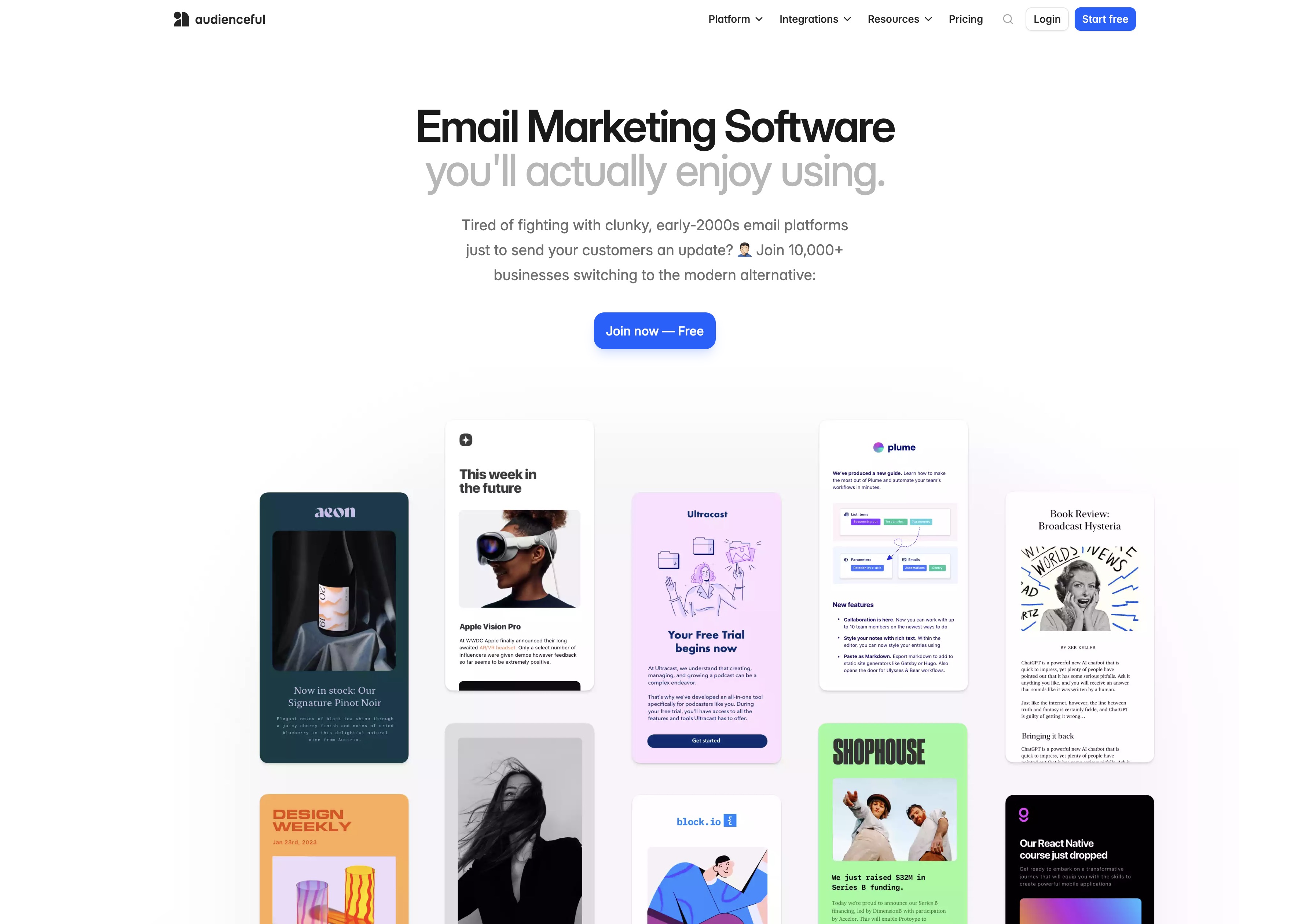
If the comparison above leaves you wanting Klaviyo's flow library at a price closer to neither, Audienceful is worth a test. It installs from the Shopify App Store and syncs customers, orders, checkouts and storefront product views. The Shopify automation templates cover abandoned checkout, browse abandonment, added to cart, welcome, post-purchase, review request, replenishment, VIP and win-back, each with the trigger already set.
Revenue attribution credits paid Shopify orders to the flow or campaign that drove them, using last click within five days with refunds netted out. The AI agent can draft a campaign, build a segment or set up a paused flow from a short brief, and the MCP server gives outside agents the same access. The collaborative editor lets several people work on one email at once, and the templates come from leading ecommerce agencies.
| Contacts | Klaviyo Email | Drip | Audienceful Essentials (yearly) | Audienceful Growth (yearly) |
|---|---|---|---|---|
| 1,000 | $30 | $39 | Free plan | Free plan |
| 10,000 | $150 | $154 | $79 | $118 |
| 50,000 | $720 | $699 | $272 | $309 |
| 100,000 | $1,380 | $1,199 | n/a | $499 |
Audienceful prices from our pricing page, checked 14 November 2026. Essentials includes three automated flows and is $99 billed monthly at 10K. Growth includes unlimited automations and is $140 billed monthly at 10K. Both are below Klaviyo and Drip at 10K on either billing term.
For WooCommerce stores, connect through Zapier or the API. See Audienceful vs Klaviyo and Audienceful vs Drip for feature-by-feature detail, and our Klaviyo alternatives list for more options. The migration help guide covers the import.
Related guides: moving from Drip to Klaviyo and our Drip review.
FAQs
Is Drip cheaper than Klaviyo?
Below 10,000 contacts, no. Klaviyo is $30 at 1,000 profiles against Drip's $39 entry tier, and the two are $150 and $154 at 10,000. Above that, Drip is cheaper: $699 against $720 at 50,000 and $1,199 against $1,380 at 100,000, checked 14 November 2026.
Does Drip have a free plan?
No. Drip offers a 14-day trial without a credit card, and sending is limited during the trial. Klaviyo has a permanent free plan for up to 250 active profiles and 500 emails a month.
Does Drip support SMS?
Yes, through a separate usage-based SMS billing system that starts at $39 a month and depends on SMS subscribers and message segments. Drip's help center lists the eligibility conditions.
Which is better for Shopify?
Both integrate well with Shopify and run the standard flows. Klaviyo collects more data and adds predictive fields. Drip is simpler and cheaper above about 10,000 contacts. If you want the standard store flows for less than either, Audienceful is a third option.
Can I migrate flows from Drip to Klaviyo?
Not directly. You export people, tags, fields and suppressions from Drip, import them into Klaviyo, then rebuild each workflow as a Klaviyo flow. Rebuild abandoned checkout and welcome first, and keep the Drip versions paused until the new ones are tested.
What's the best alternative to both?
For Shopify stores, Audienceful runs the same core flow set with revenue attribution and an AI agent for $79 a month billed yearly at 10,000 contacts. Omnisend and Shopify Messaging are also worth a look depending on how much you need.
Want the full Shopify flow set for $79 a month at 10,000 contacts? Start a free 14-day Growth trial, no card needed, and switch on abandoned checkout first.
