The best email marketing for supplement brands is the one that sends the reorder email a few days before the bottle runs out, and stops sending it to people on a subscription. For Shopify supplement and vitamin brands, Audienceful is our pick for replenishment on native order data with revenue per flow; Klaviyo leads once you have enough order history for predicted reorder dates, and Drip, Omnisend, MailerLite, Brevo and Seguno suit narrower setups. Whichever you choose, the copy carries legal risk that no platform removes, so we include a claims checklist below.
We make Audienceful and list it first. Prices were checked on 14 November 2026 against vendor pricing pages. Screenshots come from our competitor library and show vendor websites. Nothing here is legal advice.
Best email marketing for supplement brands: Best for use case
| Platform | Best for use case | What to check first |
|---|---|---|
| Audienceful | Shopify supplement brands under about 50K contacts that run on replenishment | Serving counts per SKU and how subscription status reaches the platform |
| Klaviyo | Brands with years of order data that want predicted reorder dates | The data thresholds for predictions and the active-profile bill |
| Drip | Education-heavy brands with long nurture sequences | Price above 10K contacts |
| Omnisend | Brands that want SMS reorder nudges alongside email | Standard send cap and SMS budget |
| MailerLite | Small brands that mostly send content and a simple reorder email | Depth of Shopify order triggers |
| Brevo | Large lists emailed a few times a month | Monthly send volume |
| Seguno | Shopify-only brands that want everything in the admin | Segmentation beyond Shopify customer data |
What supplement brands need from an email platform
Supplements are the cleanest replenishment category there is. Every bottle has a serving count and a daily dose printed on it, so you know when it runs out. The program lives or dies on a few things:
- Replenishment by serving count. A 30-day tub and a 90-day bottle need separate reminders. You need product-scoped triggers and delays you set per SKU.
- Subscription awareness. Subscribe-and-save customers should never get a "time to reorder" email. Your ESP must know who is on a subscription, which usually means data from Recharge, Skio or Loop.
- Education sequences. "How to take magnesium" and "what to expect in week three" keep people taking the product long enough to notice a difference, which is what drives the second order.
- Goal-based segments. Sleep, energy, gut health and training buyers want different content and cross-sells.
- Compliance-safe copy. The FTC and FDA rules on health claims apply to email exactly as they do to your product page.
The subscription businesses page and our subscription ecommerce roundup cover the subscription side in more depth.
How we chose
Each tool was scored on how it times reorders (fixed delay per product, or predicted per customer), how it learns about subscriptions, and how well it segments by product bought. Prices are at 10,000 contacts from vendor pages, checked 14 November 2026.
Audienceful: replenishment on native Shopify order data
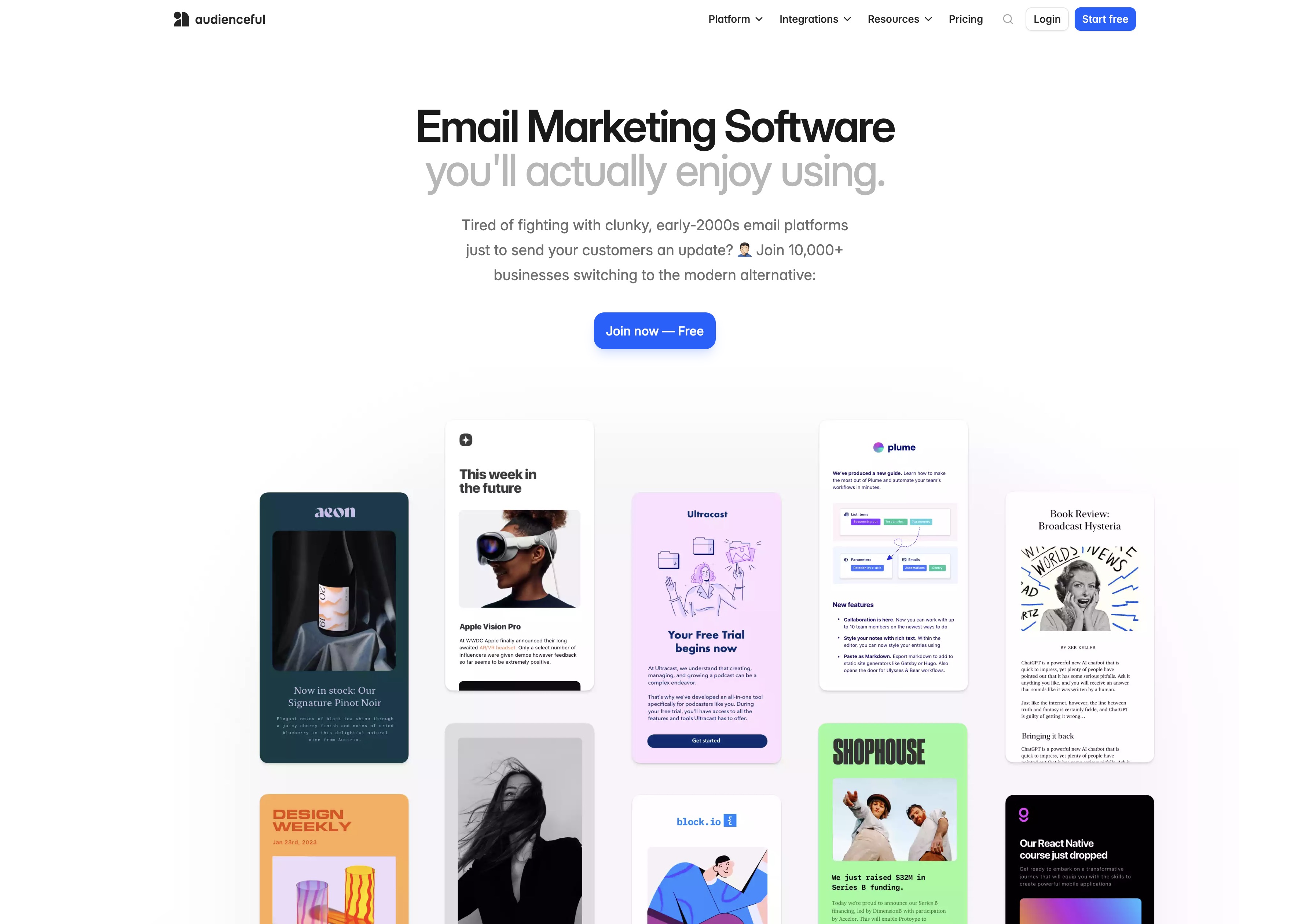
Audienceful's Shopify app syncs orders, products and customers, with a historical import so a replenishment condition sees last quarter's buyers too. The replenishment flow triggers on a paid order. Set the wait to the SKU's run-out day minus your shipping buffer, then add a branch that checks "purchased this product in the last 20 days" and exits anyone who already reordered.
For subscription status, send events from Recharge, Skio or Loop as custom events, or keep a "subscriber" field updated, and exclude those contacts from the reorder flow. Our guide to email flows for Recharge subscriptions covers the charge reminders and save flows those subscribers need instead. Native Stripe data covers brands that bill subscriptions there directly.
Segments read purchases by product with a time window, so "bought the sleep stack, hasn't bought magnesium" is two conditions. The AI agent drafts education emails in your brand voice and builds segments from a plain sentence. Review every claim it writes against the checklist below, as you would with any copywriter. Revenue attribution shows what the replenishment flow earned against the welcome series, and deliverability monitoring watches bounce and complaint rates as the list grows.
- Best for: Shopify supplement brands under about 50K contacts that run on replenishment and education.
- Starting price at 10K contacts: Growth is $118/month billed yearly with unlimited flows, against Klaviyo's $150 and Drip's $154. Essentials is $79 billed yearly with three flows, enough for welcome, checkout and replenishment.
- Ecommerce integrations: native Shopify and Stripe; subscription apps through custom events or field updates.
- Automation depth: branching flows, product-scoped conditions, goals and custom-event triggers.
- One drawback: subscription-app events need mapping on day one, so budget an hour with your subscription app's webhook settings.
See Audienceful vs Klaviyo for a plan-level comparison.
Klaviyo: for brands with enough history to predict reorders
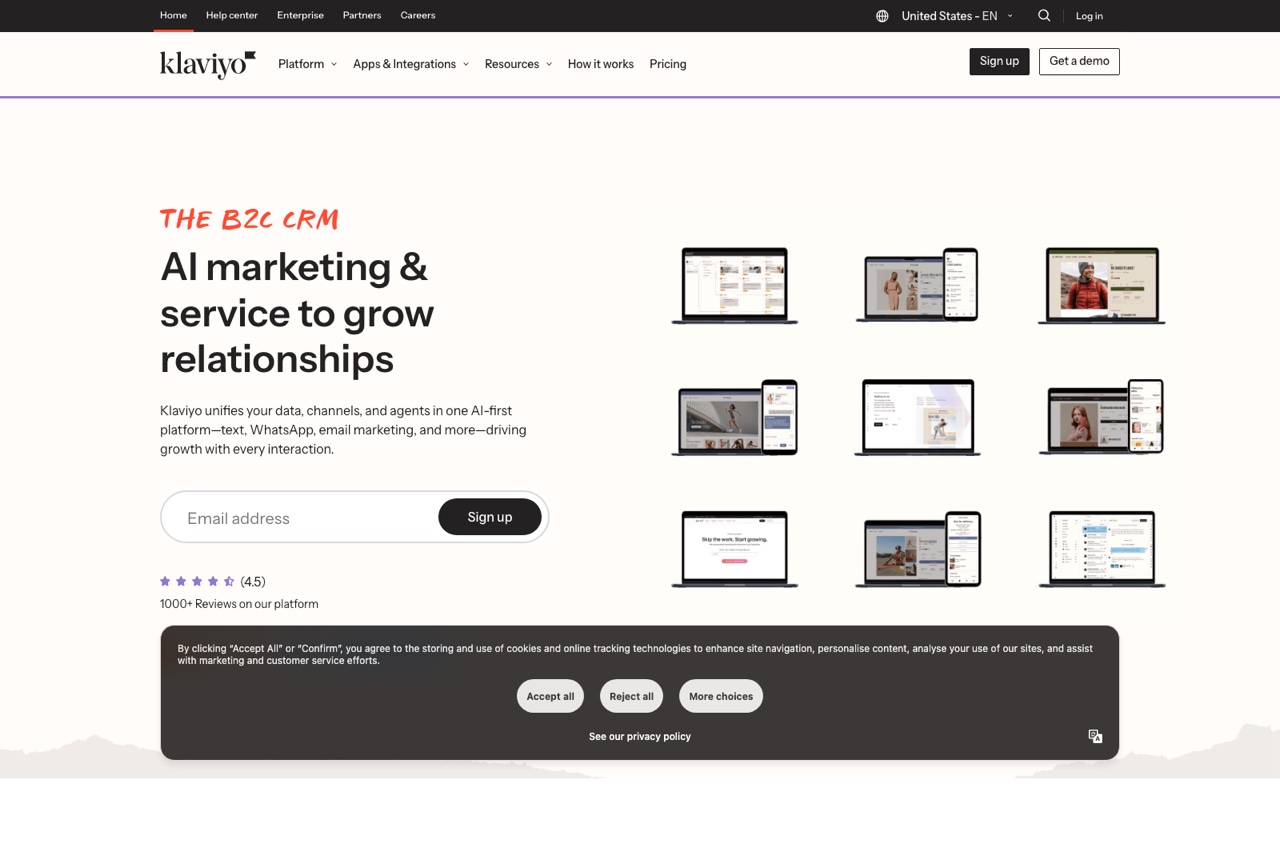
Klaviyo's predictive analytics include an expected date of next order for each customer. For a supplement brand selling one SKU at one dose, a fixed delay does nearly as well. Predictions help more when customers take two capsules some weeks and one in others, or buy several products. They need at least 500 customers with orders, 180 days of history, orders in the last 30 days and some customers with three or more orders.
Klaviyo has documented integrations with Recharge and Skio, per Recharge's guide and Skio's guide.
- Best for: established supplement brands with large order histories and subscription apps already wired up.
- Starting price at 10K contacts: $150/month on the Email plan, per its pricing page.
- Ecommerce integrations: Shopify plus documented subscription-app integrations.
- Automation depth: extensive, with predictive properties in flow branches.
- One drawback: $720/month at 50K and $1,380 at 100K on active-profile billing.
Our Klaviyo pricing guide breaks the bill down.
Drip: for education-heavy brands
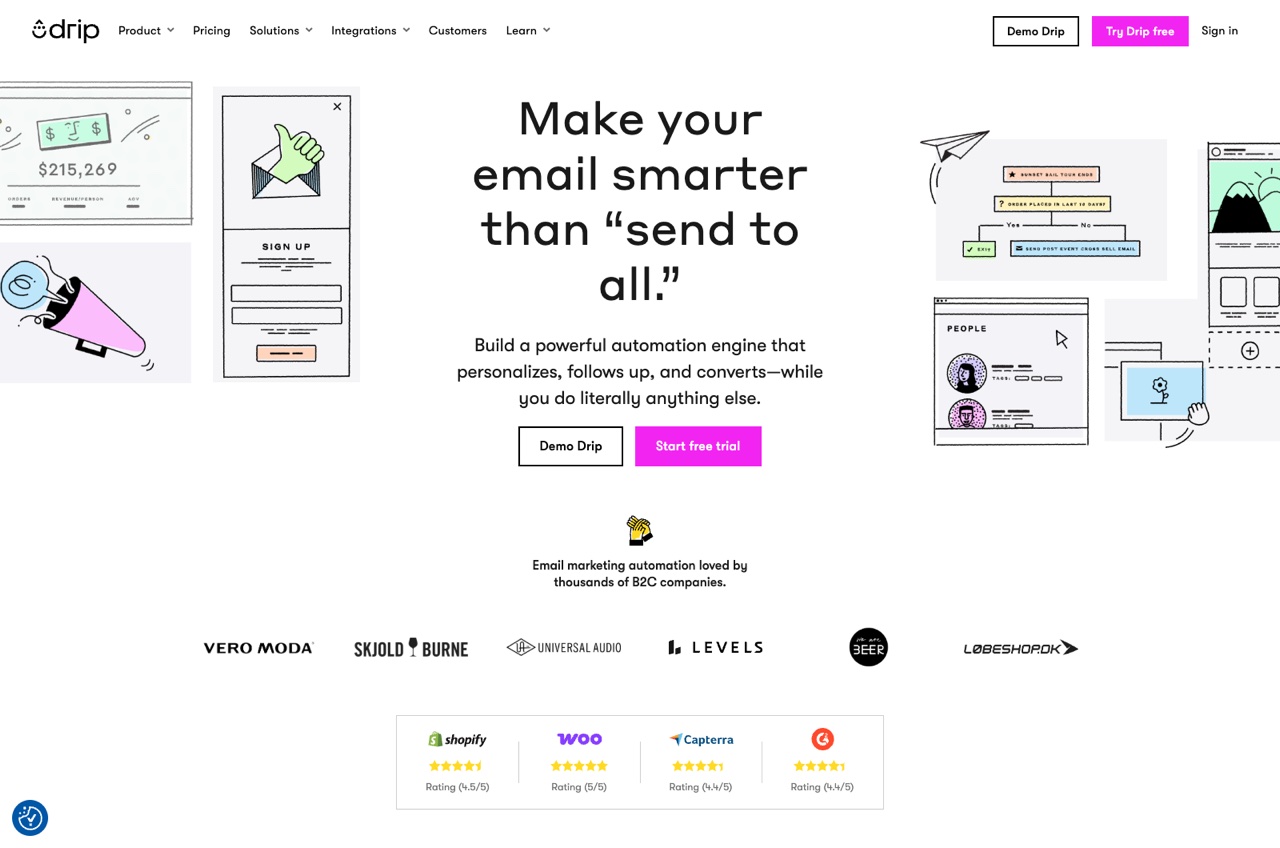
Drip is good at long branching sequences, which suits a brand whose welcome is a ten-email course on gut health. Its pricing page lists ecommerce workflows and revenue reporting.
- Best for: smaller brands that sell through education.
- Starting price at 10K contacts: $154/month; entry is $39 for up to 2,500 people.
- Ecommerce integrations: Shopify and WooCommerce; check your subscription app's route.
- Automation depth: strong visual workflows with goals and branches.
- One drawback: $699/month at 50K, steep for brands with many one-time trial buyers.
Omnisend: for SMS reorder nudges alongside email
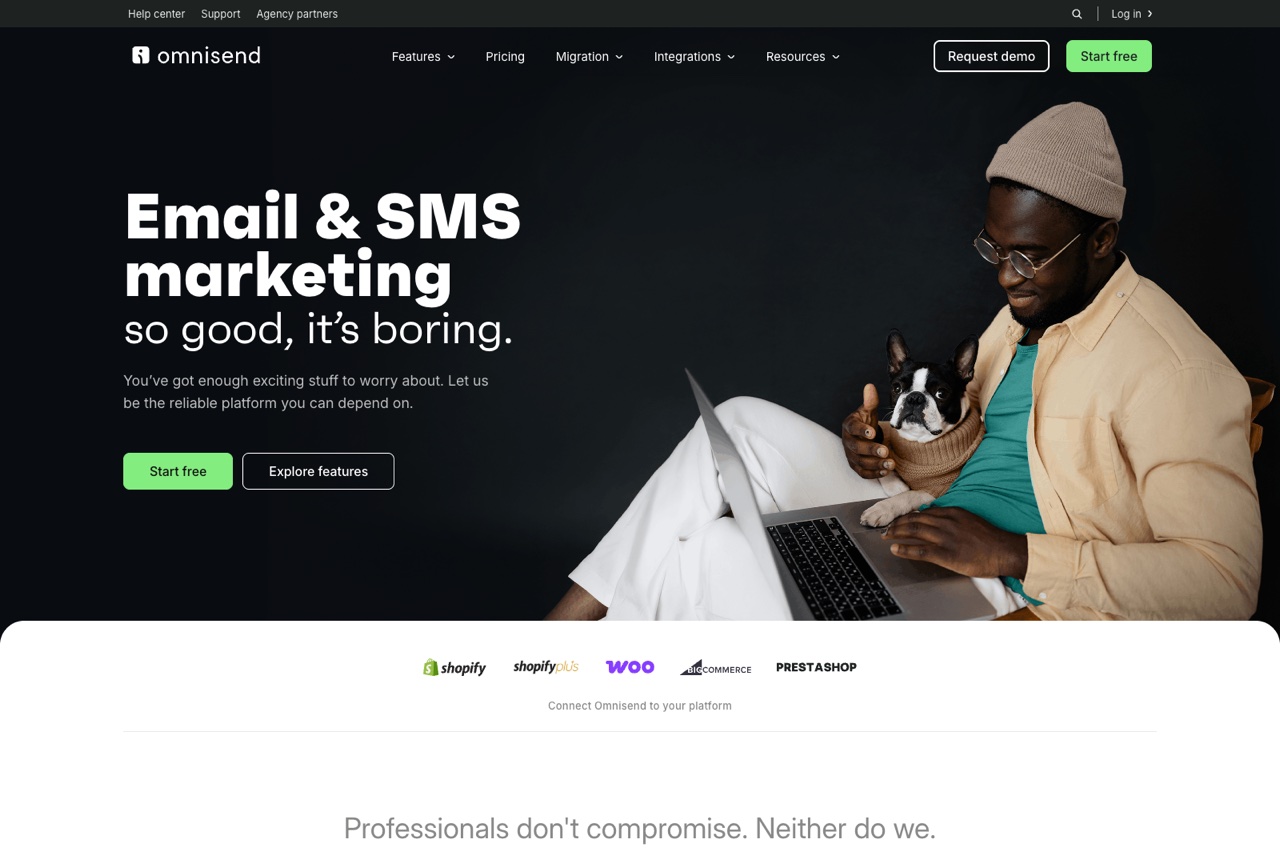
Omnisend bundles SMS on its Pro plan, and a reorder text a few days after the email does well for a product people take daily. Skio documents an Omnisend integration.
- Best for: supplement brands that want SMS reorder reminders in the same tool.
- Starting price at 10K contacts: $132/month Standard or $150 Pro, per the pricing page.
- Ecommerce integrations: Shopify, WooCommerce and BigCommerce, plus subscription-app partners.
- Automation depth: prebuilt ecommerce workflows with splits.
- One drawback: SMS health claims fall under the same rules as email, in far fewer characters, so copy review takes longer.
MailerLite: for small brands that mostly send content
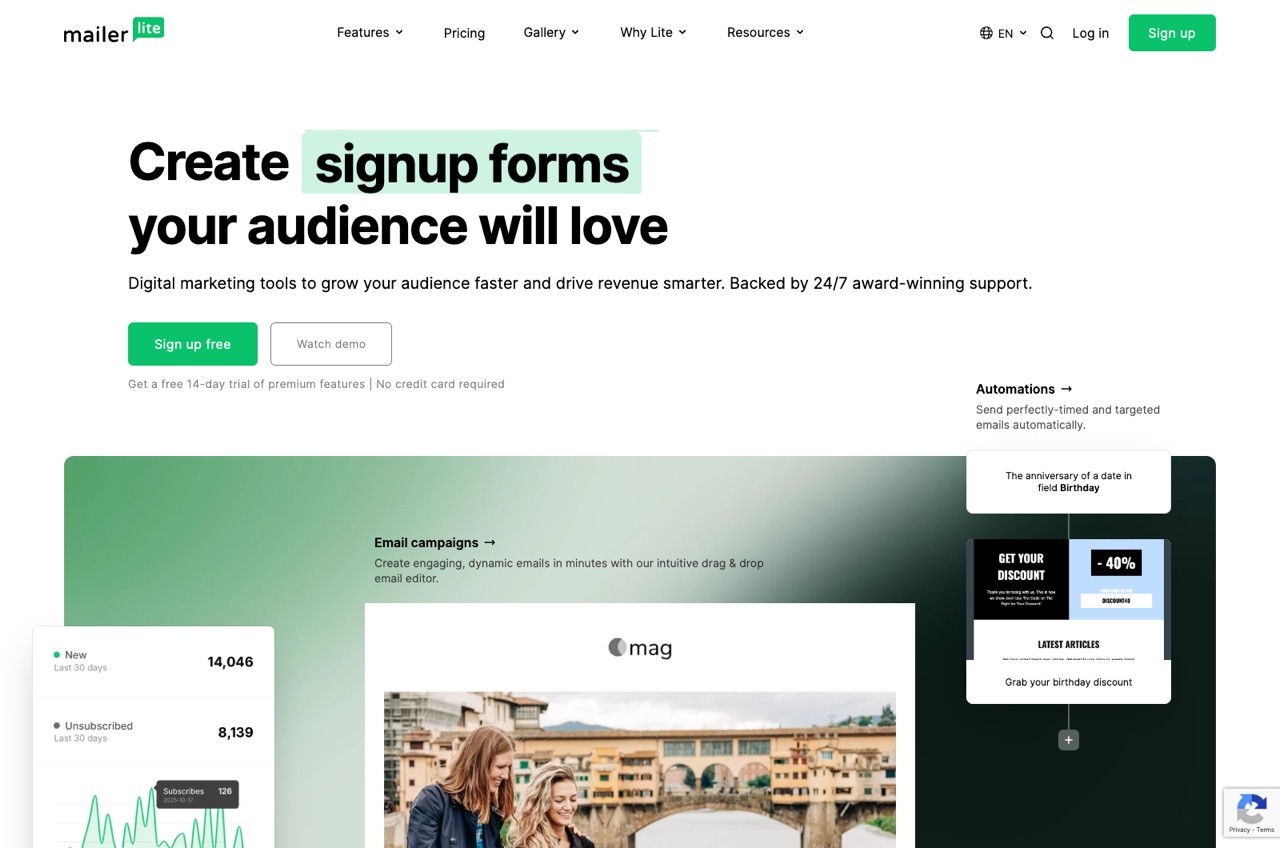
MailerLite is a clean, inexpensive tool for a brand whose list is mostly readers of a wellness newsletter. Its pricing page lists Shopify, WooCommerce and Stripe connections, and the Comfort plan includes 50 active automations.
- Best for: early supplement brands where content is the main channel.
- Starting price at 10K contacts: $89/month on Comfort, or $80.10 billed yearly.
- Ecommerce integrations: Shopify, WooCommerce and Stripe.
- Automation depth: solid for welcome and simple purchase triggers.
- One drawback: per-SKU replenishment with reorder exits and subscription exclusions takes more manual work than in a store-first platform.
Brevo: for big lists emailed a few times a month
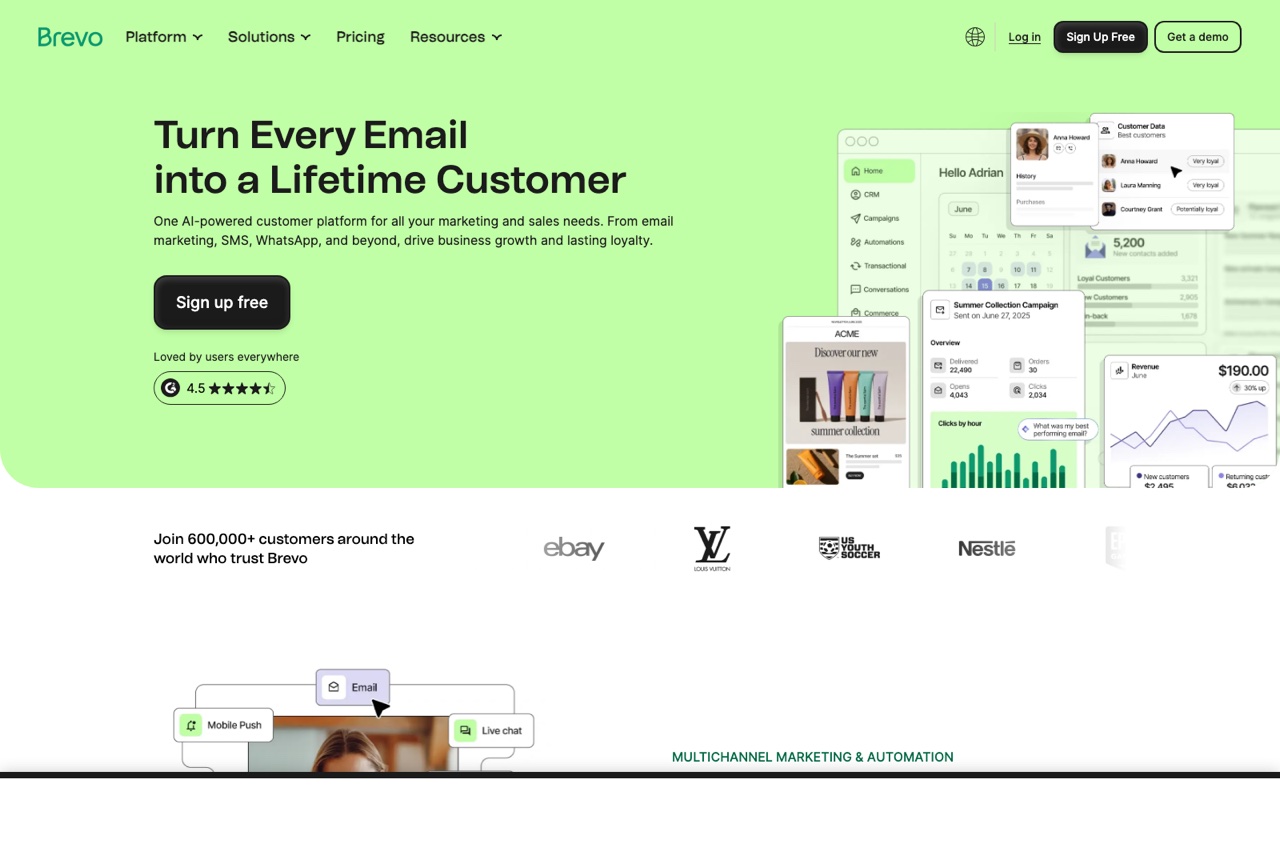
Brevo prices by monthly sends, so a 60,000-contact list emailed twice a month can come in under contact-priced tools. Its pricing page lists Standard from $18 at entry volume, with multi-step automations.
- Best for: supplement brands with a large, low-frequency list.
- Starting price at 10K contacts: set by monthly sends; request the Standard quote.
- Ecommerce integrations: Shopify and WooCommerce apps in its directory.
- Automation depth: multi-step workflows on Standard.
- One drawback: per-SKU reorder flows with subscription exclusions need careful setup.
Seguno: for Shopify-only brands that want to stay in the admin
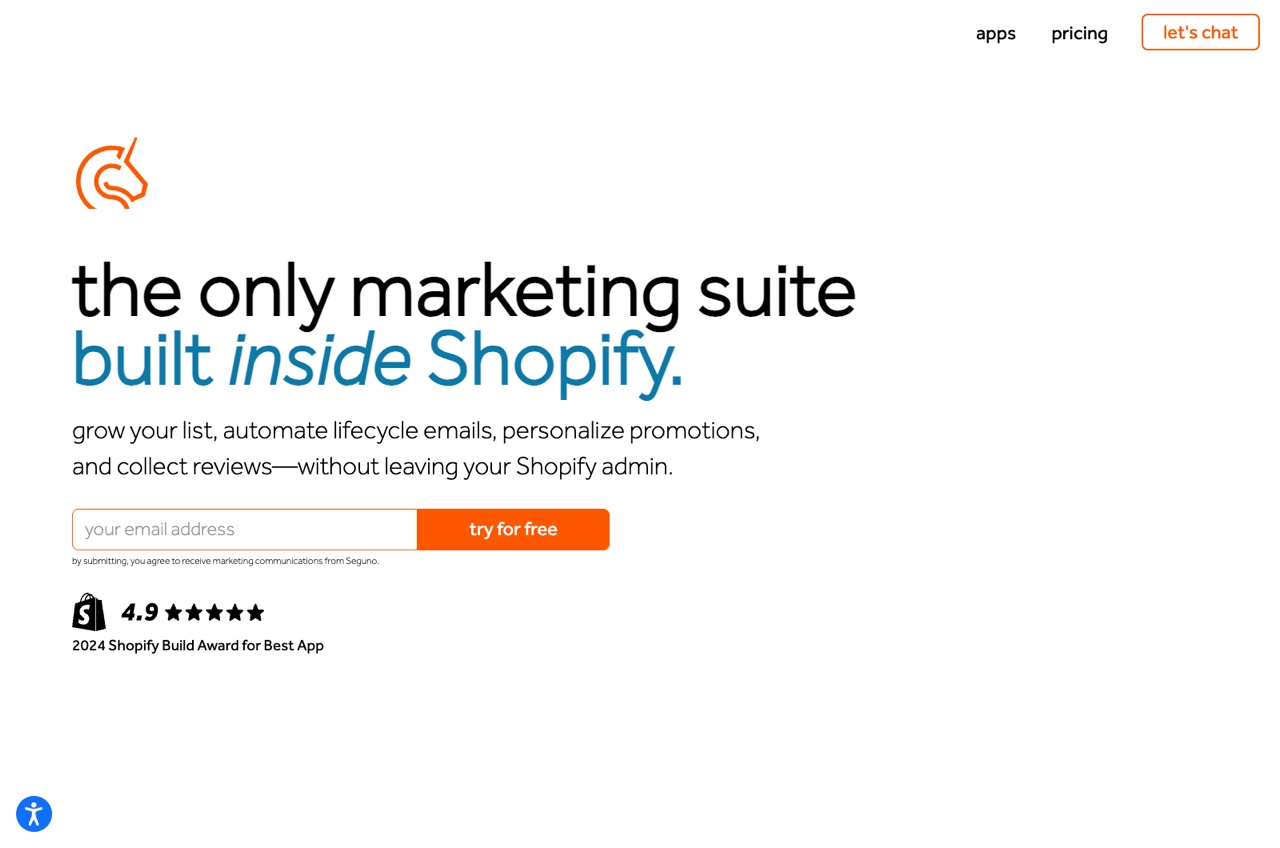
Seguno lives inside Shopify and bills there. Its billing doc sets $35 for up to 2,500 subscribers plus $20 for each further 2,500, with unlimited sending.
- Best for: small Shopify supplement brands that want one admin.
- Starting price at 10K contacts: $95/month by its published tier rule.
- Ecommerce integrations: Shopify only.
- Automation depth: prebuilt and custom multi-email automations.
- One drawback: subscription-app status is harder to bring in than in a platform with custom events.
Price comparison at the same list sizes
USD per month, checked 14 November 2026, regular monthly billing unless marked.
| Platform and plan | 1,000 contacts | 10,000 contacts | 50,000 contacts | 100,000 contacts |
|---|---|---|---|---|
| Klaviyo Email | $30 | $150 | $720 | $1,380 |
| Drip | $39 | $154 | $699 | $1,199 |
| Omnisend Standard | $20 | $132 | $413 | $900 |
| MailerLite Comfort, yearly | See selector | $80.10 | $287.10 | See selector |
| Brevo Standard | Priced by sends | Priced by sends | Priced by sends | Priced by sends |
| Seguno | $35 | $95 | $415 | $815 |
Seguno's larger rows apply its published tier rule. Sources: Klaviyo, Drip, Omnisend, MailerLite, Brevo, Seguno.
Against the store-first platforms most supplement brands shortlist, Audienceful Growth is $118 at 10K, $309 at 50K and $499 at 100K per month billed yearly, compared with Klaviyo's $150, $720 and $1,380.
Replenishment timing: the formula
Days the product lasts = servings in the container ÷ servings taken per day. Send the reminder on that day minus 5 to 7 days, so a reorder ships before she runs out. Add a second nudge 4 days later if she hasn't ordered.
Worked example: 60 capsules, two a day, lasts 30 days. Send the reminder on day 23 to 25, and the follow-up on day 27 to 29.
| Container | Daily dose | Lasts | First reminder | Second reminder |
|---|---|---|---|---|
| 60 capsules | 2 | 30 days | Day 24 | Day 28 |
| 90 capsules | 3 | 30 days | Day 24 | Day 28 |
| 120 capsules | 2 | 60 days | Day 53 | Day 57 |
| 30-serving powder tub | 1 scoop | 30 days | Day 24 | Day 28 |
| 60 gummies | 2 | 30 days | Day 24 | Day 28 |
| 180 tablets | 1 | 180 days | Day 172 | Day 176 |
Two adjustments: multiply by quantity for multi-bottle orders, and check real reorder days after 90 days. People skip doses. If your median repeat order lands on day 36 for a 30-day product, move the reminder later.
The 7 flows every supplement brand should run
| Flow | Trigger | Timing |
|---|---|---|
| Welcome and goal quiz | Signup | Immediately, goal-based recommendation day 2, social proof day 4 |
| Education drip | First order paid | Day 1 how to take it, day 7 what to expect, day 14 habit tips |
| Abandoned checkout | Checkout started | 1 hour, 24 hours, 72 hours |
| Post-purchase how-to-take | Order fulfilled | Day of delivery: dose, timing, with or without food |
| Replenishment | Paid order for a SKU, not on subscription | Per the formula above, then a subscribe-and-save offer |
| Review request | Order fulfilled | Day 30 to 45, once results are plausible |
| Win-back | No order for 2x the product's run-out window | Day 60 for a 30-day product, then day 75 |
Our guides on Shopify welcome emails, replenishment emails and win-back emails go further.
Compliance checklist for supplement emails
This is a high-level checklist, not legal advice. Have counsel review your claims.
- Stick to structure/function claims. "Supports restful sleep" is a structure/function claim. "Treats insomnia" is a disease claim that supplements can't make. See the FDA's structure/function claims page.
- Carry the DSHEA disclaimer where you make those claims. The FDA's labeling guide on claims sets the wording, which you can't modify. Put it in the email footer template so no campaign ships without it.
- Have evidence for every claim before you send. The FTC's Health Products Compliance Guidance expects competent and reliable scientific evidence, usually human clinical trials, for health claims in any ad, email included.
- Use testimonials carefully. A customer saying "this cured my anxiety" in your email is your claim. The FTC's endorsement guidance also says you can't make a discount conditional on a positive review.
- Review AI drafts like any other copy. Any AI writer, ours included, can produce a claim you can't support. Keep an approved-claims list and check against it.
FAQs
When should a supplement brand send replenishment emails?
Five to seven days before the product runs out. Divide servings by daily dose to get the run-out day, then subtract the buffer. A 60-capsule bottle at two a day lasts 30 days, so send on day 23 to 25.
What claims can supplement brands make in emails?
Structure/function claims such as "supports immune function", backed by evidence and carrying the FDA disclaimer. Not disease claims such as "prevents colds". The FDA and FTC pages linked above are the starting point, and a regulatory lawyer is the finish line.
Is Klaviyo worth it for a small supplement brand?
Its predicted reorder dates need 500 customers with orders and 180 days of history before they switch on. Below that you are paying $150/month at 10K for fixed-delay replenishment that cheaper platforms also run.
How often should supplement brands email?
Two to four campaigns a month suits most brands, plus the flows. Education content can run weekly if it's genuinely useful.
How do I email subscribers vs one-time buyers differently?
Keep subscription status in a contact field or event from your subscription app. One-time buyers get replenishment and subscribe-and-save offers. Subscribers get education, upcoming-charge notices from the subscription app, and cross-sells, never a reorder reminder.
Selling supplements on Shopify? Open a free Audienceful account and turn on the replenishment flow for your store. Free to 1,000 contacts, with a 14-day Growth trial and no card required.
