The best email marketing for beauty brands is a platform that knows what each customer bought, in what size, and when, so it can time the reorder before the bottle runs dry. For most Shopify skincare and cosmetics brands that means Audienceful, Klaviyo or Omnisend, with Drip, Mailchimp, Brevo and Flodesk fitting narrower needs. Pick on replenishment timing and sample-to-full-size support first, then compare the bill at your actual list size.
We make Audienceful and put it first. Prices below were checked on 14 November 2026 against each vendor's own pricing page. Screenshots come from our competitor library and show each vendor's website, not a flow builder or billing screen.
Best email marketing for beauty brands: Best for use case
| Platform | Best for use case | What to check first |
|---|---|---|
| Audienceful | Shopify beauty brands that want replenishment and post-purchase flows tied to revenue | Your SKU sizes and run-out windows |
| Klaviyo | Large catalogs that want predicted next-order dates | Active-profile billing and the 500-customer threshold for predictions |
| Omnisend | Brands that want email and SMS in one store-focused tool | Standard send allowance versus Pro |
| Drip | Small teams running a few deep, content-heavy sequences | Price once the list passes 10K |
| Mailchimp | Brands that also send a large editorial newsletter | Which plan includes the flows you need |
| Brevo | Low-frequency senders with a big, quiet list | Monthly send volume, not contacts |
| Flodesk | Indie and founder-led brands with a small catalog and a strong look | Depth of Shopify order data in flows |
What a beauty brand needs from an email platform
Beauty is a repeat-purchase category with a twist. A customer buys a 30ml serum, uses two pumps a night, and runs out on a schedule you can roughly predict. She also bought it because of how it looks on a shelf and how the brand talks about ingredients. Your platform has to handle both halves. Apparel works differently, with drops and size runs instead of refills, which our guide to email marketing for fashion brands covers.
These are the jobs that matter, in rough order of revenue:
- Replenishment by product size. A 15ml eye cream and a 200ml cleanser should not share one "30 days after purchase" reminder. You need a trigger on a specific product or variant and a delay you can set per SKU.
- Sample and travel-size conversion. Discovery kits and minis are cheap acquisition. The money is in the full-size order that follows. That needs a flow that fires on the sample SKU and follows up while she is still using it.
- Routine cross-sell. Someone who bought a cleanser and a moisturizer but no SPF is a segment. So is someone who bought a retinol and no barrier cream.
- Skin type and concern data. A quiz or signup form that stores "dry, sensitive, acne-prone" in contact fields lets one campaign show different hero products to different people.
- Product blocks that pull real catalog images and prices. Beauty emails are visual, and nobody wants to rebuild a product grid by hand every launch.
- Review and UGC requests timed to results. Skincare takes weeks to show anything. A review request on day 7 asks too early.
A platform can tick all six boxes in a feature table and still be painful if the Shopify data arrives late or only covers new orders. Ask how much order history it imports on connect. Our overview of email marketing for Shopify stores covers the store data side in more detail.
How we chose
We scored each tool on the six jobs above, using the vendor's own documentation and pricing page, and we listed the price at 10,000 contacts because that is where most growing DTC beauty brands sit. Klaviyo, Omnisend and Drip were priced from their live selectors. Where a vendor prices by emails sent instead of contacts, we say so rather than inventing a contact price.
Audienceful: replenishment and post-purchase flows on native Shopify data
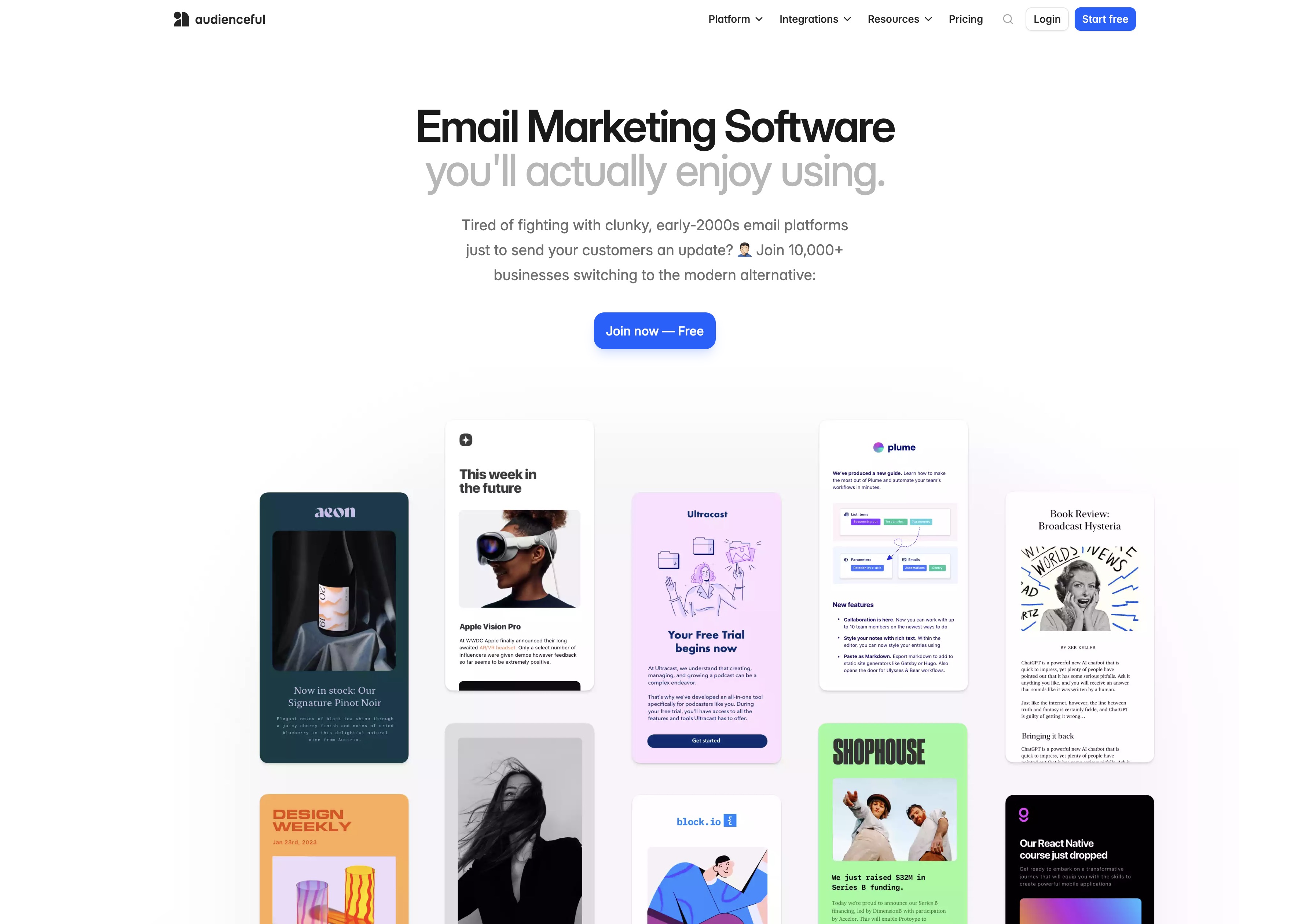
Audienceful installs from the Shopify App Store and syncs customers, orders, products, carts and checkouts, with a historical import so purchase-based segments see your past orders and not only the ones placed after you connect. The Shopify automation library includes replenishment, browse abandonment, abandoned checkout, post-purchase, review request, VIP and win-back flows you can turn on and then retime.
For a beauty brand, the useful part is that the replenishment flow triggers on a paid order and the wait is yours to set. Build one copy per size family: one for 15ml eye products, one for 30ml serums, one for 150ml cleansers. Add a condition that skips anyone who already reordered, and the reminder never lands on someone who restocked last week.
Segments read Shopify purchases by product, with time windows and negation, so "bought cleanser and moisturizer, has not bought SPF" is three conditions. The product list block pulls live images, titles and prices into the email, and a product feed of newest or best-selling items keeps launch emails current without editing.
The AI agent writes in your brand voice from your past emails and builds segments from a sentence, which is handy when you want "everyone who bought the retinol in the last 60 days and has opened in the last 30". Revenue attribution reports what each flow earned, so you can see whether the 45-day serum reminder outperforms the 60-day one. The collaborative editor lets a founder, a copywriter and a designer work on the same launch email at once, and the templates were designed by ecommerce agencies.
- Best for: Shopify beauty and skincare brands that want replenishment, post-purchase and sample flows built on real order data, with revenue per flow.
- Starting price at 10K contacts: Growth is $118/month billed yearly with unlimited flows, against Klaviyo's $150. Essentials is $79/month billed yearly with three flows. Free up to 1,000 contacts.
- Ecommerce integrations: native Shopify app with customer, order, product, cart and checkout sync, plus Stripe.
- Automation depth: branching flows, product-scoped triggers and conditions, date-based and custom-event triggers.
- One drawback: moving from Klaviyo means rebuilding each flow and retiming it per SKU, which takes an afternoon per flow if you do it properly.
See Audienceful vs Klaviyo for the side-by-side.
Klaviyo: for large catalogs that want predicted reorder dates
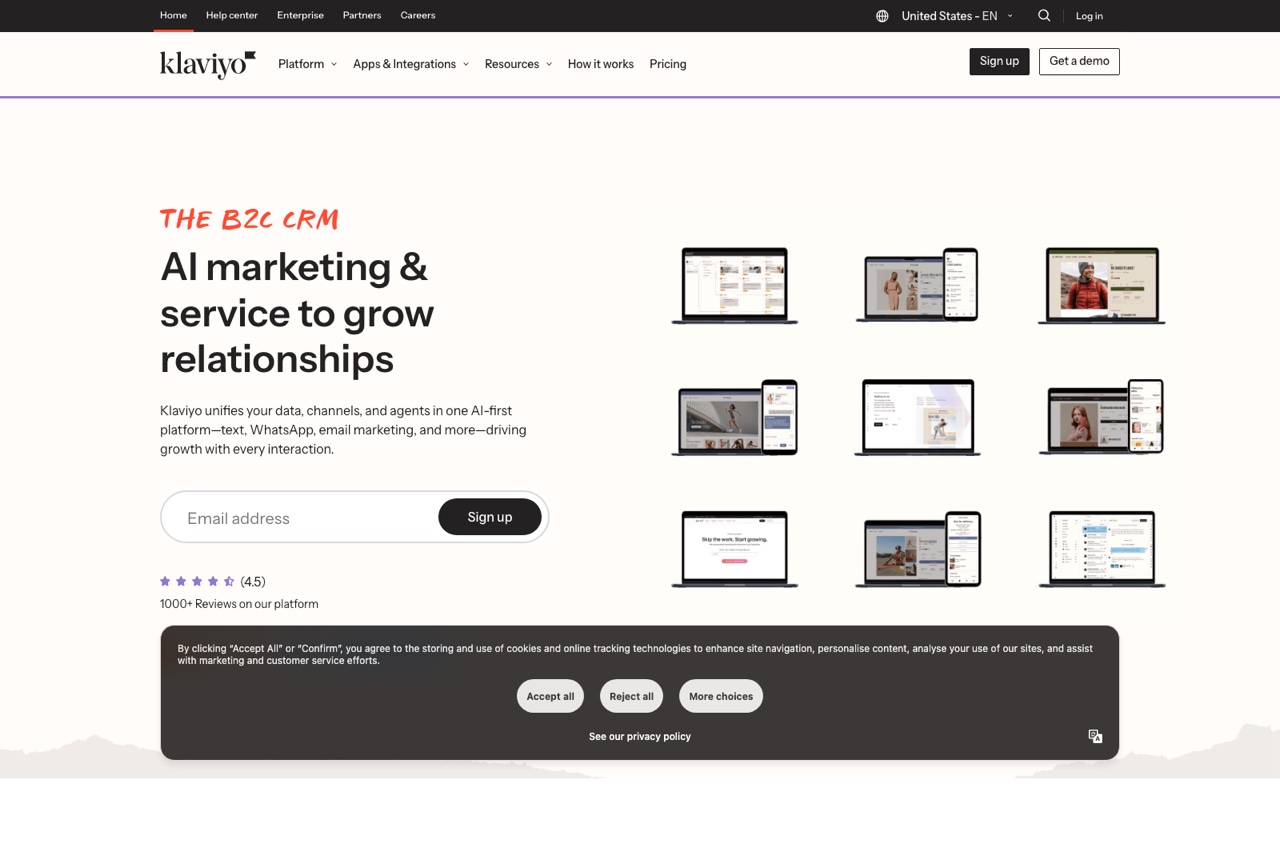
Klaviyo is the default for big Shopify beauty brands, and for good reason. Its predictive analytics include an expected date of next order per customer, which can drive replenishment off each buyer's own pattern instead of a fixed delay. That only switches on once you have at least 500 customers with orders, 180 days of order history, orders in the last 30 days and some customers with three or more orders.
Below that threshold you are setting fixed delays like everyone else. Above it, the predictions help most when one customer buys several products at different rates.
- Best for: beauty brands with large catalogs and enough order history to use predictive timing.
- Starting price at 10K contacts: $150/month on the Email plan, per the pricing page. $720 at 50K and $1,380 at 100K.
- Ecommerce integrations: deep Shopify integration plus a large app ecosystem for reviews, quizzes and loyalty.
- Automation depth: extensive, with a flow template library and predictive properties for branching.
- One drawback: the bill follows active profiles, so a big list of one-time sample buyers costs you every month whether or not you email them.
Our Klaviyo pricing breakdown and the Klaviyo pricing calculator show the cost at your list size.
Omnisend: for email and SMS from one store-focused tool
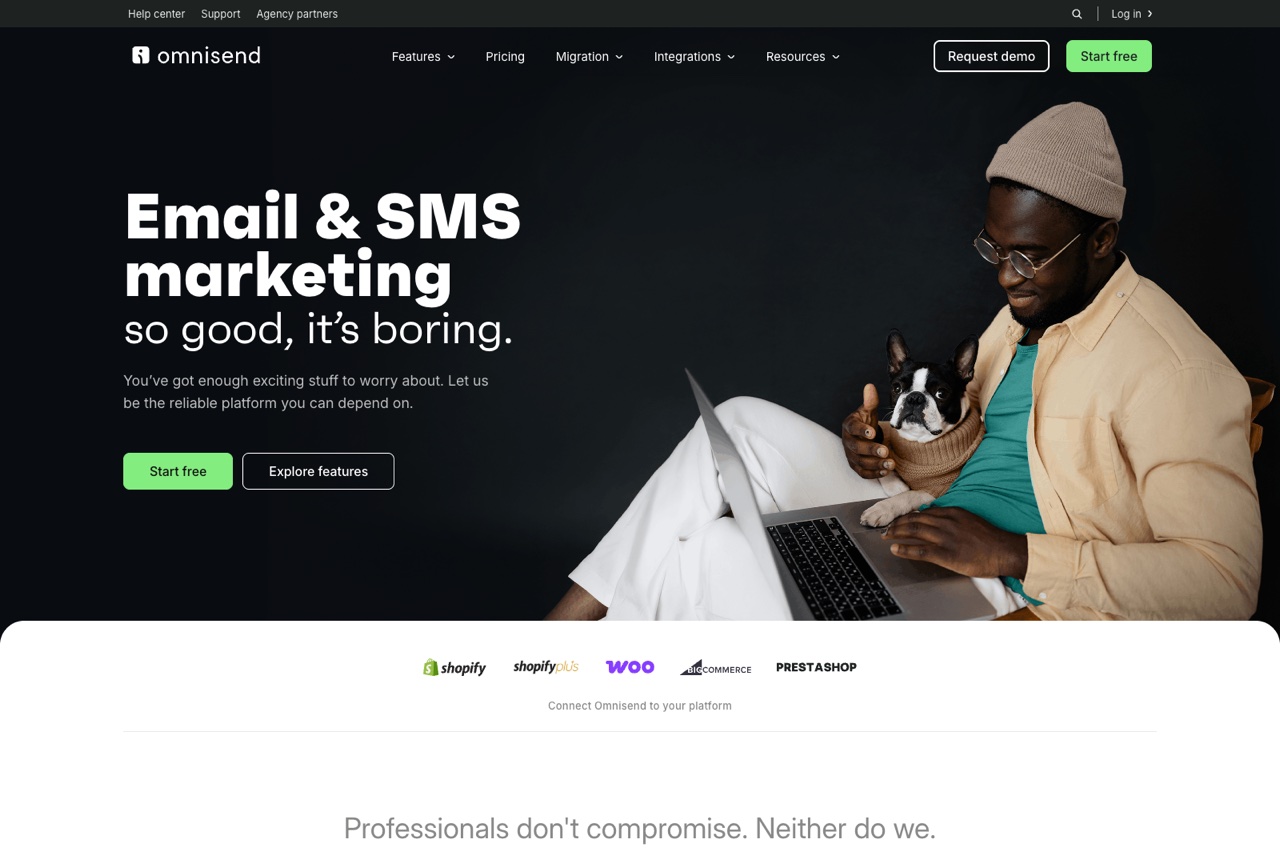
Omnisend suits a beauty brand that wants SMS and email managed together, with prebuilt ecommerce workflows and a product picker in the editor. Its current plans split Standard, which caps email sends at 12 times your contact tier, from Pro, which adds SMS credits.
For replenishment, you build a post-order workflow with a delay and product filter. Test whether the filter works on the specific variant (30ml versus 50ml), because beauty catalogs often put sizes on one product.
- Best for: beauty brands that want email and SMS from one vendor without enterprise pricing.
- Starting price at 10K contacts: $132/month for Standard, $150 for Pro, at regular monthly rates.
- Ecommerce integrations: Shopify, WooCommerce and BigCommerce, plus review and loyalty app partners.
- Automation depth: prebuilt workflows with splits and filters; custom workflows vary by plan.
- One drawback: Standard's send cap matters if you send a launch, a restock and a weekly email to the full list.
Compare it against Klaviyo in Klaviyo vs Omnisend.
Drip: for small teams with a few long, educational sequences
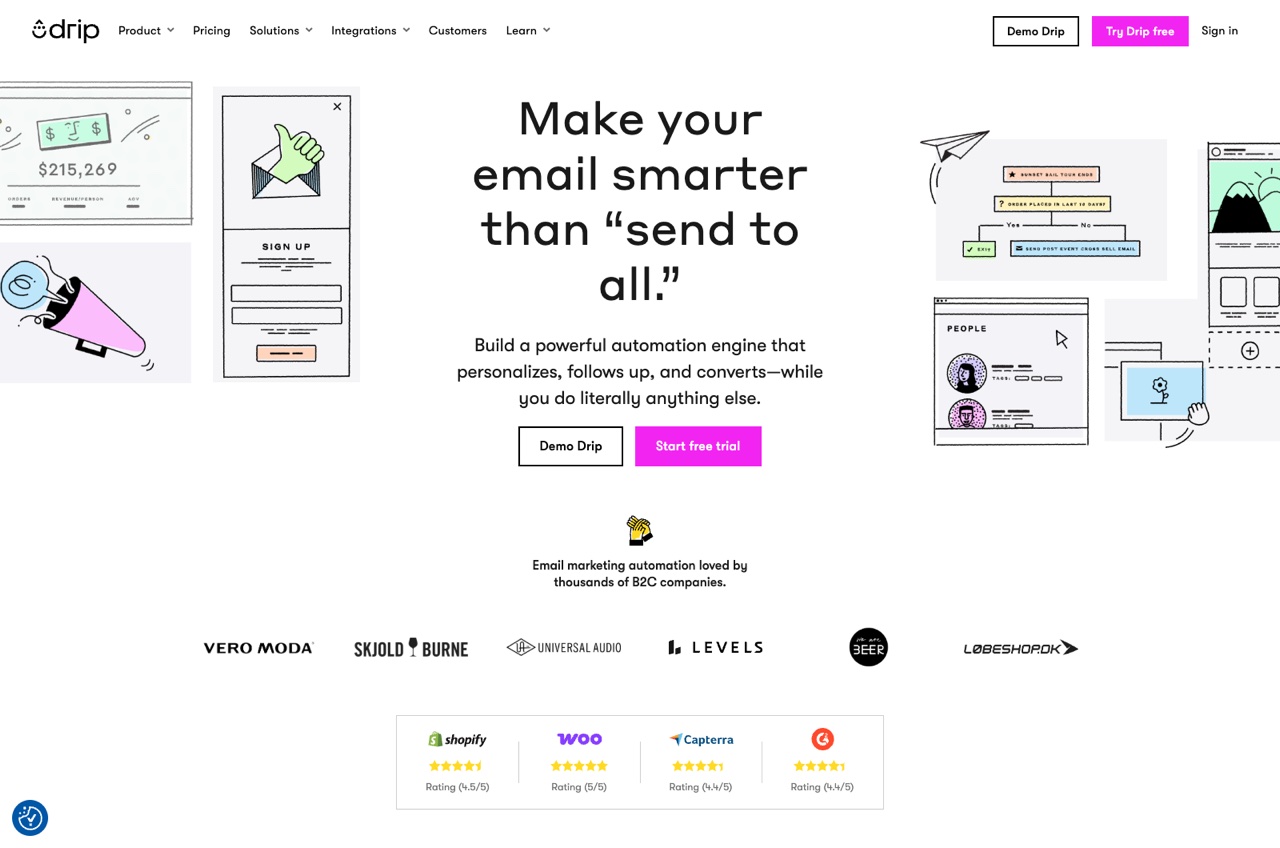
Drip has always been good at multi-step sequences with conditions, which fits ingredient education: a seven-email "how to start retinol" series that branches on whether she bought the barrier cream. Its pricing page lists ecommerce workflows, store integrations and revenue reporting.
- Best for: small skincare brands whose best email is a long how-to sequence.
- Starting price at 10K contacts: $154/month. Entry is $39 for up to 2,500 people.
- Ecommerce integrations: Shopify, WooCommerce and others listed on the pricing page.
- Automation depth: strong visual workflows with branching and goals.
- One drawback: the price climbs fast, reaching $699 at 50K, which makes it a poor fit for a brand with a big sample-buyer list.
Mailchimp: for brands that also run a big editorial newsletter
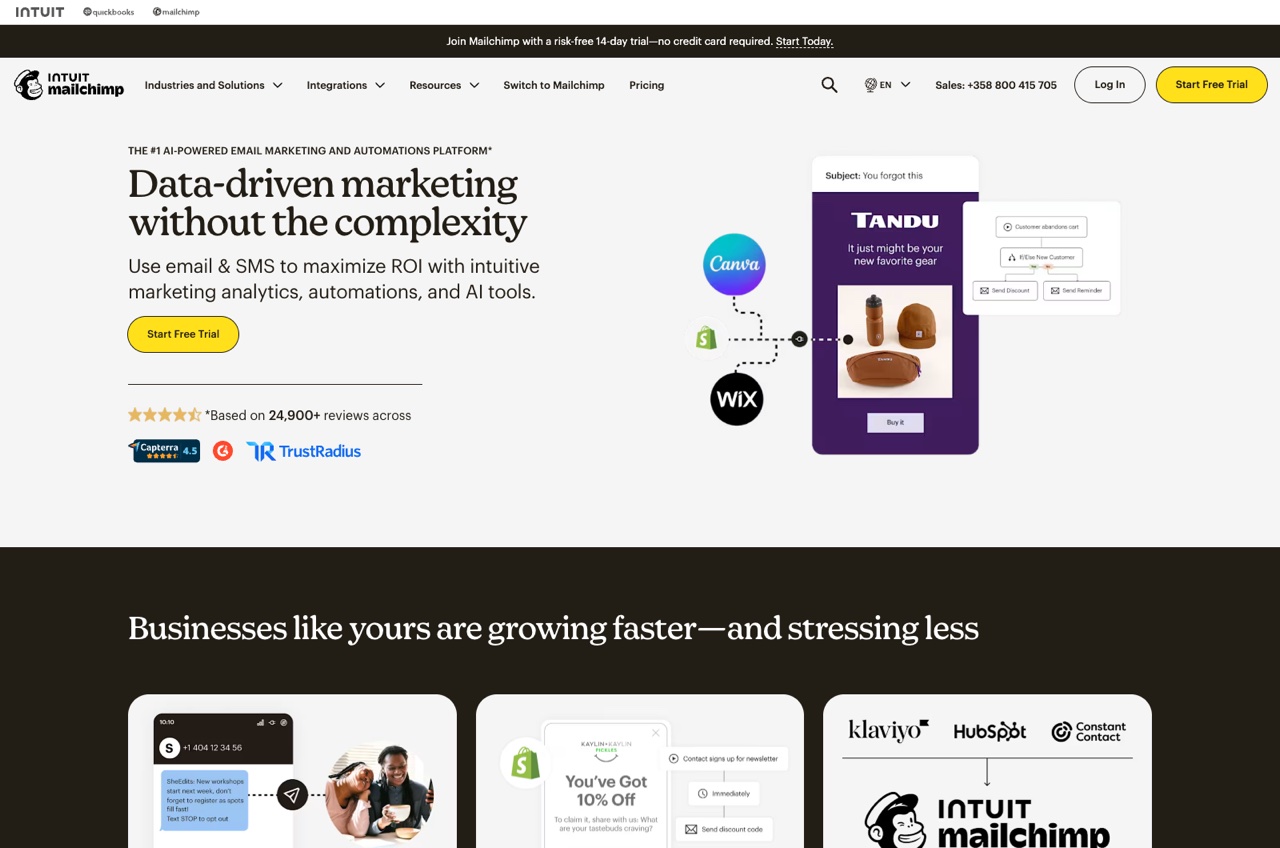
Some beauty brands are half media company, with a weekly editorial email that matters as much as the flows. Mailchimp handles that well and connects to Shopify through an official app. Its plan comparison limits Essentials to four flow steps, so replenishment plus a sample flow realistically needs Standard.
- Best for: content-led beauty brands with a large newsletter and simpler store flows.
- Starting price at 10K contacts: $135/month on Standard at the regular rate.
- Ecommerce integrations: official Shopify app; product blocks in the editor.
- Automation depth: up to 200 flows on Standard, with predictive segments on Standard and Premium.
- One drawback: product-and-size-specific replenishment takes more manual segment work than in a store-first tool.
Our Mailchimp and Shopify guide covers the connection.
Brevo: for a large list you email rarely
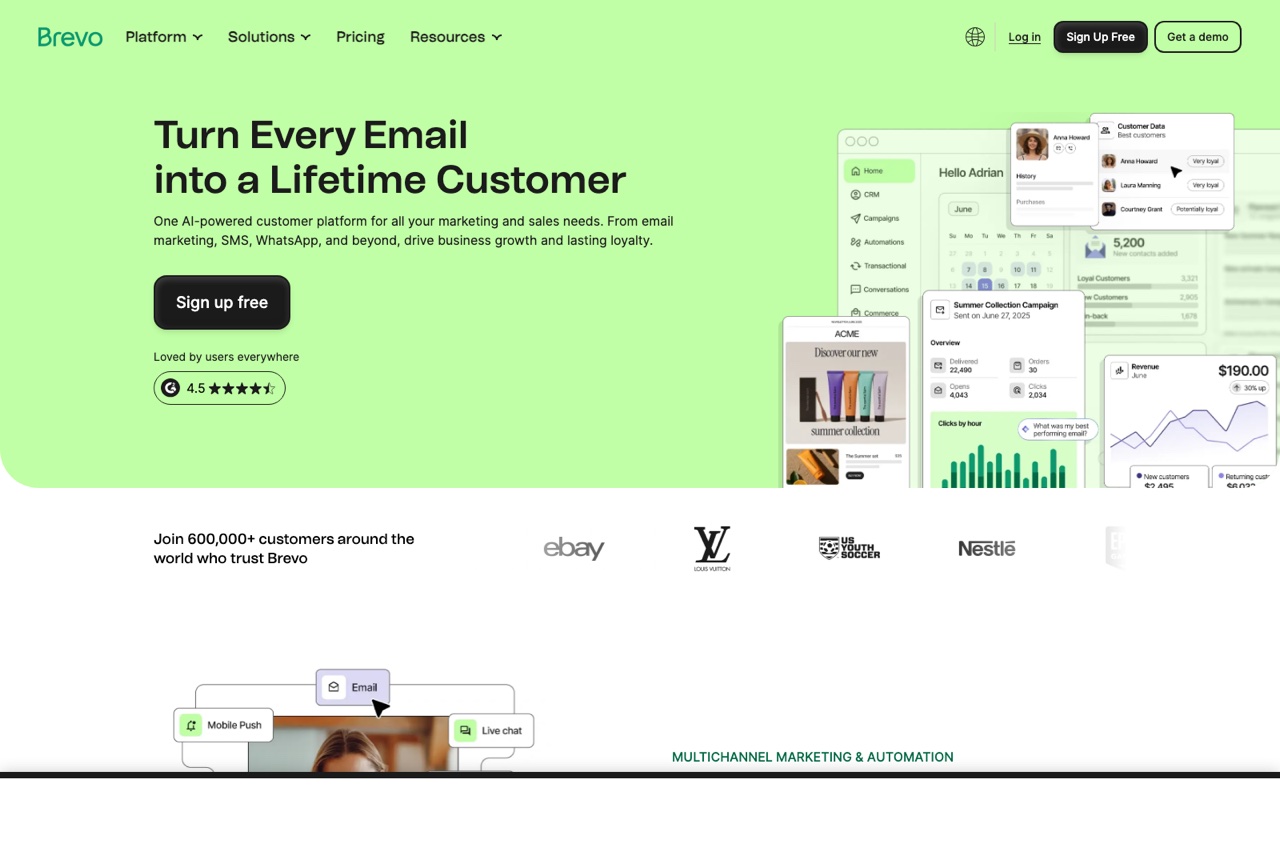
Brevo prices by emails sent rather than contacts. A brand with 40,000 sample buyers it emails twice a month can pay less than a contact-priced tool. Its pricing page lists Starter from $9 and Standard from $18 at entry volume, with multi-step automation on Standard.
- Best for: beauty brands with a large, low-frequency list and simple flows.
- Starting price at 10K contacts: depends on monthly sends; get the Standard quote for your volume.
- Ecommerce integrations: Shopify and WooCommerce apps listed in its integrations directory.
- Automation depth: multi-step workflows on Standard; advanced ecommerce features vary by plan.
- One drawback: per-product, per-size replenishment needs more setup than in a Shopify-first platform.
Flodesk: for founder-led brands with a small catalog
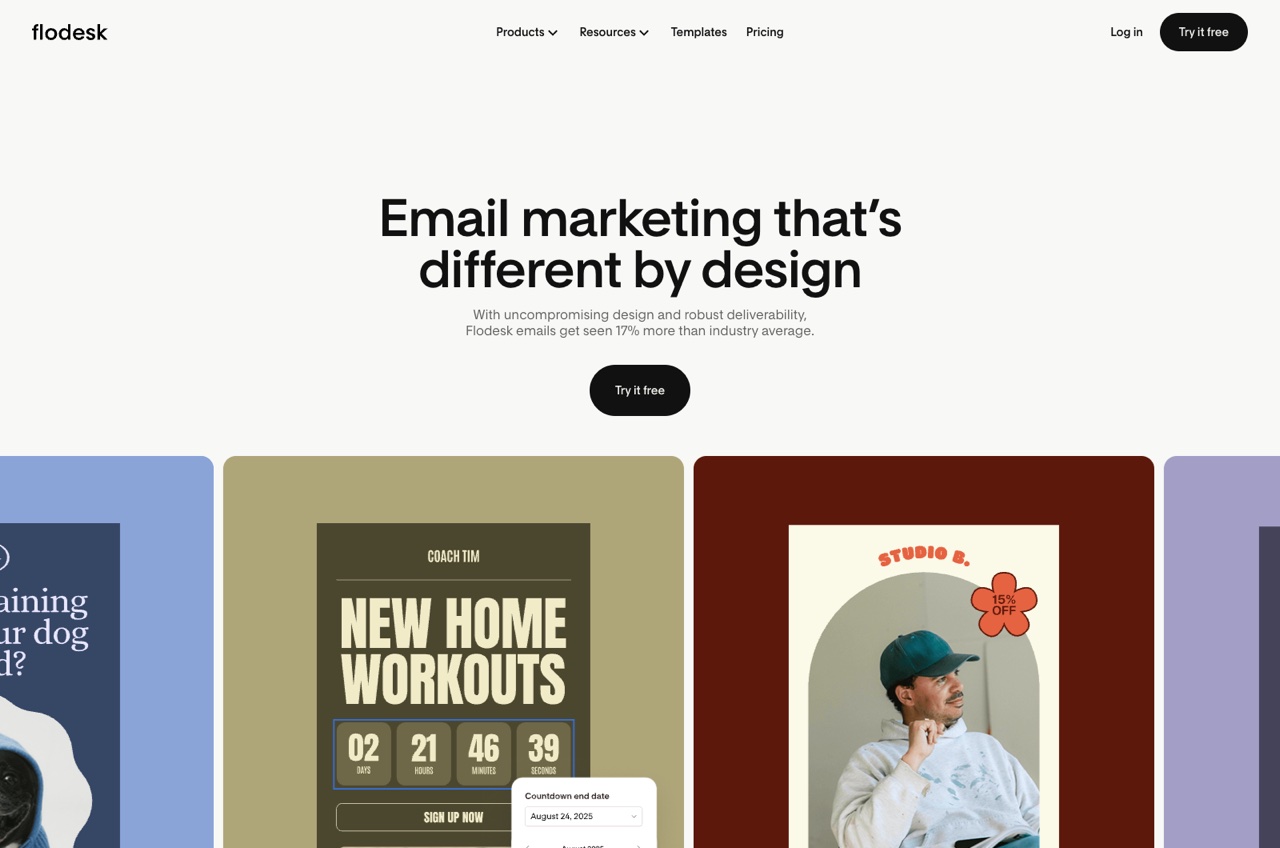
Flodesk is a design-first tool with flat pricing and unlimited subscribers. Its pricing page lists the Email plan at $46/month, or $38/month billed yearly, with workflow automations included. For an indie brand with five SKUs and a strong visual identity, that simplicity has appeal.
- Best for: small, founder-led beauty brands where the newsletter's look is the priority.
- Starting price at 10K contacts: $46/month, or $38 billed yearly, at any list size.
- Ecommerce integrations: a Shopify connection is listed; check which order fields reach your workflows.
- Automation depth: linear workflows suited to welcome and nurture sequences.
- One drawback: product-specific replenishment and routine cross-sell segments are hard to build without deep order data.
Price comparison at the same list sizes
USD per month, checked 14 November 2026. Regular monthly billing unless marked. SMS and add-ons excluded.
| Platform and plan | 1,000 contacts | 10,000 contacts | 50,000 contacts | 100,000 contacts |
|---|---|---|---|---|
| Klaviyo Email | $30 | $150 | $720 | $1,380 |
| Omnisend Standard | $20 | $132 | $413 | $900 |
| Drip | $39 | $154 | $699 | $1,199 |
| Mailchimp Standard | See selector | $135 | $450 | See selector |
| Brevo Standard | Priced by sends | Priced by sends | Priced by sends | Priced by sends |
| Flodesk Email | $46 | $46 | $46 | $46 |
Sources: Klaviyo, Omnisend, Drip, Mailchimp, Brevo, Flodesk.
Worked example at 10,000 contacts. A skincare brand running six flows (welcome, browse abandonment, checkout, post-purchase, replenishment, review request) pays $150/month on Klaviyo Email, $132 on Omnisend Standard or $154 on Drip. Audienceful Growth, which covers unlimited flows, is $118/month billed yearly. At 50,000 contacts the gap widens: Audienceful is $309 against Klaviyo's $720. Run your own numbers in the Klaviyo pricing calculator.
Replenishment timing by product size
The formula is simple. Divide the product volume by the amount used per day, then send the reminder 7 to 10 days before the estimated run-out, so shipping lands before she is empty. The usage figures below are typical assumptions; replace them with your own directions for use.
| Product | Size | Assumed daily use | Lasts about | Send reminder on |
|---|---|---|---|---|
| Serum, once daily | 30ml | 0.5ml | 60 days | Day 50 |
| Serum, twice daily | 30ml | 1ml | 30 days | Day 22 |
| Eye cream | 15ml | 0.3ml | 50 days | Day 40 |
| Moisturizer, twice daily | 50ml | 1.5ml | 33 days | Day 25 |
| Cleanser, twice daily | 150ml | 4ml | 37 days | Day 28 |
| Facial SPF | 50ml | 1.25ml | 40 days | Day 31 |
| Shampoo | 250ml | 10ml | 25 days | Day 18 |
Two refinements earn their keep. Count multiples, because someone who bought two serums will not run out on day 60. And check reorder data after a quarter: if most repeat orders on your serum land on day 41, move the reminder to day 34.
The 6 flows every beauty brand should run
| Flow | Trigger | Recommended timing |
|---|---|---|
| Welcome with routine quiz | Signup | Email 1 immediately, quiz results day 2, best sellers for her skin type day 4 |
| Browse abandonment | Viewed product, no cart | 4 hours, then a review-led follow-up at 1 day |
| Abandoned checkout | Checkout started, no order | 1 hour, 24 hours, 72 hours |
| Post-purchase how-to-use | First order paid | Delivery day plus 1, then day 10 with layering tips |
| Replenishment | Order paid for a specific SKU | Per the size table above, plus a subscribe-and-save follow-up 7 days later |
| Review request with photo | Order fulfilled | Day 21 to 28 for skincare, day 10 for makeup and fragrance |
Our guides cover each in more depth: replenishment emails, post-purchase emails and review requests.
The sample-to-full-size flow deserves its own note because almost nobody builds it. Trigger on the purchase of your discovery kit or mini SKU. On day 5, ask how her skin is reacting and link the full-size versions of what was in the kit. On day 10, send a credit equal to the kit price, valid for 14 days, toward any full-size product. Exit anyone who orders a full size. Most kits contain about a week of product, so the timing matches the moment she decides whether to keep using it.
Switching platforms without losing revenue
Export flows as written specs before you cancel anything: trigger, filters, delays and the copy of each email. Import contacts with their consent status and suppression list, and run the Shopify historical import so replenishment conditions see past orders. Warm up the new sending domain on your most engaged buyers first. Our Klaviyo migration guide lists the order, and the Klaviyo alternatives roundup covers the wider shortlist.
FAQs
What is the best email platform for a small beauty brand?
For a small Shopify beauty brand, choose a tool that triggers on specific products and imports past orders. Audienceful is free up to 1,000 contacts with the Shopify flows included. Flodesk is a fine pick if you have a handful of SKUs and mostly send newsletters.
When should a skincare brand send replenishment emails?
Seven to ten days before the product runs out, based on size and daily use. A 30ml serum used once a day lasts about 60 days, so send around day 50. Adjust after a quarter of real reorder data.
How often should beauty brands email?
Most beauty brands send one to three campaigns a week, plus flows. Send more around launches and sales, and pull unengaged subscribers into a lower-frequency segment rather than mailing them every time.
Do beauty brands need SMS as well as email?
Not to start. Email carries replenishment, education and reviews well. SMS earns its cost for launch alerts and restocks to a small, opted-in VIP group.
How do I turn sample buyers into full-size customers?
Trigger a flow on the sample SKU, check in around day 5, then send a time-limited credit equal to the sample price toward a full size around day 10. Stop the flow as soon as she orders.
Is Klaviyo worth it for a beauty brand under 10K contacts?
It works, but you pay $150/month at 10K for features like predicted next-order dates that need at least 500 buyers and 180 days of history to switch on. Below that, a fixed-delay replenishment flow on a cheaper platform does the same job.
Running a Shopify beauty brand? Create your Audienceful account, install the Shopify app and turn on the replenishment and post-purchase flows. It's free up to 1,000 contacts, with a 14-day Growth trial and no card required.
