Our Klaviyo review in one line: Klaviyo is the strongest email platform for Shopify data, with deep flows, segmentation and predictive analytics, but it's expensive past 10,000 profiles and its default attribution makes email look better than it is. It's worth it for a store that will build and test flows and can carry $150 a month at 10,000 profiles. If the bill is the problem, Audienceful runs the same core Shopify flows for less, covered at the end.
Disclosure: we make Audienceful, a direct competitor. This review uses Klaviyo's own pricing page and help center, checked 14 November 2026, plus its public Shopify App Store and Trustpilot ratings from the same day. We did not run a paid Klaviyo account for this review, and we say where a point comes from documentation rather than use.
Klaviyo review: the verdict
| Our score | 3.8 out of 5 |
| Best for | Shopify stores from about 5,000 to 100,000 profiles with someone who will build and test flows |
| Not for | Newsletters, B2B, very small stores and anyone on a tight budget |
| Price at 10,000 profiles | $150 a month on the Email plan |
| Biggest strength | Shopify data depth, flows and predictive segments |
| Biggest catch | The bill grows with every reachable profile, and default attribution runs high |
How we scored it: pricing and value 25% (2.5/5), ecommerce automations 25% (5/5), segmentation and data 15% (5/5), ease of use 15% (3/5), support 10% (3/5), reporting 10% (4/5). Weighted total 3.78, rounded to 3.8.
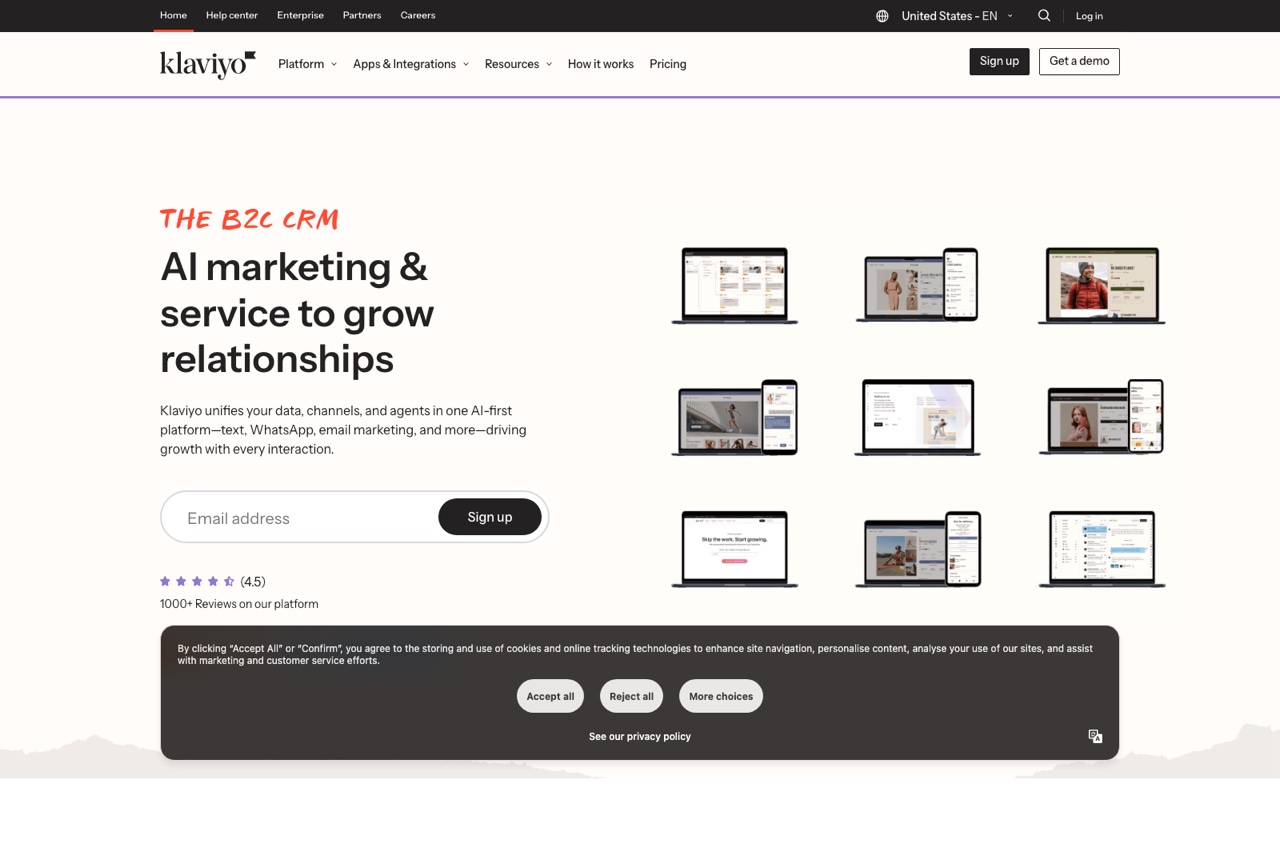
Klaviyo's website, from our competitor screenshot library. Not an in-app screen.
What Klaviyo does well
Shopify data, all of it. Klaviyo's Shopify integration guide covers customers, orders, products, checkouts and on-site events like viewed product. That data is what everything else runs on, and it's the reason most stores pick Klaviyo.
Flows. Klaviyo's flow template library covers welcome, abandoned cart, browse abandonment, post-purchase, win-back, back in stock and more, with conditional splits on any profile property or event.
Segmentation. Segments can combine any event and property, like "viewed product X twice in seven days, hasn't ordered, predicted lifetime value over $200". Few tools match that flexibility.
Predictive analytics. Klaviyo's predictive analytics guide lists predicted lifetime value, churn risk, average time between orders and expected next order date. They unlock once at least 500 customers have placed an order, with 180 days of order history and orders in the last 30 days.
Shopify merchants rate it highly. The Shopify App Store listing shows 4.7 out of 5 from 3,442 reviews, checked 14 November 2026.
Klaviyo pricing review
Klaviyo's live pricing page, checked 14 November 2026, shows three self-serve options: Free, Email, and a newer Marketing plan from $25 a month at 500 profiles, which was running a $1 first month for up to 5,000 profiles. SMS is an add-on; the Shopify listing shows it from $15 a month for 1,250 credits. Accounts above 150,000 profiles get a custom quote.
Email plan prices from Klaviyo's live selector, checked 14 November 2026:
| Active profiles | Email plan, monthly |
|---|---|
| 250 | Free |
| 500 | $20 |
| 1,000 | $30 |
| 5,000 | $100 |
| 10,000 | $150 |
| 25,000 | $400 |
| 50,000 | $720 |
| 100,000 | $1,380 |
The Free plan covers 250 active profiles and 500 emails a month, with email support for the first 60 days. The Email plan at 500 profiles includes 5,000 emails.
Look at the curve. From 10,000 to 50,000 profiles the list grows five times and the bill grows almost five times, from $150 to $720. Doubling again to 100,000 takes it to $1,380. There's no volume discount to speak of. Our Klaviyo pricing guide has every tier, and the Klaviyo pricing calculator prices your exact count.
Active profile billing
Klaviyo bills on active profiles. Its active profile guide says "Any profile that can be emailed through Klaviyo is considered an active email profile." That includes subscribers and customers who checked out but never opted in. Suppressed profiles don't count.
Two rules follow from that guide. If your active count outgrows your plan, Klaviyo may move you up at the next billing cycle. And lowering your count doesn't lower your bill automatically; you pick the cheaper plan yourself unless auto-downgrade is on.
The practical effect: a store adding 1,000 profiles a month through checkout and popups climbs tiers every few months, whether or not those people buy. Suppressing unengaged profiles is the main lever. Our guide to reducing Klaviyo costs walks through it, and the Klaviyo price increase post explains how billing moved to this model in 2025.
Setting up flows on Klaviyo
Based on Klaviyo's documentation, a new store's first week looks like this:
- Install the Klaviyo app from the Shopify App Store and connect the store. Historical customers, orders and products sync in. Our guide to setting up Klaviyo with Shopify covers this step in detail.
- Authenticate your sending domain.
- Turn on signup forms so new visitors enter the welcome flow.
- Build the core flows from templates: welcome, abandoned checkout, browse abandonment and post-purchase.
- Add conditional splits, for example first-time buyers vs repeat buyers in post-purchase.
The templates get you running. The value comes from editing them for your products and margins, and that's where Klaviyo's learning curve shows. The interface has grown to cover SMS, reviews, a customer hub and helpdesk tools, and new users often take a while to find their way around.
Segmentation and predictive features
This is Klaviyo's best area. Segments update in real time and can mix properties, events, predictive fields and list membership. A store with enough order history can target "high predicted lifetime value, churn risk rising" without any custom work.
The catch is the predictive threshold. A store with fewer than 500 customers who've ordered, or less than 180 days of history, won't see the predictive fields. Small stores pay Klaviyo prices without the feature that most sets it apart.
Email builder
The drag-and-drop builder has product blocks that pull from your catalog, dynamic content and coupon blocks. It works. It doesn't have real-time collaboration, so two people editing the same email take turns. For most stores that's fine.
Attribution: why reported revenue runs high
This is the part reviews skip. Klaviyo's conversion tracking guide says that for new accounts "the default attribution windows are 5 days for email opens and clicks," using last touch.
Two things push that number up:
- Opens count. Apple Mail Privacy Protection loads images automatically, which registers as an open for many Apple Mail users. A customer who never looked at your email but buys within five days can be credited to it.
- Five days is long. A loyal customer who buys every week will often have opened something in the last five days. Klaviyo credits the email, even if the customer would have bought anyway.
You can change the window and switch to click-only attribution in Klaviyo's settings. Do it before you compare Klaviyo's revenue numbers with another tool's, or with your Shopify reports. Our post on revenue attribution explains the general problem.
Deliverability
Klaviyo provides the tools: domain authentication, a deliverability hub and guidance on sunsetting unengaged profiles. Inbox placement depends mostly on your domain setup and list hygiene. If you're seeing problems, our posts on Klaviyo deliverability issues and Klaviyo emails going to spam cover the fixes.
Support: why Trustpilot and the App Store disagree
The Shopify App Store shows Klaviyo at 4.7 from 3,442 reviews, with 88% five-star and 8% one-star. Trustpilot shows 1.6 from 377 reviews, with 58% one-star. Both checked 14 November 2026.
The gap is mostly about who writes the review. App Store reviews come from merchants with the app installed, often early on, when the flows are new and working. Trustpilot draws reviews from anyone, and recent ones there cluster around support response, billing on profile counts and price. The Free plan's support also ends after 60 days.
Our read: the product is good, and billing and support are where Klaviyo frustrates people.
Who should use Klaviyo, and who shouldn't
Use Klaviyo if you run a Shopify store where repeat purchases matter, you have the order history to use predictive segments, and someone on the team will build and test flows every month.
Skip Klaviyo if you send newsletters, run a B2B or SaaS business, have a small store under a few thousand profiles, or care more about cost than depth. Our Klaviyo for SaaS post covers the SaaS case.
Alternatives by situation
- You want something easier with 24/7 support: Omnisend. See Klaviyo vs Omnisend.
- You send a few campaigns and want everything inside Shopify: Shopify Messaging. See Shopify Email vs Klaviyo.
- You mostly send newsletters: MailerLite. See Klaviyo vs MailerLite.
- Price is the problem: Audienceful.
Audienceful's native Shopify app syncs customers, orders, line items and products, with a one-time historical import. Its Shopify flow library has nine ready-made flows: welcome, browse abandonment, added to cart, abandoned checkout, post-purchase, review request, replenishment, VIP and win-back. Every flow and campaign gets revenue attribution. An AI agent on every plan builds segments and flows from a brief, the MCP server gives your own agents the same access, the editor is collaborative in real time and templates come from leading agencies.
At 10,000 contacts Audienceful is $79 a month billed yearly ($99 monthly) on Essentials, or $118 on Growth with unlimited automations, against Klaviyo Email's $150. At 50,000 it's $272 billed yearly on Essentials or $309 on Growth, against $720. Both pricing pages checked 14 November 2026. See Audienceful vs Klaviyo, the Klaviyo alternatives roundup, and moving off Klaviyo if you've decided.
FAQs
Is Klaviyo worth it for a small store?
Usually not under a few thousand profiles. The predictive features need 500 customers who've ordered and 180 days of history, and the Email plan is already $100 a month at 5,000 profiles. A small store gets most of the value from a few core flows, which cheaper tools also run.
How much does Klaviyo cost at 10,000 contacts?
$150 a month on the Email plan, per Klaviyo's live selector checked 14 November 2026. SMS is extra.
Why are Klaviyo's Trustpilot reviews so bad?
Trustpilot shows 1.6 out of 5 from 377 reviews, while the Shopify App Store shows 4.7 from 3,442. Trustpilot reviews come from anyone, and recent ones focus on support response, billing on profile counts and price. App Store reviews come from installed merchants and focus on the product.
Does Klaviyo over-report revenue?
Its default settings credit a lot. New accounts attribute a purchase to an email opened or clicked in the previous 5 days, on last touch. Apple Mail's automatic opens and frequent buyers both push that number up. Switching to a shorter, click-based window gives a more conservative figure.
Is Klaviyo's free plan enough?
For testing, yes. It covers 250 active profiles and 500 emails a month, with email support for the first 60 days. Any store that grows past 250 reachable profiles will need the Email plan, from $20 a month.
What's the best cheaper alternative?
For Shopify stores, Audienceful is $79 a month billed yearly at 10,000 contacts against Klaviyo's $150, with nine ready-made Shopify flows and revenue attribution. Omnisend Standard is $132 at the same size.
Like Klaviyo's flows but not the bill? Estimate your savings with the Klaviyo pricing calculator, then start a free 14-day Growth trial.
