Klaviyo vs Customer.io is mainly a question of which data model and operating workflow fit your business: a Shopify store can start with Klaviyo's documented store integration, while a SaaS or app team should closely evaluate Customer.io's people, objects and event-driven journeys. Both can use custom events, so “ecommerce only” versus “developer only” is too crude. Audienceful is another option combining native Shopify and Stripe data with lifecycle flows, collaboration and revenue attribution.
We make Audienceful. Prices below were checked 14 November 2026. This comparison uses documented product capabilities and proposed acceptance tests; it does not claim measured implementation times or authenticated builder screenshots we do not have.
Klaviyo vs Customer.io: start with the event you need
A store might begin with a checkout and line items. A SaaS product might begin with a trial, an activation milestone and several users associated with one company. Both are customer behavior, but the data relationships and stop conditions differ.
| Decision | Klaviyo evaluation | Customer.io evaluation |
|---|---|---|
| Shopify store | Native store connection, event history and flow behavior | Define how the required store data reaches journeys |
| SaaS product | Custom product events plus supported billing data | People, objects, relationships and event-driven targeting |
| Billing model | Active profiles and selected send allowance | Profiles, plan and message allowances |
| Engineering work | Required for product events not supplied by a connector | Required data instrumentation and integration ownership |
| Channels | Check the current package and required channels | Check the current multichannel package and usage terms |
| Team workflow | Test who can build, review and operate flows | Same operational acceptance test |
Sources: Klaviyo's Shopify guide, Events API, Customer.io data setup and pricing comparison.
Do not choose from a raw feature count. A single missing event in your implementation can prevent the flow that matters most, even when the platform has hundreds of other features.
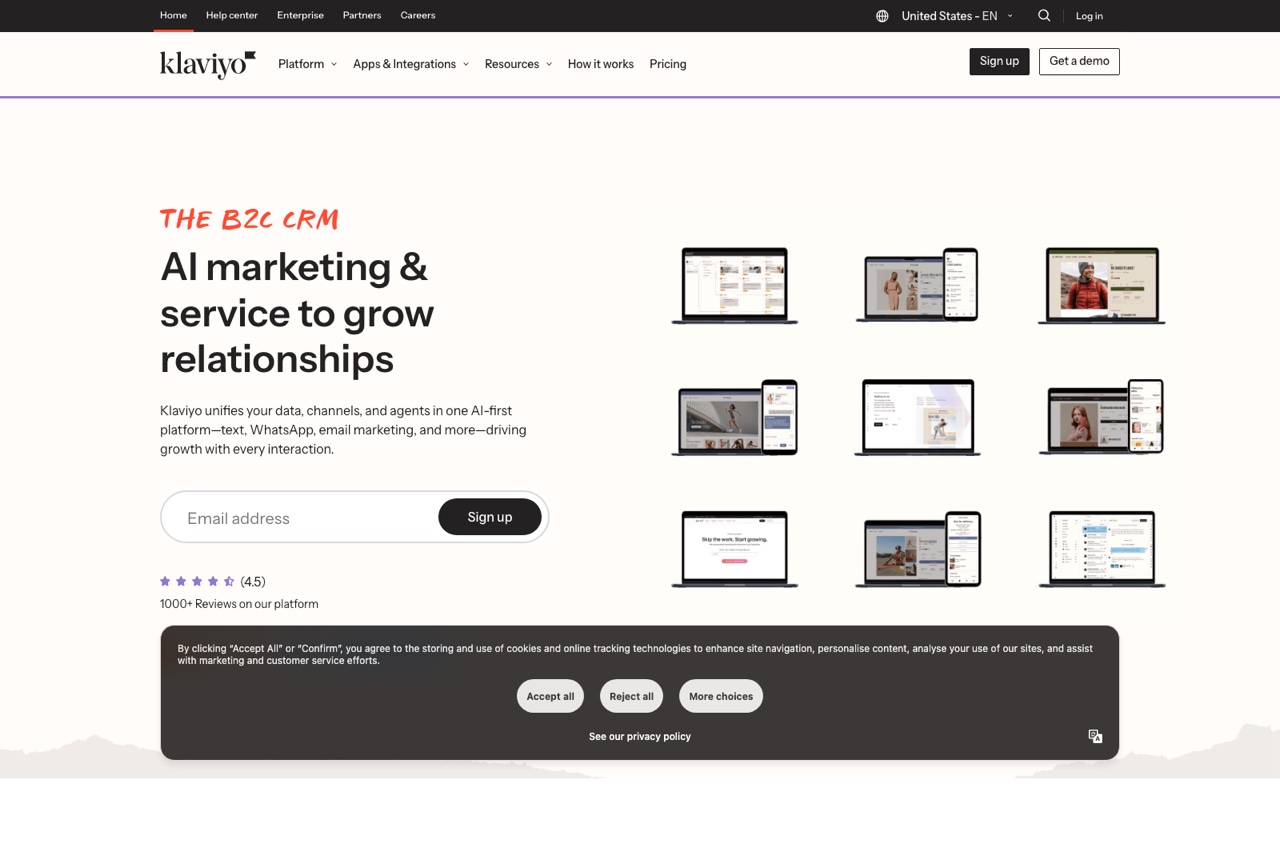
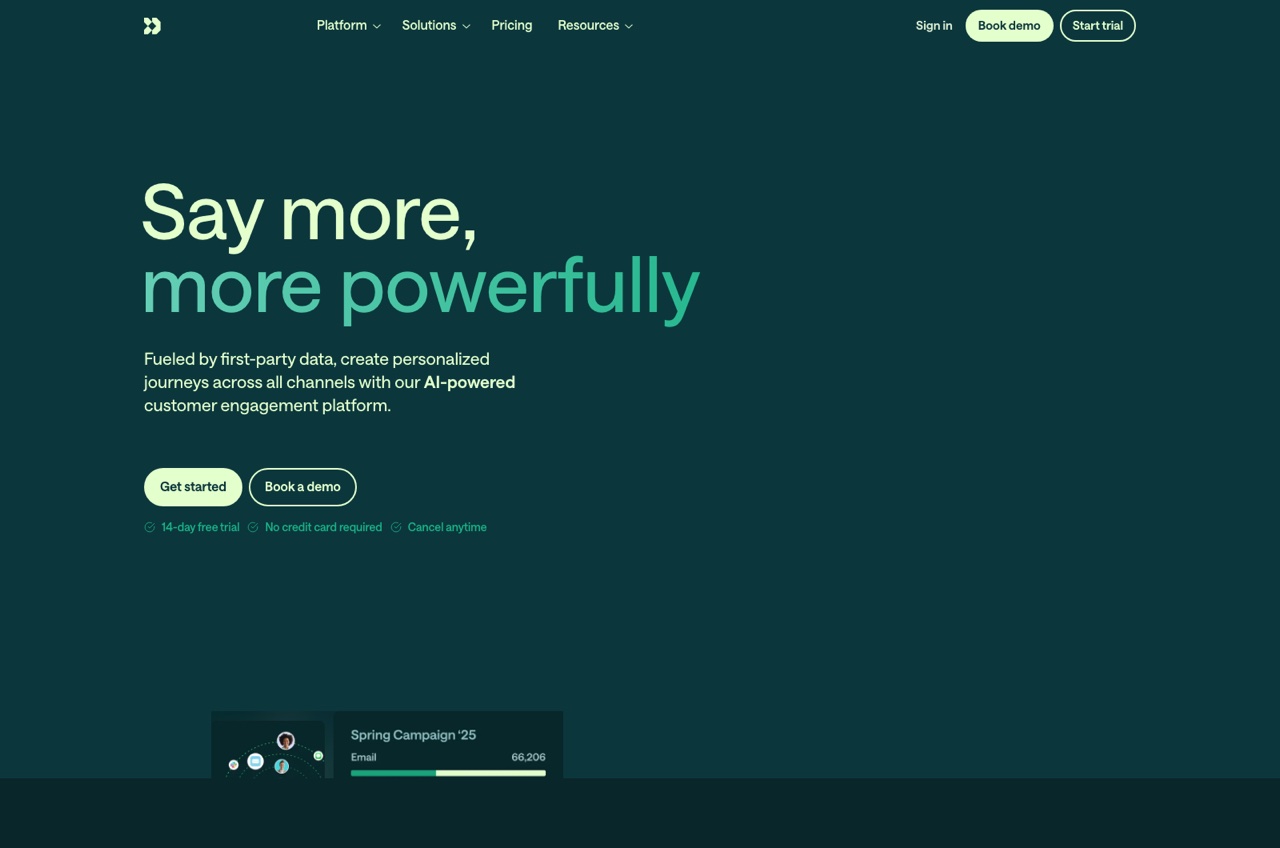
Website references from the content library; these are not authenticated journey-builder screens.
The data-model difference in a concrete example
For checkout recovery, you need a person, checkout identifier, recoverable URL, relevant products and an order-completion event. For a SaaS trial, you need user identity, account relationship, trial-end date, activation progress and paid-conversion state.
The following is a business-event schema, not a provider-ready request body:
{
  "event_id": "evt_123",
  "event_name": "trial_started",
  "user_id": "usr_123",
  "account_id": "acct_456",
  "occurred_at": "2026-11-14T09:00:00Z",
  "properties": {
    "plan": "team",
    "trial_ends_at": "2026-11-28T09:00:00Z",
    "activation_completed": false
  }
}
For Klaviyo, map that into its documented profile and metric event structure. For Customer.io, map it into the selected Track or Data Pipelines API. The property names in your application are not automatically interchangeable with the provider's request envelope.
Keep the event's occurrence time, stable identity and duplicate policy explicit. A late billing webhook, repeated event or changed email address should have a defined outcome. That is an integration responsibility whichever platform you choose.
Pricing: compare profiles and sends separately
Klaviyo's active-profile definition and Customer.io's maximum-profile billing FAQ describe different counting rules. Customer.io includes uniquely identified people and objects, so its profile count need not equal your number of email addresses.
The table combines checked selector amounts with one clearly labelled calculation. Prices are USD, before tax, SMS, additional channels or services.
| Population | Klaviyo Email monthly | Customer.io Essentials monthly |
|---|---|---|
| 5,000 | $100 | $100 |
| 10,000 | $150 | $145 |
| 25,000 | $400 | $280 model using the published incremental profile rate; confirm quote |
| 30,000 | $500 | $325 |
| 50,000 | $720 | From $505; confirm capacity |
| 100,000 | $1,380 | Quote required |
Sources: Klaviyo pricing and Customer.io pricing, checked 14 November 2026. Customer.io's 25K figure is calculated as $100 + 20,000 × $0.009; it is not presented as an independently checked selector quote.
Customer.io Essentials includes one million monthly emails in the published package, with $0.12 per additional thousand. At 30K profiles and 1.5 million emails, the model is $325 + $60 = $385. Premium starts at $1,000 per month billed yearly; compare the actual plan entitlement rather than assuming every larger audience requires Premium.
Klaviyo's selected profile tier includes a sending allowance, so high-frequency mail needs its own check. Neither platform's base price is a complete all-channel budget. Our Customer.io pricing guide and Klaviyo pricing guide cover the details, and there's a separate guide for when Customer.io is too expensive.
Integration matrix: native connection versus implementation work
“Native” should mean the documented connection delivers the fields and events you actually need. It should not mean the entire journey is complete without configuration.
| Data source | Klaviyo | Customer.io | Acceptance test |
|---|---|---|---|
| Shopify | Documented native integration | Specify and verify the selected data-in route | Checkout, order, refund and consent arrive correctly |
| Stripe | Documented invoice/payment integration with webhook setup | Specify and verify the billing-data route | Failure, recovery, trial and cancellation needs are covered |
| Segment | Verify the selected integration and mapping | Documented Destination Actions integration | Identify and track calls map to intended people/events |
| Product backend | Events API and maintained profile data | Track or Data Pipelines API | Activation and current account state are reliable |
| Webhooks | Verify direction, event and package | Verify data-in or data-out workflow | Authentication, retries and identity are tested |
Klaviyo's Stripe guide documents invoice and payment metrics. Do not infer a complete trial lifecycle from those alone. Customer.io's Segment guide explains Destination Actions and event shaping, while its integration directory is the place to verify a chosen route.
This matrix does not label Customer.io's unverified Shopify or Stripe route as a proven one-click connector, nor does it assert that a route is impossible. Require a demonstration of the exact implementation before assigning engineering effort or cost.
Build the same trial-onboarding journey in both
Use a common acceptance sheet rather than two unrelated demos. The intended behavior might be: welcome a new trial user, wait for an activation milestone, offer help only if it is missing and stop the upgrade pitch after paid conversion.
- Define
trial_started,activation_completedand paid-conversion state. - Connect a controlled user and account relationship.
- Create the initial message and its fallback values.
- Add a delay and branch on actual activation.
- Set the goal or exit after conversion.
- Test a normal trial, an extension, an early conversion and a repeated event.
Record the work your team needed in each tool: integration code, data transformations, dashboard configuration and content review. We have not measured those hours here, so a blanket “ten-minute setup” would be misleading.
For a Shopify business, repeat the same exercise with checkout recovery instead. Test an order during the delay and a customer already subscribed through another form. That evaluates the flow the store will actually depend on.
Segmentation and company relationships
Customer.io's data-driven segments update membership from conditions as people match or stop matching. Klaviyo also supports profile and event-based targeting, documented through its event model. The difference to test is the relationship and data available to the rule, rather than whether either has a segment builder.
For SaaS, define which people should receive an account-level message. The billing contact, account administrator and daily end user can be different people. A payment event attached to one email does not automatically settle the recipient policy for every journey.
For ecommerce, inspect variants, repeat purchases, refunds and time windows. A “spent over $500” segment can differ if one setup includes refunded amounts or uses a different currency interpretation. Compare known members and exclusions, not just headline totals.
A static migration field can preserve historical information without updating it. Document which integration owns future changes so the audience does not become stale after the first week.
Channels, editors and operational ownership
Customer.io's current package comparison includes channels beyond email, such as push and in-app messaging. If those are central to the product experience, evaluate them directly with the required SDK and consent setup. Klaviyo's current comparison should likewise be checked for the exact channel and product being purchased.
Do not turn a multichannel checklist into a promise that every message has the same price or implementation effort. Ask about channel-specific usage, environments, identity, suppression handling and support.
For the editor, have the people who will produce and approve campaigns build a reusable design. Test dynamic content, fallback text, mobile layout and preference links. A developer can make an API call successfully while the marketing team still struggles to review the recurring message.
Assign owners for integration failures, copy changes, domain authentication and delivery monitoring. An otherwise capable platform can be a poor fit if the required maintenance falls between the growth and engineering teams.
Deliverability and reporting: avoid unsupported winners
Authentication, consent, audience quality, sending patterns and message relevance affect results. Neither a vendor's scale claim nor an unsourced comparison score proves which platform will place your campaign in the inbox.
Inspect actual provider responses, bounces, complaints and a recent engaged-audience pilot. Preserve suppression rules and test unsubscribe behavior in every sending path. Use our deliverability checklist to structure the review.
Compare attribution settings before comparing revenue. A broader crediting window or different bot filtering can change the reported number without changing the customer's purchase. Use store or billing results as an independent measure alongside the platform reports.
Another option for Shopify and Stripe workflows
Audienceful combines native Shopify, Stripe and Clerk data with custom events, branching automations, webhooks and transactional email support. Ready-made Shopify flows and Stripe flows provide starting structures for checkout recovery, onboarding, trial ending, dunning and win-back.
The collaborative editor, agency-designed templates, revenue attribution and enterprise-grade delivery monitoring support the operating team. The AI agent and complete MCP coverage let agents manage campaigns, segments and flows as well as prepare content.
At 10K contacts, Audienceful Growth's checked yearly-billed monthly equivalent is $118, lower than the checked $150 Klaviyo Email and $145 Customer.io Essentials bases. On monthly billing, Growth is $140. Both relevant live pages were checked 14 November 2026; compare allowances and billable units as well as the displayed amount.
Read Audienceful versus Customer.io, Audienceful versus Klaviyo, Klaviyo for SaaS and Customer.io alternatives. For a move, start with migration help and preserve permission and flow progression deliberately.
FAQs
Is Customer.io good for ecommerce?
It can support ecommerce journeys when the right customer and store data reaches it. Test the required event, product context, consent and purchase exit rather than assuming a generic event platform automatically includes your full store workflow.
How much does Customer.io cost?
Essentials starts at $100 monthly for 5K profiles and one million monthly emails. The checked ladder includes $145 at 10K and $325 at 30K. Premium starts at $1,000 monthly billed yearly; larger requirements need a quote.
Does Customer.io integrate with Shopify?
Specify the supported data-in route for your setup and verify actual events. This guide does not claim a checked one-click Shopify connector. Require a test of customer, checkout, order, refund and permission data before purchase.
Can Klaviyo handle SaaS product events?
Yes, its Events API can associate custom activity with profiles. Your application must still supply the events, identity and current state needed for each lifecycle journey.
Which needs more engineering effort?
It depends on the available native data, your account relationships and the journeys you need. Build the same acceptance test in both and record the actual integration and maintenance work; a universal hour estimate would hide those differences.
What's a cheaper alternative to both?
At the defined 10K size, Audienceful Growth has a lower checked base price on the stated billing terms. Compare the required sending allowance, integration behavior and workflow before deciding from price alone.
To compare native store and billing workflows, start with Audienceful and test the journey your team needs most.
