Klaviyo vs HubSpot is less a feature contest than a choice between two kinds of product. Klaviyo is an ecommerce email and SMS platform that costs $150 a month at 10,000 contacts, while HubSpot Marketing Hub is part of an all-in-one CRM suite whose Professional plan starts at $800 a month plus a $3,000 onboarding fee. Shopify stores usually belong on Klaviyo, and B2B teams with a sales pipeline usually belong on HubSpot. For a lighter, cheaper stack that covers Shopify and Stripe lifecycle email, Audienceful is a third option covered below.
We make Audienceful. Prices were checked on the live Klaviyo and HubSpot pricing pages on 14 November 2026. Screenshots are from our competitor library and show each vendor's website, not their workflow builders.
Klaviyo vs HubSpot: the short answer by business type
| Business | Pick | Reason |
|---|---|---|
| Shopify or DTC store | Klaviyo | Store data, ecommerce flows and a price that scales with your list, not your seats |
| B2B company with a sales team | HubSpot | CRM, deals, sales sequences and marketing in one database |
| Self-serve SaaS | Neither is a clear fit | HubSpot is priced for sales-led teams; Klaviyo is shaped around stores |
| Store already running HubSpot CRM | Often both, connected | HubSpot for the customer service and sales side, Klaviyo for store email |
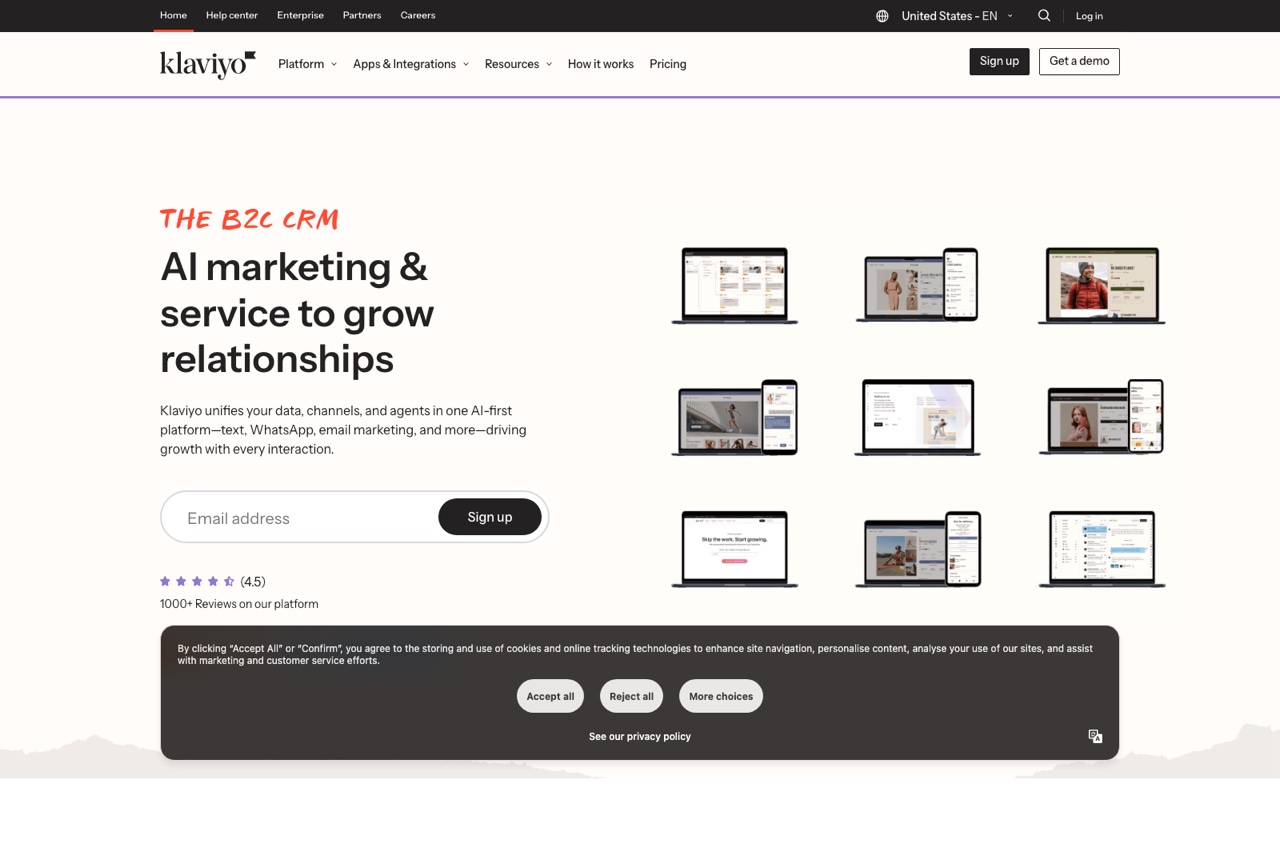
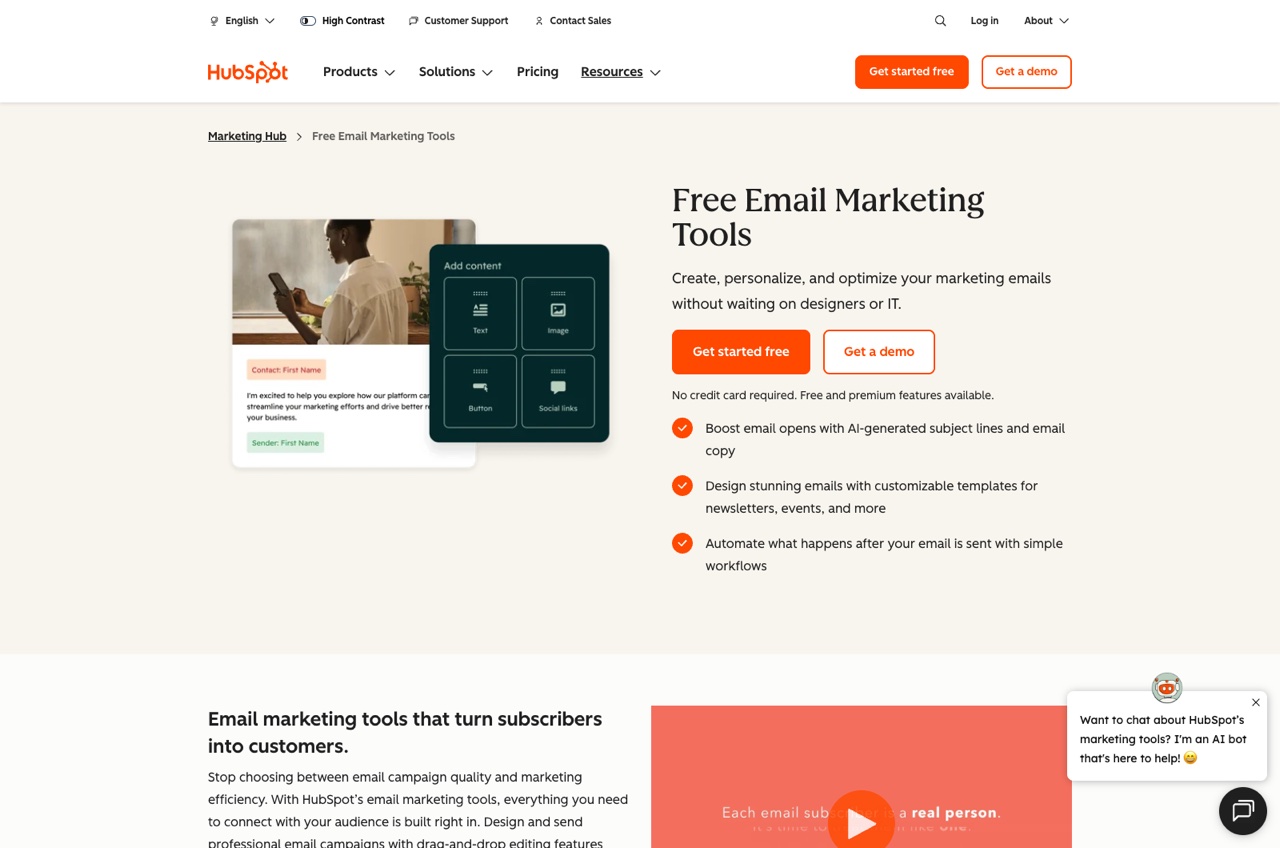
At a glance
| Klaviyo | HubSpot Marketing Hub | |
|---|---|---|
| What it is | Ecommerce email, SMS and customer data | Marketing module of a CRM suite |
| Billing unit | Active profiles | Seats plus marketing contacts |
| Free plan | 250 active profiles, 500 emails a month | Free tools and free CRM for up to 2 users |
| Entry paid plan | Email, $20/month at 500 profiles | Starter, priced per seat, 1,000 marketing contacts |
| Mid plan | Email at $150/month for 10K | Professional from $800/month, 3 seats, 2,000 marketing contacts |
| Onboarding fee | None | $3,000 on Professional, $7,000 on Enterprise |
| Shopify | Native, deep sync | Shopify app; lighter store data |
| CRM and deals | No sales pipeline | Full CRM with deals and sales tools |
| Best at | Revenue flows for stores | Lead nurture and sales alignment |
Sources: Klaviyo pricing and HubSpot Marketing Hub pricing, checked 14 November 2026.
Pricing at real list sizes
Klaviyo's price follows your active profiles. HubSpot's follows three things: the plan, the number of Core Seats, and the number of marketing contacts. Professional includes 2,000 marketing contacts and Enterprise includes 10,000. More contacts cost extra, and HubSpot's page does not publish the per-contact rate, so you need a quote.
| Contacts | Klaviyo Email | HubSpot Professional |
|---|---|---|
| 1,000 | $30 | From $800 (2,000 contacts included) |
| 10,000 | $150 | Quote needed above 2,000 contacts |
| 50,000 | $720 | Quote needed |
| 100,000 | $1,380 | Quote needed |
Klaviyo monthly list prices; HubSpot Professional's yearly-billed starting price. Checked 14 November 2026.
HubSpot's Starter plan is priced per seat (the page showed $20 per seat per month with a lower new-customer offer) and includes 1,000 marketing contacts. It covers basic email and forms. Most teams comparing HubSpot with Klaviyo are looking at Professional, because that is where marketing automation workflows live.
First-year cost, modeled
Here is what a business with 10,000 email contacts would pay in year one.
| Item | Klaviyo Email | HubSpot Professional |
|---|---|---|
| Base plan, 12 months | $1,800 | $9,600 |
| Onboarding fee | $0 | $3,000 |
| Extra marketing contacts (8,000 above the included 2,000) | Included | Quote |
| Extra seats beyond 3 | n/a | $45/month each |
| First-year total before extras | $1,800 | $12,600 plus contacts |
So HubSpot is at least seven times Klaviyo's cost at this size, before contact add-ons. That is fine if the CRM and sales tools replace other software you pay for. It is hard to justify for email alone. Our Klaviyo pricing guide covers Klaviyo's tiers, and HubSpot email marketing alternatives shows the same HubSpot math against other tools.
Ecommerce data and the Shopify integration
Klaviyo was built for this. Its Shopify integration syncs customers, orders, products, checkouts and on-site browsing, and feeds predicted lifetime value and next-order date into segments. Product blocks pull from your catalog.
HubSpot connects to Shopify through its app and syncs contacts, deals and products into the CRM. That works for reporting and simple abandoned cart emails. It is not designed around catalog-heavy campaigns, browse abandonment or replenishment timing.
Winner: Klaviyo.
Automation and flows
Klaviyo's flows start from ecommerce triggers: checkout started, order placed, product viewed, back in stock, price drop. Splits use any profile property, event or predictive value.
HubSpot workflows on Professional can act on contacts, companies, deals and tickets. They can rotate leads to sales reps, create tasks, update lifecycle stages and send emails. That breadth is the point of HubSpot.
Winner: Klaviyo for store revenue flows. HubSpot for lead nurture and anything that touches sales.
CRM, pipelines and sales tools
HubSpot is a CRM first. Deals, pipelines, sequences, meetings, quotes and a shared contact timeline are what you are paying for. Marketing Hub sits on that database.
Klaviyo is not a sales CRM. It has detailed customer profiles and a helpdesk, but no deal stages or sales seats.
Winner: HubSpot, by design.
Segmentation and reporting
Klaviyo segments mix event data, purchases and predictive fields, and its reporting is built around revenue per campaign and flow. HubSpot segments (lists) can use any CRM property across contacts, companies and deals, and its attribution reporting connects marketing touches to closed deals.
Winner: Klaviyo for store revenue reporting. HubSpot for B2B pipeline attribution.
Using both together
Many stores keep HubSpot for service or wholesale sales and run Klaviyo for consumer email. Klaviyo's own HubSpot migration guide says it has no built-in HubSpot integration. Ongoing sync runs through a third-party app in the Klaviyo marketplace, or a connector such as Zapier.
A combined stack at 10,000 contacts might be HubSpot's free CRM plus Klaviyo Email at $150 a month, plus a connector fee. That is the cheapest way to keep a CRM and run store email properly. Adding HubSpot Professional on top only makes sense if you also use its marketing workflows for a B2B audience.
Decide which tool owns consent. If both can send marketing email, an unsubscribe in one must reach the other, or you will email people who opted out.
SaaS lifecycle email: which is better?
SaaS email runs on billing and product events. HubSpot can take custom events on higher plans and works well for sales-assisted SaaS where a rep follows up on trials. Its cost scales with seats and contacts, which hurts a self-serve product with thousands of free signups.
Klaviyo has a native Stripe integration and takes custom events through its API. Its templates and reporting are shaped around orders, so trial and dunning flows need more setup. Our Stripe email automation guide covers the flows SaaS teams need.
Winner: HubSpot for sales-led SaaS. For self-serve SaaS, look at tools built around billing data.
Alternatives if both are overkill: Audienceful
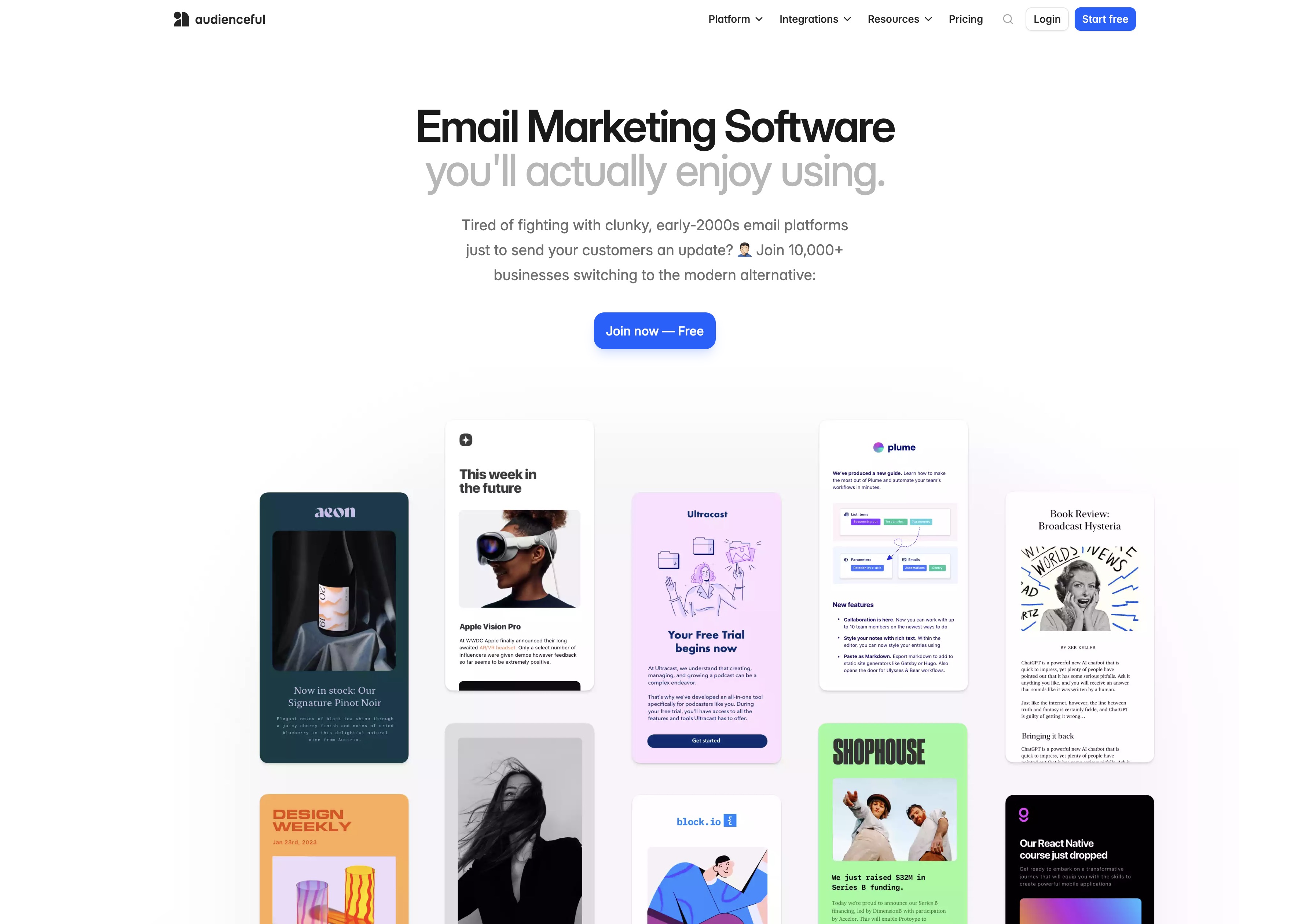
Audienceful covers both store and SaaS lifecycle email without CRM-suite pricing. Stores install the Shopify app and start from Shopify flow templates for abandoned checkout, browse abandonment, added to cart, welcome, post-purchase, review request, replenishment, VIP and win-back. SaaS teams connect Stripe and Clerk and start from Stripe flow templates for trial ending, failed payment and subscription win-back.
Product events come in through the REST API as custom events. Revenue attribution shows what each flow earned. The AI agent drafts emails, builds segments and sets up paused flows from a brief, and the MCP server lets outside agents do the same. The collaborative editor and agency-designed templates keep campaign production quick. If you want a contact database alongside email, Audienceful also has a lightweight CRM.
| Contacts | Klaviyo Email | HubSpot Professional | Audienceful Essentials (yearly) | Audienceful Growth (yearly) |
|---|---|---|---|---|
| 10,000 | $150 | $800 + quote for contacts, $3,000 onboarding | $79 | $118 |
| 50,000 | $720 | Quote | $272 | $309 |
Audienceful prices from our pricing page, checked 14 November 2026. Essentials includes three automated flows; Growth includes unlimited automations and users.
B2B teams who rely on HubSpot's full sales suite (seats, sequences, deal pipelines) should stay on HubSpot. For everyone else, see Audienceful vs HubSpot, Audienceful vs Klaviyo and our HubSpot migration guide.
FAQs
Does HubSpot integrate with Klaviyo?
Not natively. Klaviyo's help center says it has no built-in HubSpot integration. You can sync them with a third-party app from the Klaviyo marketplace or a connector like Zapier, and you should decide which tool owns unsubscribes.
Is HubSpot good for ecommerce email?
It can send store email and abandoned cart messages through its Shopify app, but it is built for CRM-led marketing. Stores that depend on browse, cart and replenishment flows usually get more from an ecommerce email tool.
Is Klaviyo a CRM?
No. Klaviyo stores rich customer profiles and has a helpdesk, but it has no deals, pipelines or sales seats. HubSpot is a CRM.
Which is cheaper at 10,000 contacts?
Klaviyo, by a wide margin. Klaviyo Email is $150 a month. HubSpot Professional starts at $800 a month with 2,000 marketing contacts included, plus a $3,000 onboarding fee and a quote for the extra 8,000 contacts. Checked 14 November 2026.
Should a SaaS company use Klaviyo or HubSpot?
A sales-led SaaS company with reps working trials fits HubSpot. A self-serve SaaS company driven by Stripe events usually finds both expensive or awkward and does better with a lifecycle tool built on billing data.
Can I use both?
Yes. A common setup is HubSpot's free CRM plus Klaviyo for email, connected through a third-party sync. Keep one tool in charge of consent.
Want Shopify flows, Stripe lifecycle email and an AI agent for a fraction of HubSpot's price? Start a free 14-day trial and connect Shopify or Stripe first.
