Klaviyo vs Mailchimp has a fairly clear answer for most online stores. Klaviyo is the stronger tool when automated flows on Shopify data drive a real share of revenue, and Mailchimp is the cheaper, simpler tool when your email is mostly newsletters and promotions. At 10,000 contacts Mailchimp Standard is $135 a month and Klaviyo is $150, and the gap widens fast after that. If you want Klaviyo-style Shopify flows without Klaviyo's bill, Audienceful is a third option covered near the end.
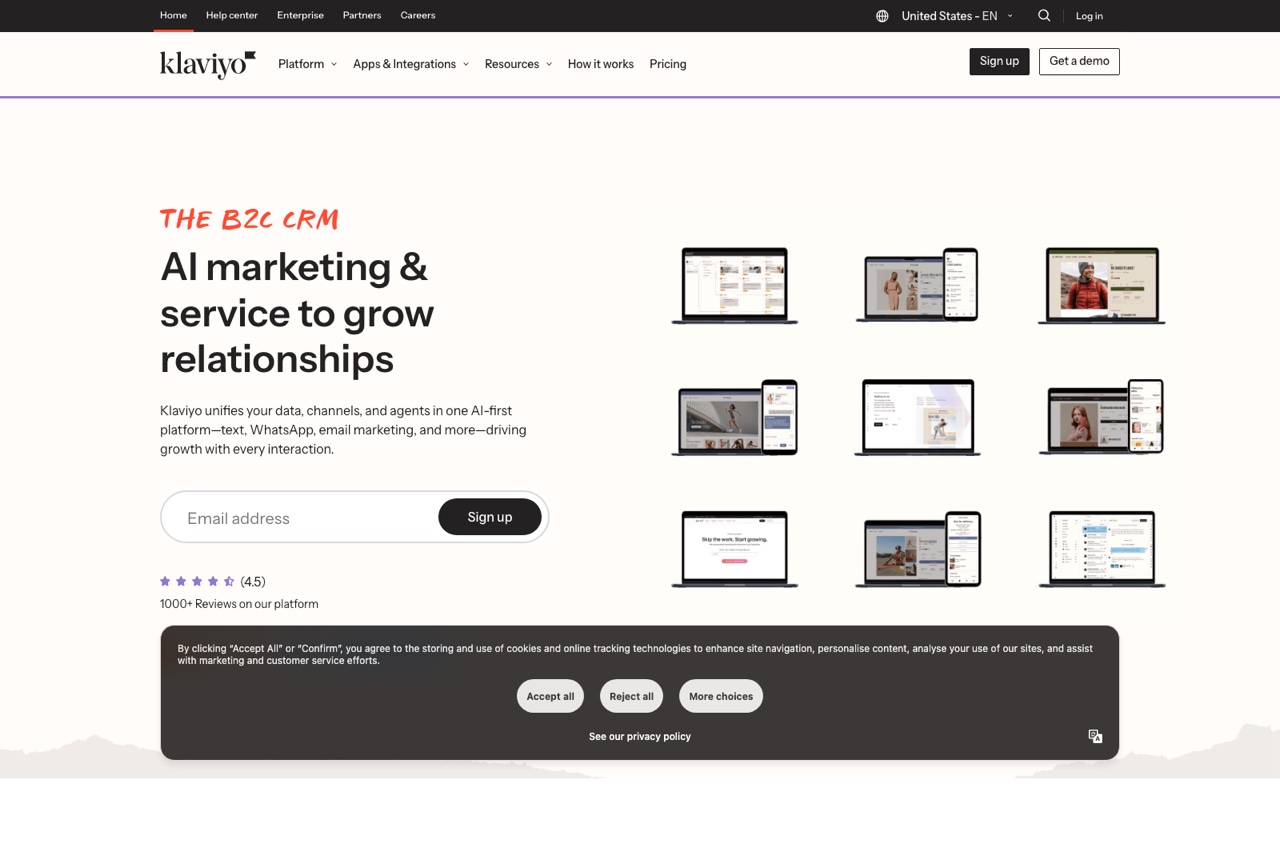
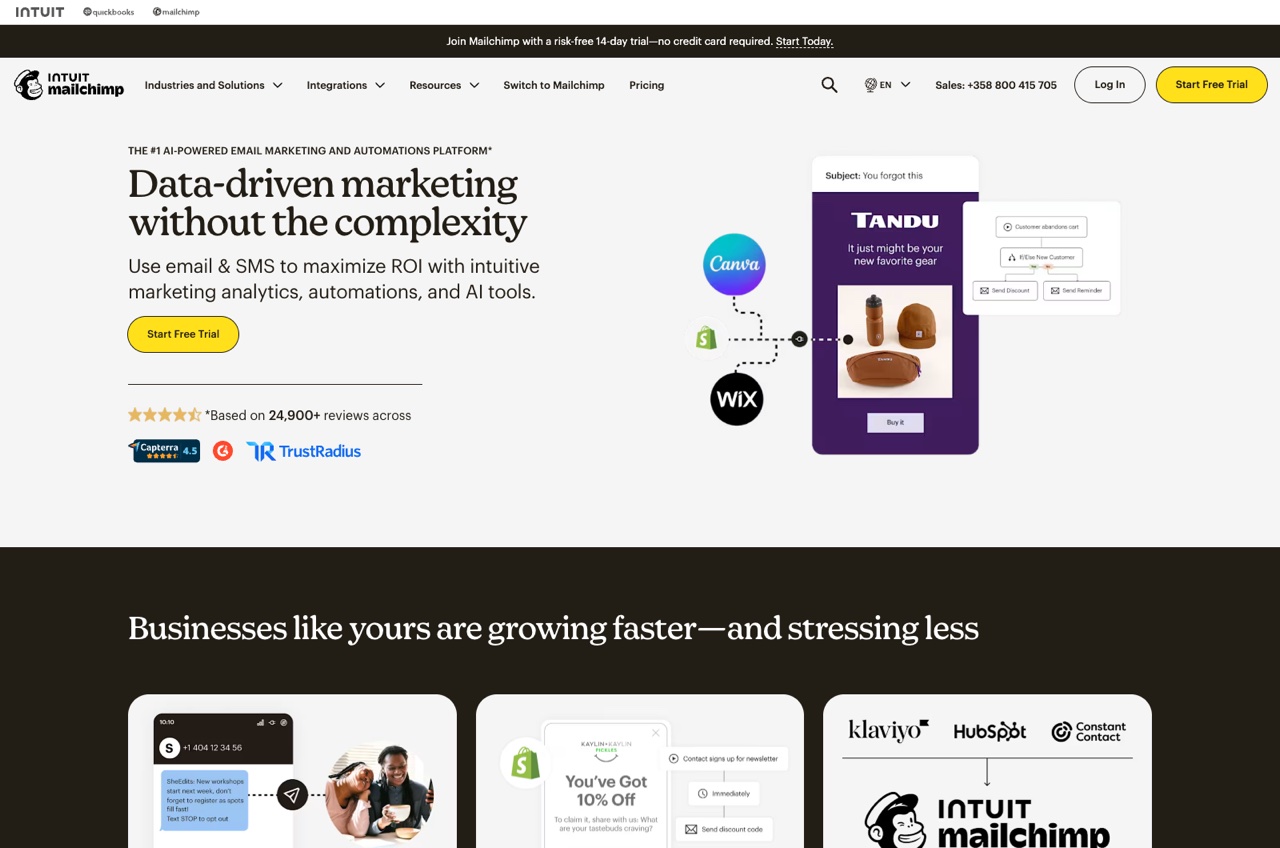
We make Audienceful. Prices below come from the live Klaviyo and Mailchimp pricing pages, checked 14 November 2026, in USD before tax and add-ons. The screenshots come from our competitor library and show each vendor's website, not their flow builders.
Klaviyo vs Mailchimp: the short verdict
Pick Klaviyo if you run a Shopify store where repeat purchases matter, you plan to build browse, cart, post-purchase and win-back flows, and someone on the team will look after them. Its Shopify data model is deeper, its segments can use predicted values, and its reporting is built around store revenue.
Pick Mailchimp if you send a regular newsletter, run a welcome series and an abandoned cart email, and the store is one part of a wider business. It costs less at every list size we checked on its Standard plan, and its editor and content tools suit teams that send more than promotions.
Pick neither if you want the full store flow set and find Klaviyo's price at 50,000 contacts hard to justify. That case is covered in the last section.
At a glance
| Klaviyo | Mailchimp | |
|---|---|---|
| Built for | Ecommerce, Shopify first | General small business marketing |
| Billing unit | Active profiles | Contacts, including unsubscribed |
| Free plan | 250 active profiles, 500 emails a month | 250 contacts, 500 sends a month (250 a day) |
| Price at 10K | $150 (Email plan) | $135 (Standard) |
| Price at 50K | $720 | $450 (Standard) |
| Automation limits | Full flow builder on every plan | Essentials capped at 4 flow steps; Standard up to 200 flows |
| Monthly send allowance | Tied to the profile tier | 10x contacts on Essentials, 12x Standard, 15x Premium |
| Predictive segments | Yes, with enough order history | Some predictive fields on higher plans |
| SMS | Add-on | Separate add-on |
| Best fit | Stores where flows are a revenue line | Newsletter-led businesses with a store attached |
Sources: Klaviyo pricing, Mailchimp pricing and Mailchimp's plan guide, checked 14 November 2026.
Klaviyo vs Mailchimp pricing at real list sizes
Both vendors bill by audience size and change features by plan. The fair match is Klaviyo's Email plan against Mailchimp Standard, because Standard is the first Mailchimp plan without the four-step cap on flows.
| Contacts | Klaviyo Email | Mailchimp Standard |
|---|---|---|
| 1,000 | $30 | Quote on the live selector |
| 2,500 | See live selector | $60 |
| 10,000 | $150 | $135 |
| 50,000 | $720 | $450 |
| 100,000 | $1,380 | Quote on the live selector |
Monthly list prices, checked 14 November 2026. We left cells blank where the selector didn't show a USD figure we could read that day, rather than guessing from neighboring tiers.
At 10,000 contacts the difference is $15 a month. At 50,000 it's $270 a month, or $3,240 a year. That jump is the reason so many stores start on Mailchimp and the reason many Klaviyo stores go looking for something cheaper once they pass 30,000 profiles. Our Klaviyo pricing guide and the Klaviyo pricing calculator show every Klaviyo tier.
Two promotions affect year one. Mailchimp's page offers 15% off for the first 12 months on Standard and Premium at 10,000 contacts or more. Budget on the list price, because both revert.
Who you pay for
This changes the real bill more than the headline price.
Klaviyo bills on active profiles, meaning people you can email or text. Suppressed profiles don't count, so suppressing old, unengaged contacts is the main way to lower the bill.
Mailchimp counts subscribed, unsubscribed and non-subscribed contacts in an audience, according to its plan guide. Archived contacts don't count. A store that synced every Shopify customer, including people who never opted in, pays for all of them until it archives the ones it won't email. Our guide to reducing the Mailchimp bill walks through that cleanup.
So the store with 10,000 subscribers and 12,000 past buyers who never opted in can end up on a far higher Mailchimp tier than the subscriber count suggests. Check what each tool would actually bill before comparing.
Shopify integration depth
Klaviyo's Shopify integration syncs customers, orders, products, checkouts and on-site activity such as viewed product and added to cart. Those events feed flows, segments and revenue reporting from day one, and Klaviyo imports order history so predictive fields can populate.
Mailchimp connects through its own official Shopify app. According to Mailchimp's Shopify guide, customers, orders and products sync, customer tags sync one way from Shopify, and most data syncs in real time. It works, and it's far better than the years when the two companies weren't on speaking terms. The difference is how much of the product is built around that data. In Klaviyo the store is the center of the account. In Mailchimp the store is one source feeding an audience you also use for other things. Our Mailchimp for Shopify post covers the setup in detail.
Ecommerce flows, flow by flow
This is where store owners feel the difference week to week.
| Flow | Klaviyo | Mailchimp |
|---|---|---|
| Welcome series | Prebuilt | Prebuilt journey |
| Abandoned checkout | Prebuilt | Prebuilt journey |
| Added to cart | Prebuilt, uses on-site tracking | Build from the journey builder |
| Browse abandonment | Prebuilt | Product retargeting journey; check plan |
| Post-purchase thank you | Prebuilt | Prebuilt journey |
| Cross-sell | Prebuilt, can use product data | Build from the journey builder |
| Replenishment | Prebuilt, can use predicted timing | Build with timed delays |
| Win-back | Prebuilt, can use churn risk | Re-engagement journey |
| Back in stock | Prebuilt | Not a standard journey; check integrations |
Sources: Klaviyo's Shopify integration and Mailchimp automations.
Mailchimp's plan limits matter here. Essentials allows only four steps per flow, which rules out a cart sequence with a delay, a condition and two follow-ups. If you plan to run more than a welcome email and one reminder, budget for Standard. Klaviyo has no equivalent cap on its paid plans. Our Shopify email flows guide covers which flows to build first and the timing that works.
Segmentation and personalization
Klaviyo segments can combine any event and profile property: "viewed product X twice in seven days, hasn't ordered, predicted lifetime value above $200." Predicted lifetime value, expected next order date and churn risk need enough order history, so a new store may not see them populated for months.
Mailchimp segments on purchase data from the store connection, tags, merge fields and engagement. Standard and Premium add more of the predictive pieces and behavioral targeting. For "bought in the last 90 days" or "has spent over $200" it's fine. For multi-condition behavioral segments, Klaviyo is quicker to build and keeps them current in real time.
Email builder and templates
Both editors are drag and drop with product blocks that pull from the catalog. Klaviyo's template library leans toward promotional ecommerce layouts, and it has AI writing and subject line tools built in. Mailchimp's editor is broader, with stronger brand kit, content studio and layout tools, which helps teams that send editorial newsletters as well as sales.
If your emails are mostly product grids and discount codes, Klaviyo gets you there faster. If your list reads you for content, Mailchimp's editor is the more flexible of the two.
Deliverability
Neither vendor publishes inbox placement data we can verify, and third-party tests disagree with each other. Treat any deliverability "winner" with suspicion. Both support domain authentication, and both review or restrict accounts with high complaint rates.
What you control matters far more: SPF, DKIM and DMARC on your sending domain, sending to people who engage, and a sunset policy for people who don't. Klaviyo's billing model nudges you toward suppression, which also helps deliverability. Our deliverability checklist covers the setup that applies to either tool.
Reporting and revenue attribution
Klaviyo's reporting is built around store revenue: attributed revenue per flow and campaign, configurable attribution windows, cohort and benchmark views. Mailchimp reports revenue per campaign and journey when the store is connected, plus its own engagement metrics. Klaviyo's attribution is more configurable, and its default window is generous, so compare carefully if you switch and the numbers drop. Set the window yourself and keep it fixed.
SMS and other channels
Both sell SMS as an add-on. Klaviyo's SMS sits in the same flow builder as email, so a cart flow can send an email, wait, then text. Mailchimp's SMS has its own pricing page and works alongside journeys. If SMS inside the same flow is important, Klaviyo is the more developed option.
Support and learning curve
Mailchimp is easier to pick up. Most people send a first campaign within an hour. Klaviyo asks more of you, because the value sits in flows and segments you build and test. Support channels on both depend on plan, so check what your tier includes on each Klaviyo and Mailchimp pricing page before relying on chat during a sale.
Who should choose which
- Shopify store, under 5,000 contacts, mostly newsletters: Mailchimp Standard, or even Essentials if you only need a welcome email.
- Shopify store, 5,000 to 30,000 contacts, flows drive repeat orders: Klaviyo, if someone will build and maintain the flows.
- Store past 30,000 contacts with a mostly unengaged list: Mailchimp is cheaper, but archive non-subscribers first. On Klaviyo, suppress aggressively.
- Store with a content-led brand and a small product range: Mailchimp.
- Store that wants Klaviyo's flow set at a lower price: see the Audienceful section below.
Moving from Mailchimp to Klaviyo
Most switching in this pair goes from Mailchimp to Klaviyo, so here is the order that avoids lost data.
- Export each Mailchimp audience with statuses, using Mailchimp's export guide. Keep unsubscribed and cleaned contacts in their own files.
- Connect Shopify to Klaviyo and let historical orders sync before importing anything else.
- Import suppressions first, then subscribers who aren't Shopify customers, with consent status mapped.
- Rebuild flows one at a time, starting with abandoned checkout and welcome. Templates don't transfer, so rebuild your two or three best emails.
- Turn off each Mailchimp journey only after its replacement is live, then cancel.
Tags and merge fields come across as profile properties if you map them on import. Our Mailchimp export guide and Mailchimp migration guide cover each step, and cancelling Mailchimp covers the last one.
A third option for Shopify stores: Audienceful
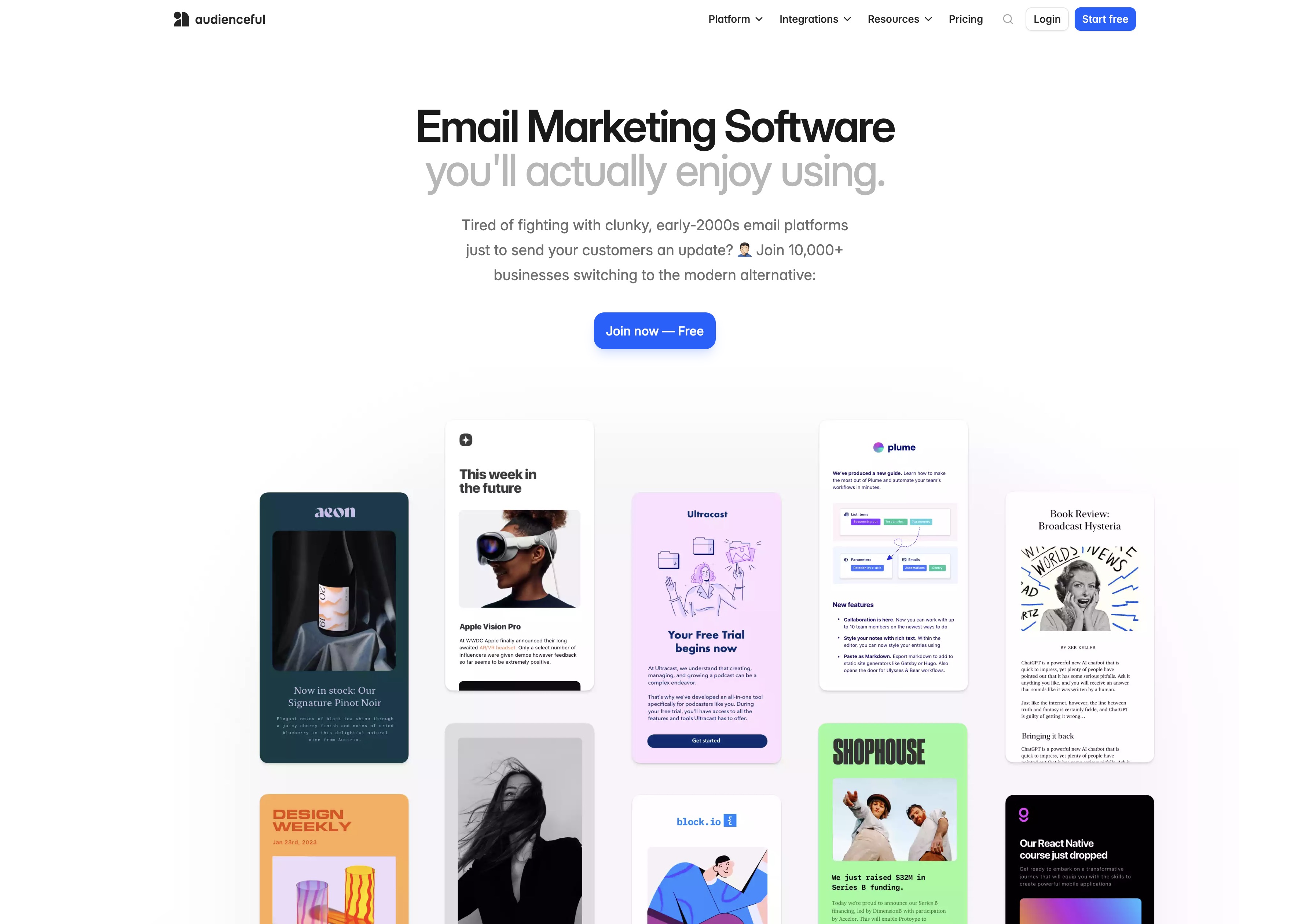
If you want Klaviyo's Shopify flows without Klaviyo's bill, Audienceful is built for that gap. It installs from the Shopify App Store and syncs customers, orders, products, carts and checkouts, with a historical order import so segments work from the first day. The Shopify automation templates cover welcome, abandoned checkout, added to cart, browse abandonment, post-purchase, review request, replenishment, VIP and win-back, each with the trigger set.
Coming from Mailchimp, the one-click Mailchimp import brings audiences, tags, merge fields and statuses across, with unsubscribes and cleaned contacts kept suppressed.
- Revenue attribution per email and per flow, crediting paid Shopify orders with refunds netted out.
- An AI agent with full MCP coverage. It builds campaigns, segments and flows from a short brief, and the MCP server gives outside agents the same access.
- A collaborative editor where several people work on one email at once, with templates designed by leading ecommerce agencies.
- Enterprise-grade deliverability with manual sender approval, spam testing and monitoring built in.
| Contacts | Klaviyo Email | Mailchimp Standard | Audienceful Essentials (yearly) | Audienceful Growth (yearly) |
|---|---|---|---|---|
| 10,000 | $150 | $135 | $79 | $118 |
| 50,000 | $720 | $450 | $272 | $309 |
| 100,000 | $1,380 | Quote on selector | n/a | $499 |
Audienceful prices from our pricing page, checked 14 November 2026. Essentials includes three automated flows and is $99 billed monthly at 10,000. Growth includes unlimited automations and is $140 billed monthly at 10,000. There's also a free plan. For more detail, see Audienceful vs Klaviyo, Audienceful vs Mailchimp, and our roundups of Klaviyo alternatives and Mailchimp alternatives. If you're leaving Klaviyo instead, migrating from Klaviyo lists the exports.
FAQs
Is Klaviyo better than Mailchimp for Shopify?
For stores where automated flows bring in a real share of revenue, yes. Klaviyo's Shopify data, prebuilt flows and predictive segments go further. For a store whose email is mostly a newsletter and one cart reminder, Mailchimp does the job for less.
Why is Klaviyo so much more expensive than Mailchimp?
Klaviyo prices itself as a revenue tool for stores, and its tiers climb steeply past 10,000 profiles. At 10,000 contacts it's $150 against Mailchimp Standard's $135. At 50,000 it's $720 against $450. Prices checked 14 November 2026.
Does Mailchimp still integrate with Shopify?
Yes. Mailchimp has an official Shopify app that syncs customers, orders and products, with most data in real time. Customer tags sync one way from Shopify.
Can I import my Mailchimp list into Klaviyo and keep tags?
Yes. Export each audience with statuses and tags, then import into Klaviyo and map tags and merge fields to profile properties. Import suppressions first so unsubscribed people stay unsubscribed.
Which has better deliverability?
Neither publishes verifiable inbox placement data. Your own domain authentication, list hygiene and sending habits decide most of the result on either platform.
Is there a cheaper alternative with Klaviyo-level flows?
Audienceful runs the same core Shopify flow set with revenue attribution and an AI agent for $79 a month billed yearly at 10,000 contacts, against Klaviyo's $150. Omnisend and Drip are also worth comparing; see our Klaviyo alternatives list.
Want Klaviyo-style Shopify flows for about half the price? Start a free 14-day Growth trial, import your Mailchimp list in one click, no card needed.
