In Mailchimp vs ActiveCampaign, Mailchimp is the simpler and usually cheaper choice for newsletters and light automation, and ActiveCampaign is the stronger choice when automation and a built-in CRM drive the business. The catch is that ActiveCampaign's useful plans start at Plus, which costs more than Mailchimp Standard at most list sizes. If you've outgrown Mailchimp's automations but don't need a sales CRM, Audienceful is a middle path with native Stripe and Shopify flows, covered below.
We make Audienceful. Prices below were checked on the vendors' own pages on 14 November 2026, in USD, before tax and add-ons. Screenshots come from our competitor library and show each vendor's website, not its app.
The verdict by use case
| Your business | Better fit | Why |
|---|---|---|
| Newsletter or simple announcements | Mailchimp | Easier editor, cheaper at small lists, fine automation for a welcome series |
| Ecommerce store | Close; depends on flows | Both connect to Shopify; Mailchimp needs Standard for real flows, ActiveCampaign Starter caps actions |
| SaaS with trials and billing events | ActiveCampaign Plus or above | Stripe integration starts at Plus, with unlimited automation actions |
| Sales-led B2B | ActiveCampaign | CRM, lead scoring and pipelines alongside the email |
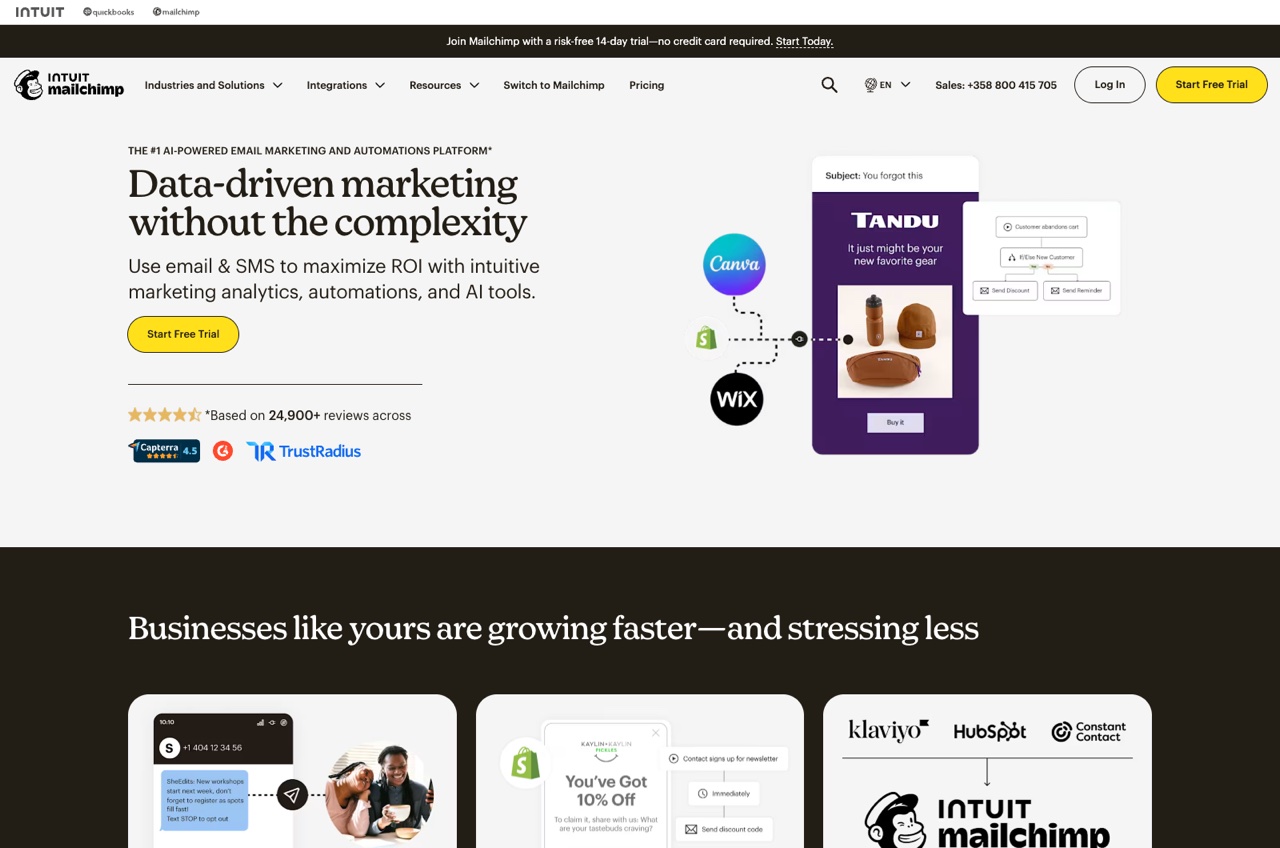
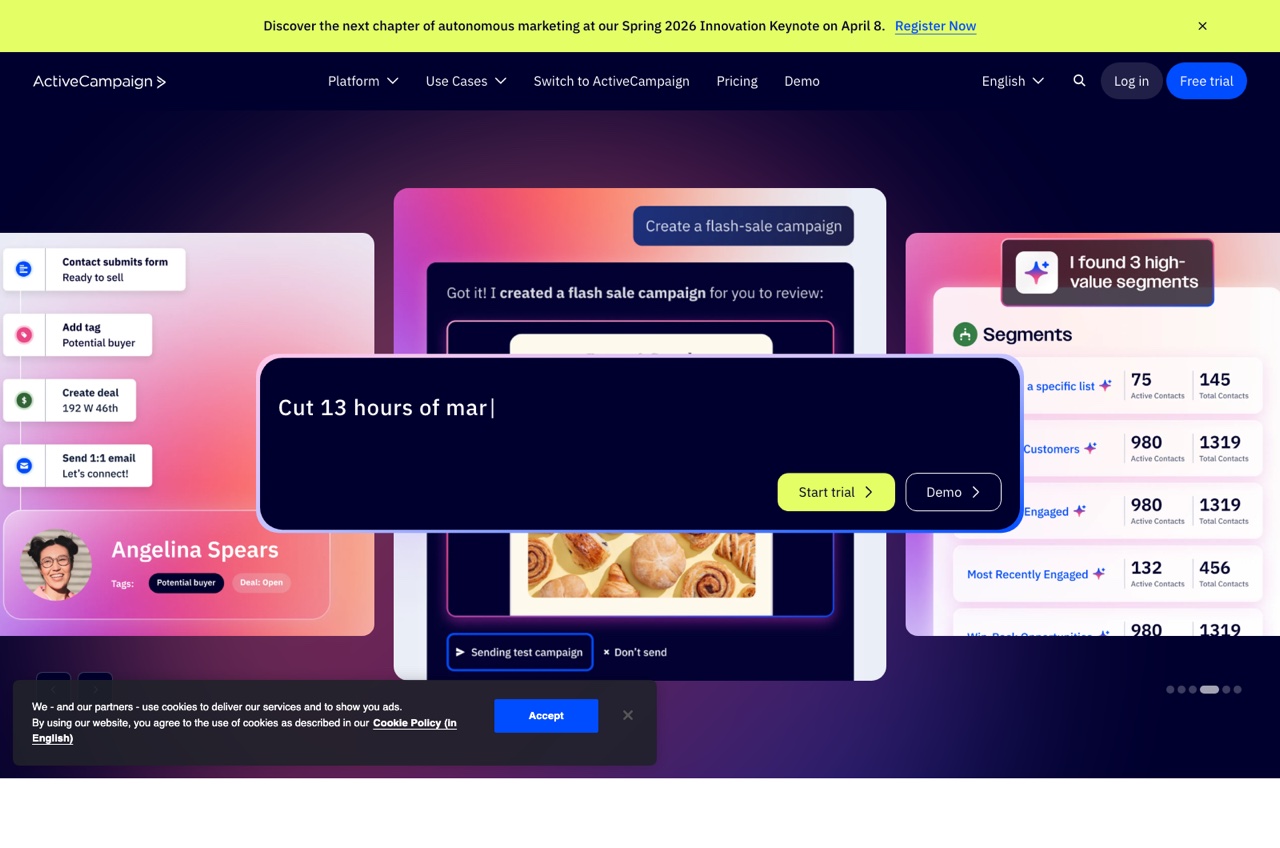
Mailchimp vs ActiveCampaign at a glance
| Mailchimp | ActiveCampaign | |
|---|---|---|
| Free plan | 250 contacts, 500 sends a month | None; 14-day trial |
| Paid plans | Essentials, Standard, Premium | Starter, Plus, Pro, Enterprise |
| Automation limit on the entry plan | Essentials: up to 4 flow steps | Starter: 5 actions per automation |
| Unlimited-depth automation from | Standard (up to 200 flows) | Plus (unlimited actions) |
| Monthly sends | 10x contacts on Essentials, 12x on Standard, 15x on Premium | 10x on Starter and Plus, 12x on Pro, 15x on Enterprise |
| Shopify | Official Shopify app | Standard integration on all plans; Shopify Plus on Pro and Enterprise |
| Stripe | Through an integration | Native integration from Plus |
| CRM | Audience and contact profiles | CRM built in, with pipelines as an add-on |
| Who counts toward the bill | Subscribed, unsubscribed and non-subscribed contacts | Contacts in the account |
Sources: Mailchimp pricing, Mailchimp's plan guide, ActiveCampaign pricing.
Pricing at 1K, 10K, 50K and 100K contacts
The two vendors show prices differently. ActiveCampaign's public selector displayed yearly billing when we checked, so its figures are monthly equivalents billed yearly. Mailchimp's are regular monthly prices.
| Contacts | Mailchimp Standard (monthly) | ActiveCampaign Starter (yearly) | ActiveCampaign Plus (yearly) | ActiveCampaign Pro (yearly) |
|---|---|---|---|---|
| 1,000 | Quote on selector | $15 | $49 | $79 |
| 10,000 | $135 | $149 | $189 | $375 |
| 50,000 | $450 | Not offered | $609 | $969 |
| 100,000 | Quote on selector | Not offered | Quote | Quote |
Checked 14 November 2026 on ActiveCampaign's selector and Mailchimp's selector. Cells we couldn't read in USD are left as quotes rather than estimated. Starter tops out at 25,000 contacts.
Mailchimp Standard and ActiveCampaign Plus are the fair match: both are the first plan with unlimited automation depth. At 10,000 contacts Plus costs $54 a month more, and at 50,000 it costs $159 more. Mailchimp's page also shows 15% off for 12 months at 10,000 contacts or more for new customers, which widens the gap in year one.
ActiveCampaign's add-ons change the total. The pricing page lists SMS, WhatsApp, sales pipelines, sales engagement and transactional email as separate add-ons. Mailchimp sells SMS and Mailchimp Transactional separately too, and Transactional needs Standard or Premium.
Our ActiveCampaign pricing guide lists every tier, and our post on Mailchimp's price increase covers its recent changes.
Automation builder depth
This is the main reason people compare these two.
Mailchimp's journey builder handles triggers, delays, conditional branches and actions on contacts. On Essentials, a flow can have up to four steps, enough for a short welcome and little else. Standard raises it to up to 200 flows with the full builder. For most programs, Standard is the real starting point.
ActiveCampaign's automation builder is deeper. You get if/else branches, goals that pull contacts forward when they convert, wait-until conditions, split tests and actions that update contacts and deals. Starter allows five actions per automation, and ActiveCampaign's actions guide shows how quickly a branching flow uses them. Plus removes the limit.
If you've hit Mailchimp's wall, the question is how often. A team that runs three or four flows will be fine on Mailchimp Standard. A team that runs a dozen interlocking flows with goals and lead scoring will feel the difference in ActiveCampaign.
Segmentation
Mailchimp segments on fields, tags, engagement, purchase data from connected stores and predicted demographics on higher plans. ActiveCampaign segments on all of that plus site tracking, event tracking, deal stage and lead score, with advanced segmentation on Pro.
For "trial users who haven't created a project and opened at least one email this week", ActiveCampaign is easier. For "subscribers who opened the last newsletter", both are fine.
CRM and sales features
ActiveCampaign includes a CRM with contact and deal records, lead scoring and sales automation. Pipelines are an add-on on the current pricing page. Enterprise adds a premium Salesforce integration.
Mailchimp has contact profiles and audience management but isn't a sales CRM. If a sales team needs deals and stages in the same tool as email, that settles it in ActiveCampaign's favor.
Ecommerce: Shopify and abandoned cart
Mailchimp connects through its official Shopify app. Customers, orders and products sync, and most data syncs in real time (Mailchimp's Shopify guide). Abandoned cart and product retargeting journeys run on that data.
ActiveCampaign includes a standard Shopify integration on all plans, and Shopify Plus, BigCommerce and Magento as premium integrations on Pro and Enterprise. Abandoned cart and product blocks are part of the ecommerce feature set.
Neither was built for stores first. A dedicated ecommerce platform will give you more store flows out of the box. Our Mailchimp for Shopify post and ActiveCampaign alternatives for ecommerce go deeper.
SaaS lifecycle: trials, billing events and custom events
This is the scenario most comparisons skip.
A typical SaaS program needs a trial onboarding sequence, a trial-ending reminder, a failed-payment (dunning) series and a win-back after cancellation. Each one starts from a billing event in Stripe or a product event from your app.
- ActiveCampaign has a native Stripe integration on Plus and above, and accepts custom events through its API and site tracking. That covers both billing and product triggers, at Plus pricing.
- Mailchimp connects to Stripe through an integration, and accepts custom events through its Marketing API. It's workable for simple trial sequences. Most teams find the journey builder thin for multi-branch onboarding.
For a worked version of these flows, see our guide to Stripe email automation and the trial onboarding flow template.
Editor and templates
Mailchimp's editor is the more polished of the two, with a brand kit, saved sections and a large template library. ActiveCampaign's editor is capable and includes conditional content on Pro, but most reviewers find it a step behind on design. Our ActiveCampaign review with pros and cons covers the editor and automation builder in more depth.
Deliverability
Both run large, well-managed sending infrastructure, and both offer domain authentication. Neither publishes a verified inbox placement rate, and we won't invent one. Your results depend on authentication, list hygiene and sending only to people who engage. Our deliverability checklist covers the setup.
AI features
Both vendors ship AI writing and content tools. ActiveCampaign's generative AI starts on Plus according to its pricing page. Mailchimp includes AI content tools on its paid plans. Test them on your own copy before letting them make a decision for you.
Migrating from Mailchimp to ActiveCampaign
- Export each Mailchimp audience with statuses using Mailchimp's export guide. Keep unsubscribed and cleaned contacts separate.
- Map Mailchimp tags and merge fields to ActiveCampaign tags and custom fields before importing.
- Import subscribed contacts, then import unsubscribed ones as unsubscribed so they stay suppressed.
- Connect Shopify or Stripe and confirm events arrive.
- Rebuild one automation at a time. Count actions if you're on Starter.
- Authenticate your sending domain and warm up before the first full send.
- Turn off each Mailchimp journey once its replacement is live, then cancel.
A middle path: Audienceful
If you've outgrown Mailchimp's automations but ActiveCampaign's CRM is more than you need, Audienceful sits between them:
- Multi-step branching automations and custom events on every paid plan.
- Native Stripe flows for trial onboarding, trial ending, dunning and win-back. See the Stripe automation templates.
- Native Shopify flows for stores. See the Shopify automation templates.
- Revenue attribution per email and per flow.
- An AI agent with full MCP coverage that builds automations, segments and campaigns from a brief.
- A collaborative editor with agency-designed templates, and enterprise-grade deliverability with monitoring.
- A one-click Mailchimp importer for audiences, tags, merge fields and statuses.
Audienceful costs less than both at the list sizes that matter here. Checked 14 November 2026:
| Contacts | Audienceful | Mailchimp Standard (monthly) | ActiveCampaign Plus (yearly) |
|---|---|---|---|
| 1,000 | Free | Quote on selector | $49 |
| 10,000 | $79 Essentials or $118 Growth, billed yearly | $135 | $189 |
| 50,000 | $309 Growth, billed yearly | $450 | $609 |
Essentials includes three flows; Growth has unlimited automations. Compare details on Audienceful vs ActiveCampaign and Audienceful vs Mailchimp, or see our Mailchimp alternatives. If your team is weighing an API sender instead, read SendGrid vs Mailchimp.
FAQs
Is ActiveCampaign better than Mailchimp for automation?
Yes, for depth. ActiveCampaign Plus has unlimited actions per automation, goals, wait conditions and lead scoring. Mailchimp Standard handles most common flows well, and Essentials is limited to four steps per flow.
Is ActiveCampaign more expensive than Mailchimp?
At comparable plans, yes. At 10,000 contacts, ActiveCampaign Plus is $189 a month billed yearly and Mailchimp Standard is $135 a month. At 50,000 it's $609 against $450. Prices checked 14 November 2026.
Does ActiveCampaign have a free plan?
No. ActiveCampaign offers a 14-day free trial with no credit card. Mailchimp has a free plan for 250 contacts and 500 sends a month.
Can I import my Mailchimp list into ActiveCampaign?
Yes. Export each audience from Mailchimp with statuses, map tags and fields, then import. Import unsubscribed contacts as unsubscribed so they stay suppressed.
Which is better for Shopify?
Neither is built around Shopify, but both connect. Mailchimp's official app syncs customers, orders and products. ActiveCampaign's standard Shopify integration is on every plan, with Shopify Plus support on Pro and Enterprise. A store that relies on flows should also look at ecommerce-first tools.
Want ActiveCampaign-level automations without the add-on bill? Build your first flow free on Audienceful.
