Mailchimp vs HubSpot is really a question about whether you need a CRM. HubSpot Marketing Hub is part of a CRM suite and suits sales-led teams that want marketing and pipeline in one place, but its automation starts on Professional at $800 a month plus a $3,000 onboarding fee. Mailchimp is an email tool at $135 a month for 10,000 contacts on Standard, and suits teams whose growth comes from email. If lifecycle email is the real job, a specialist like Audienceful can sit next to HubSpot's free CRM; that option is covered near the end.
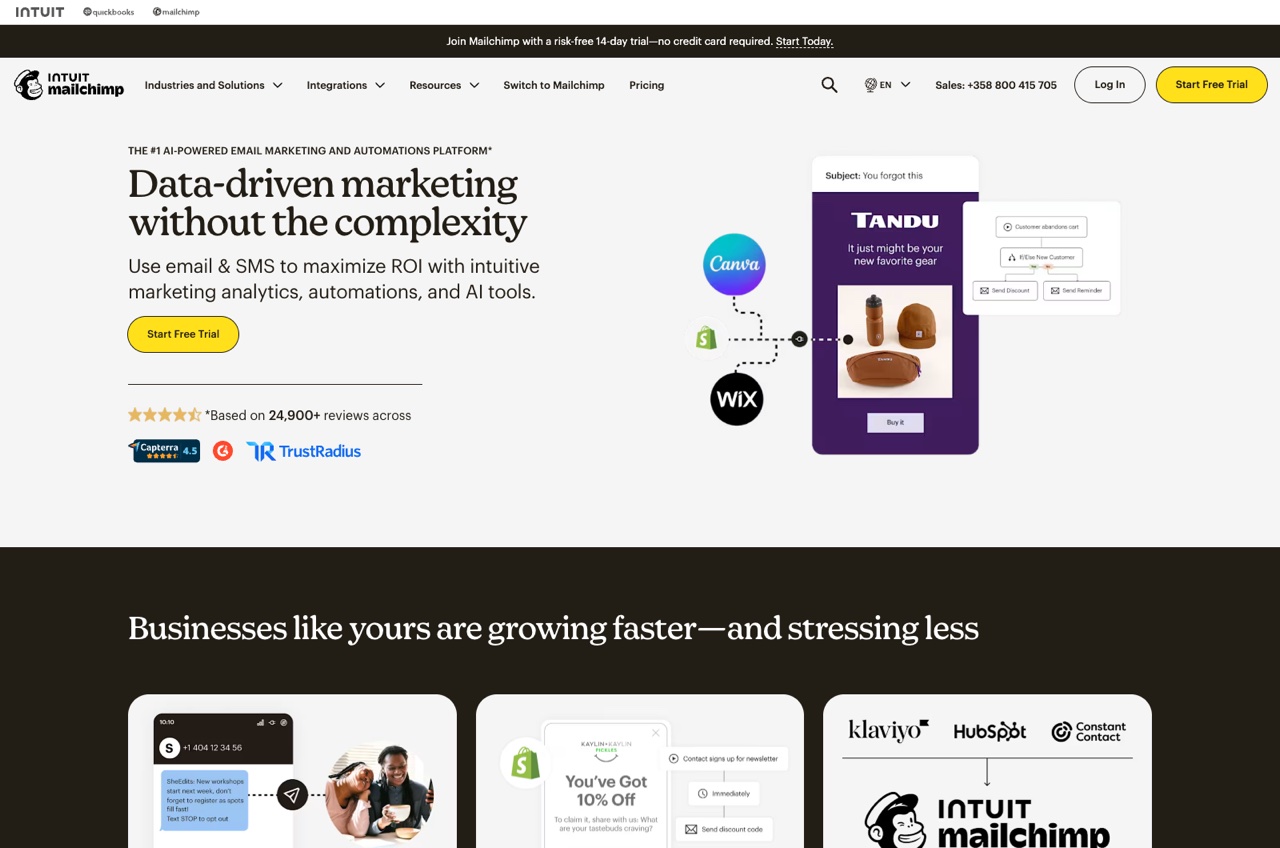
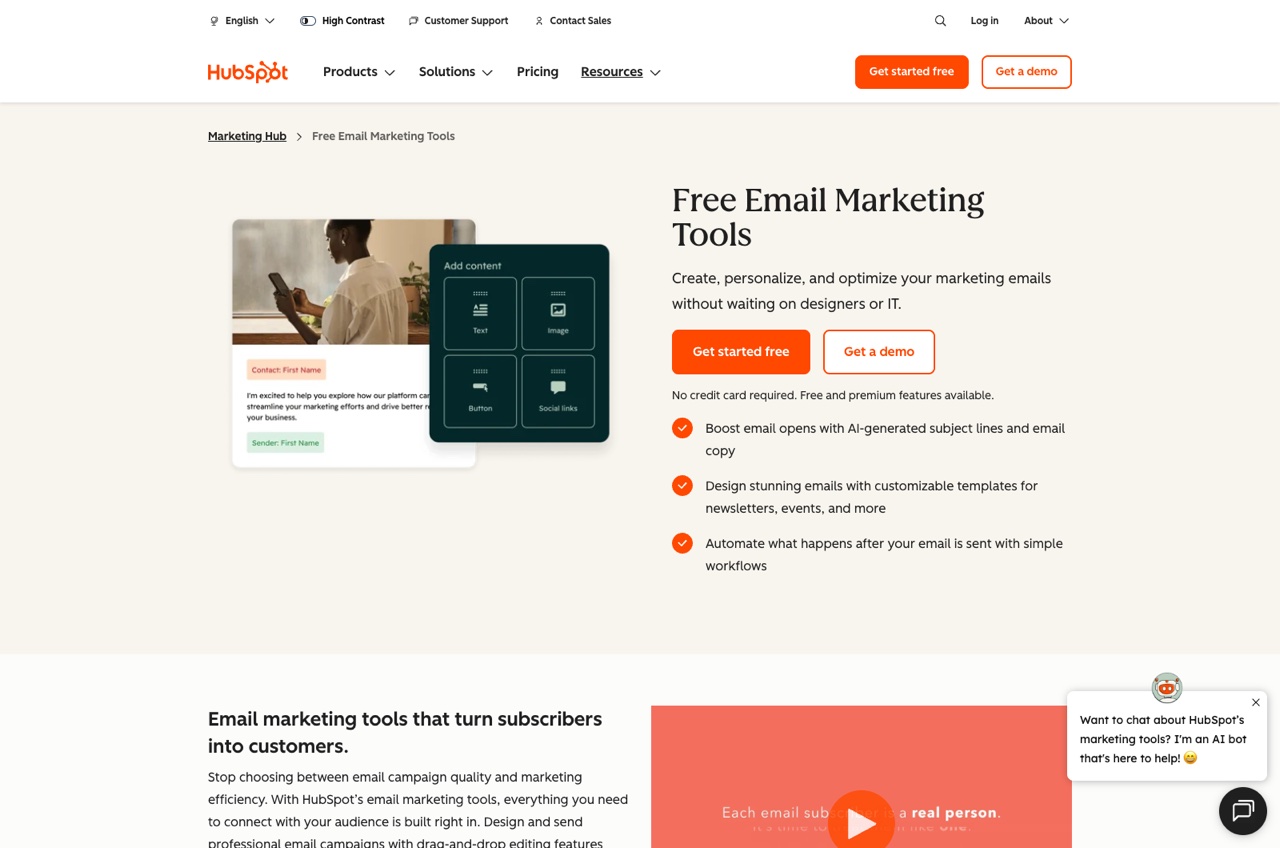
We make Audienceful. HubSpot figures come from the Marketing Hub pricing page and Mailchimp's from its pricing page and plan guide, as recorded on 14 November 2026. Screenshots come from our competitor library and show each vendor's website.
Mailchimp vs HubSpot: the verdict
- Choose HubSpot if you have a sales team, deals in a pipeline and a long buying cycle, and you want marketing emails, forms, lead scoring and the CRM to share one record. It's expensive, and it's the most complete suite of the two.
- Choose Mailchimp if email is the channel, nobody needs deal stages, and you want campaigns and journeys at a predictable price.
- Choose a specialist next to HubSpot's free CRM if your main need is lifecycle email off product, billing or store events. That's often the cheapest setup that does the job well, and our guide to the best email marketing for HubSpot CRM compares the options.
At a glance
| Mailchimp | HubSpot Marketing Hub | |
|---|---|---|
| What it is | Email marketing platform | Marketing suite on a CRM |
| Free plan | 250 contacts, 500 sends a month | Free tools and free CRM |
| Entry paid plan | Essentials | Starter, $20 per seat a month, 1,000 marketing contacts |
| Automation plan | Standard, $135 at 10K contacts | Professional, from $800 a month, 3 seats, 2,000 marketing contacts |
| Onboarding fee | None | $3,000 on Professional, $7,000 on Enterprise |
| Top plan | Premium | Enterprise, from $3,600 a month |
| Billing unit | Contacts, including unsubscribed | Seats plus marketing contacts |
| CRM | Audience and tags | Full CRM with deals, tasks, sales tools |
| Ecommerce | Official Shopify app | Shopify integration, B2B focus |
Sources: HubSpot Marketing Hub pricing and Mailchimp pricing, 14 November 2026.
Mailchimp vs HubSpot pricing
How HubSpot charges
HubSpot charges for seats, then for marketing contacts above the plan's included amount, and Professional and Enterprise require a one-time onboarding fee. Starter shows $20 per seat a month at the regular rate (the page also showed a lower promotional figure). Professional is $800 a month with the yearly option, including three seats and 2,000 marketing contacts, with extra seats at $45 a month. Enterprise starts at $3,600 a month with 10,000 marketing contacts. Our HubSpot Marketing Hub pricing guide covers every line.
Marketing contacts are the people you've chosen to email. Non-marketing contacts can sit in the CRM free. That's a useful lever: keep every lead in the CRM, and mark only the people you'll email as marketing contacts.
How Mailchimp charges
Mailchimp bills on contacts in your audience, including unsubscribed and non-subscribed ones. Archived contacts don't count. Standard includes up to 200 flows and 12 sends per contact per month. Essentials is cheaper but caps flows at four steps.
Cost at 1K, 10K and 50K contacts
| Contacts | Mailchimp Standard | HubSpot Starter | HubSpot Professional |
|---|---|---|---|
| 1,000 | Live selector | $20 per seat | $800, plus $3,000 onboarding |
| 2,500 | $60 | Starter base plus contact packs | $800 plus contact packs |
| 10,000 | $135 | Quote | $800 plus contact packs, plus $3,000 |
| 50,000 | $450 | Quote | Quote, plus $3,000 |
Mailchimp checked 14 November 2026. HubSpot's page doesn't publish a contact-pack price for every size, so the larger cells need a quote.
Year-one cost example
A 10,000-contact SaaS team with three marketers that needs branching automation:
| Item | Mailchimp Standard | HubSpot Professional |
|---|---|---|
| Plan, 12 months | $1,620 | $9,600 |
| Onboarding | $0 | $3,000 |
| Extra marketing contacts above 2,000 | Included | Quote |
| Year-one total before extras | $1,620 | $12,600 plus contacts |
Mailchimp's page also offers 15% off for 12 months at 10,000 contacts or more on Standard, which would lower year one further. HubSpot's free CRM exists alongside either option, which matters in the hybrid setup below.
Email editor and templates
Both editors are drag and drop. Mailchimp's has more email-specific design control, a brand kit and AI copy tools. HubSpot's is tied into its content system, so emails share brand settings, modules and personalization tokens with landing pages and the CRM. Marketers who only send email usually find Mailchimp quicker. Teams producing emails, landing pages and blog content together get more from HubSpot.
Automation
HubSpot's workflows on Professional are powerful: branching on any CRM property, internal notifications, task creation, deal stage changes and lead scoring in the same flow. They're also the reason for the price jump, because Starter's automation is limited.
Mailchimp's journey builder handles branching, delays, tags and store triggers, with up to 200 flows on Standard. It doesn't create sales tasks or move deals, because there aren't any. For email-only automation, Mailchimp Standard covers most of what teams need at a fraction of HubSpot's cost.
CRM and sales alignment
This is where HubSpot is in a different category. Contacts, companies, deals, tickets and activity share one record. Sales sees which emails a lead opened, marketing sees which deals closed, and lifecycle stages move automatically. If your revenue comes through sales calls, that alignment is worth paying for.
Mailchimp has audience tools, tags and a basic contact profile. Teams that need a CRM usually connect one, often HubSpot's free CRM.
Ecommerce
Mailchimp is the more developed store tool of the two. Its official Shopify app syncs customers, orders and products, mostly in real time, per Mailchimp's Shopify guide, and abandoned cart and post-purchase journeys run from that data. HubSpot connects to Shopify too, but the suite is designed for B2B and service businesses, and most stores won't use the CRM side. See Mailchimp for Shopify, and for a store-first rival to HubSpot, our Klaviyo vs HubSpot comparison.
SaaS lifecycle: Stripe events and product signups
For SaaS, the useful triggers are product events and billing events: signed up, activated, trial ending, payment failed, plan changed, cancelled. HubSpot can receive these through integrations and custom events on higher plans. Mailchimp can through its API, Zapier and integrations. In both cases, someone has to wire the events in and keep them flowing. Our Stripe email automation guide explains which events matter.
Reporting and attribution
HubSpot Professional reports on campaigns, attribution across touchpoints and revenue tied to deals. That's its strength for B2B. Mailchimp reports per campaign and journey, with revenue when a store is connected, and more A/B options on higher plans. For email performance, Mailchimp is simpler. For "which campaign drove this closed deal", HubSpot is the tool.
Deliverability
Neither publishes inbox placement data we can verify. Both send from shared infrastructure by default and support domain authentication, and HubSpot offers dedicated IPs on higher tiers. Your own setup matters more: SPF, DKIM and DMARC, consent and pruning inactive contacts. Our deliverability checklist and why HubSpot marketing emails go to spam cover the details.
Using them together
Many teams run HubSpot's free CRM for sales and a separate tool for email. HubSpot keeps contacts, companies and deals. The email tool handles campaigns and automations, and the two sync contacts and properties. That avoids Professional's $800 a month and $3,000 onboarding while keeping a real CRM. Mailchimp has a HubSpot integration for this, and other email tools do too.
Migration
- HubSpot to Mailchimp: export marketing contacts with subscription status and the properties you segment on. Import unsubscribes first. Rebuild workflows as journeys.
- Mailchimp to HubSpot: export audiences with statuses, import into HubSpot, and decide who's a marketing contact before the first bill. Rebuild journeys as workflows.
Our HubSpot marketing email migration guide and Mailchimp migration guide cover the exports.
A specialist next to your CRM: Audienceful
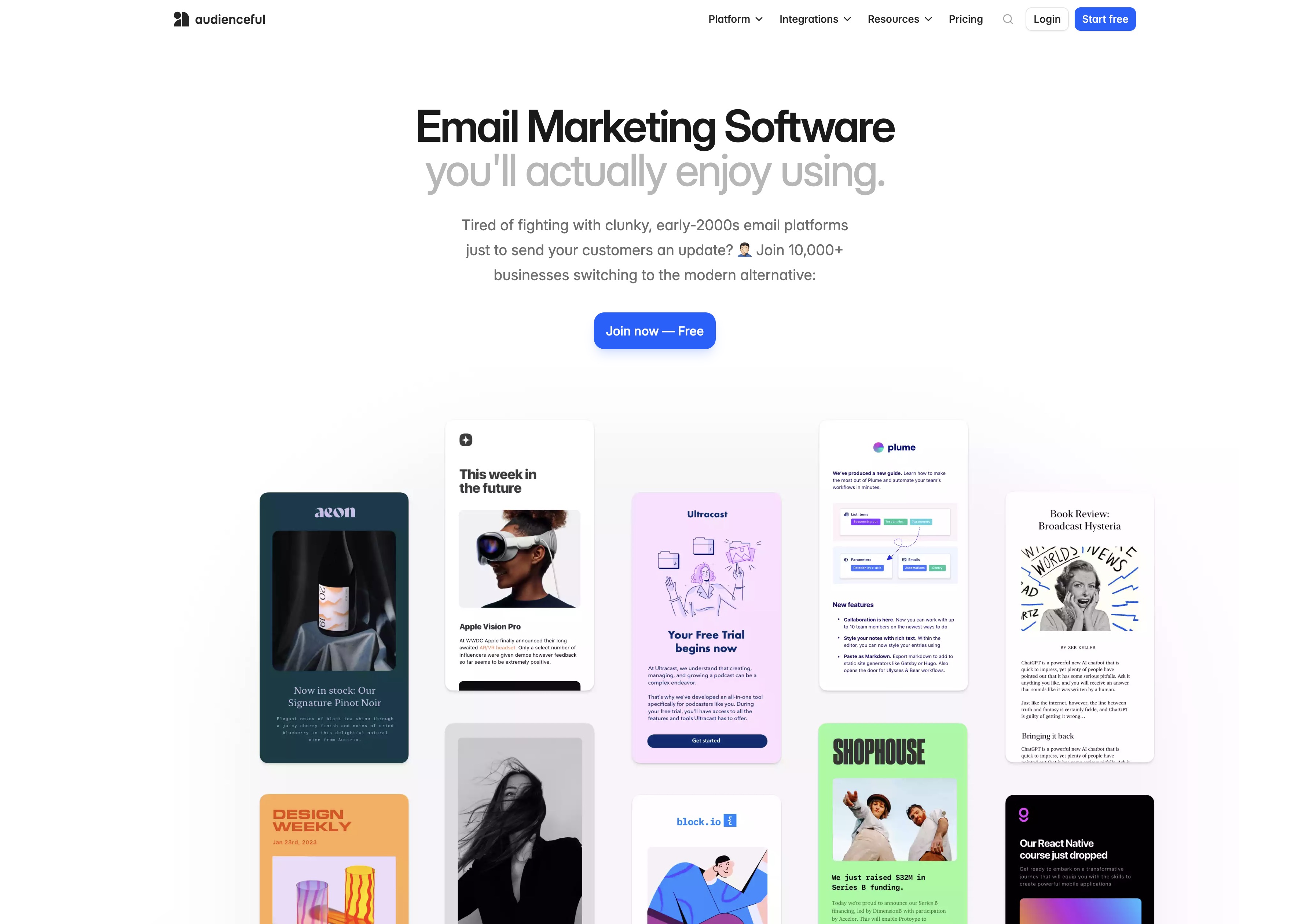
If what you need is strong lifecycle and marketing email, not a CRM bill, Audienceful fits the hybrid setup. The HubSpot integration syncs contacts, companies, deals, lists and lifecycle stages, and can trigger email when a deal moves or a lifecycle stage changes.
- Native Stripe with prebuilt flows for onboarding, trial ending, failed payments and win-back, plus Clerk for signups and Shopify for stores.
- Branching automations and custom events through the REST API, webhooks and Zapier.
- Revenue attribution per email and per flow.
- An AI agent that builds automations from a brief, with full MCP coverage.
- A collaborative editor, agency-designed templates and deliverability monitoring.
| Contacts | Mailchimp Standard | HubSpot Professional | Audienceful (yearly) |
|---|---|---|---|
| 10,000 | $135 | $800 plus contacts, $3,000 onboarding | $79 Essentials, $118 Growth |
| 50,000 | $450 | Quote, $3,000 onboarding | $272 Essentials, $309 Growth |
Audienceful prices from our pricing page, checked 14 November 2026. Essentials includes three automated flows. Growth includes unlimited automations. No onboarding fee, and there's a free plan. See Audienceful vs HubSpot, Audienceful vs Mailchimp, our HubSpot email marketing alternatives and Mailchimp alternatives, and the Stripe connection guide.
FAQs
Is HubSpot better than Mailchimp?
For sales-led teams that need a CRM, yes. For teams whose growth comes from email, Mailchimp does the job for far less. HubSpot Professional starts at $800 a month plus $3,000 onboarding, against $135 a month for Mailchimp Standard at 10,000 contacts.
Can I use Mailchimp and HubSpot together?
Yes. Many teams run HubSpot's free CRM for sales and Mailchimp for email, syncing contacts between them. It's the cheapest way to keep a CRM and run proper campaigns.
How much does HubSpot Marketing Hub cost for 10,000 contacts?
Professional starts at $800 a month billed yearly with 2,000 marketing contacts included, so 10,000 needs extra contact packs on a quote, plus the $3,000 onboarding fee. Starter at that size also needs contact packs. Recorded 14 November 2026.
Is HubSpot's email marketing free?
HubSpot has free marketing tools with limited email sends and HubSpot branding, plus a free CRM. Automation workflows and higher send limits need paid plans.
Which is better for a startup?
Usually Mailchimp, or a lifecycle email tool next to HubSpot's free CRM. Few startups need Professional's price in year one. Move up when a sales team needs deal-level attribution.
Need great lifecycle email, not a CRM bill? Connect Stripe and launch onboarding and dunning flows free on Audienceful.
